 OK, finally saw this. Narukagami's review on the Samurai Archives Film Forum covered much of what I also think, so I'll limit myself to new avenues.
As expected, about a 2 on a 100 based accuracy scale. A Lord Asano attacks an unarmed Lord Kira, is sentenced to seppuku, and a group of 47 of his former vassals led by Oishi Yoshio murder Kira. Everything, and I do mean EVERYTHING, else is wrong. Even small details that were changed seemingly only for the sake of doing so. Culturally, they managed to get virtually everything wrong too, stressing the fantasy vibe. I mention this only in passing, because the movie claims to only be BASED on the story, and no sane person could watch the trailer and expect real history. So accuracy wasn't an issue for me. Does make you wonder why they hired Stephen Turnbull as an historical consultant and kept him on the set for months, because it appears they ignored any advice he might have given them. I need that gig.
OK, finally saw this. Narukagami's review on the Samurai Archives Film Forum covered much of what I also think, so I'll limit myself to new avenues.
As expected, about a 2 on a 100 based accuracy scale. A Lord Asano attacks an unarmed Lord Kira, is sentenced to seppuku, and a group of 47 of his former vassals led by Oishi Yoshio murder Kira. Everything, and I do mean EVERYTHING, else is wrong. Even small details that were changed seemingly only for the sake of doing so. Culturally, they managed to get virtually everything wrong too, stressing the fantasy vibe. I mention this only in passing, because the movie claims to only be BASED on the story, and no sane person could watch the trailer and expect real history. So accuracy wasn't an issue for me. Does make you wonder why they hired Stephen Turnbull as an historical consultant and kept him on the set for months, because it appears they ignored any advice he might have given them. I need that gig.
 Keanu Reeves was GODAWFUL. It might have been the worst performance I've ever seen in a big budget movie. I get that he's supposed to be stoic, but Japanese actors can pull this off and still be interesting in the process. Reeves just looked eternally befuddled and mentally challenged, with his character coming across as the village idiot. And this is what's supposed to turn on the Great Lord Asano's daughter? Which brings us to...
The Great Lord Asano's daughter Mika and the love story, which as Narukagami mentioned is shoehorned in for no discernible reason. Why any woman would find Reeves's character attractive is beyond me, and Mika is by far the most unlikeable female lead/primary love interest I've ever seen in a 'samurai' film. There is no chemistry between the two and you just want to see them die painfully, preferably at each other’s hand. With a chainsaw.
Keanu Reeves was GODAWFUL. It might have been the worst performance I've ever seen in a big budget movie. I get that he's supposed to be stoic, but Japanese actors can pull this off and still be interesting in the process. Reeves just looked eternally befuddled and mentally challenged, with his character coming across as the village idiot. And this is what's supposed to turn on the Great Lord Asano's daughter? Which brings us to...
The Great Lord Asano's daughter Mika and the love story, which as Narukagami mentioned is shoehorned in for no discernible reason. Why any woman would find Reeves's character attractive is beyond me, and Mika is by far the most unlikeable female lead/primary love interest I've ever seen in a 'samurai' film. There is no chemistry between the two and you just want to see them die painfully, preferably at each other’s hand. With a chainsaw.
 This unlikablilty spills over to the rest of the cast. You're supposed to be CHEERING for the 47 Ronin, but they are so arrogant, intolerant (accurate here, as historically they booted out one of their members for being of insufficient rank), dishonest (even to their Lord), and downright mean spirited and nasty, you want to see them all die too (at least the film delivers here). Oishi is particularly loathsome. Granted, this is probably the way samurai were in real life, but in a fantasy epic, you want the heroes to be heroes. Flawed, yes, but not complete and unredeemable bastards. Conversely, Kira and his fox-witch are virtually the only engaging characters in the film. I did enjoy the fact that they role-reversed the usual depictions and made Kira a young, vibrant man and Asano the wrinkled and decrepit old Lord.
 And they spent 175 mil on this? Where? It sure isn't up on the screen. The CG wasn't as bad as I feared-the Kirin in the beginning was awful, and the Oni that Reeves fights in the UFC pit on Dejima (I was REALLY hoping for a Don Frye cameo) is almost as bad. Still, the effects they did for the 'swirling cloth' Tengu and the witch were well done, and the water dragon looked fine. The real problem with the CG is they did a very poor job of staging things so the actors looked like they were interacting with the fantasy creatures. This was particularly noticeable in the opening Kirin hunt and Reeves's battle with the water dragon. They'd have been much better off using practical effects-the few in the film (such as the Tengu makeup) were well done.
 The film also wasted some of its biggest assets. Kira's super-samurai is set up for a climactic battle against...someone, but is unsatisfactorily thrown away during the final fight. And the cool skull headed gun-toting tattooed dude featured prominently in advertising is given almost nothing to do, appearing for only a few seconds during the Dejima sequence during which he has zero impact on the proceedings.
 Having said all that, I actually did enjoy the movie as a fantasy epic. It moved along well, Kikuchi Rinko gives a great over-the-top performance as Kira’s witch that fits the mood a fantasy should have, the sets and costuming are goofy but impressively so, and the fighting that doesn’t involve monsters is pretty well done. If you approach this the same way as you would a late 50’s/early 60’s Ray Harryhausen style fantasy/quest film, I believe most fans of the genre would find it a pleasant enough way to pass two hours. And like most fantasy flicks, the problems with it only result in a so-bad-it’s-good vibe. It’s probably not worth buying the DVD/Blu-ray for most people, but definitely worth a spot on your Netflix queue.
 Speaking of which, the extras on the DVD/Blu-ray were a major disappointment. Basing this on a real story, you’d think they’d at least have a pseudo-documentary of the historical incident, but it rates barely a passing mention. If nothing else, it would have given Turnbull a chance to earn whatever they were paying him. Instead, you get several of your typical ‘behind-the-scenes-crew-member-with-a-video-camera’ vignettes. These look to have originally been part of a whole that was chopped up in order to give the appearance of more ‘extras’. There are a handful of deleted scenes, and that’s it. No commentary track or any sort of in-depth examination of the film-can’t say I blame them. They likely didn’t want to throw more money into a losing effort. The short vignettes spend much of their time having cast and crew gush about how awesomely talented and brilliant Reeves is and how they just loved working with him and having him on the set, and how he was seemingly in command of everything that went on from costuming to plot (so now we know who REALLY gets the blame for this box-office disaster). Yes, people will lie through their teeth to remain gainfully employed. If you want to hear anything about the Japanese cast, sorry, these aren’t the extras you’re looking for, because they receive only a few brief sentences. There are some hilariously jaw-dropping moments during the extras, such as when one of the ‘artistes’ claims that they’ve designed a film that visually is historically authentic and accurate but that yet brings it refreshingly into the present day and gives it a totally modern look. I like to think some mischievous editor dropped that into the proceedings for the sole purpose of amusing me.
So enjoy the 47 Ronin for what it is-a mess of a film that features enough monsters, witchery, ass-kicking, and absurdity to make it worth a rental. And about as authentic and realistic as most of the other films that feature the 47 Ronin-which is to say not at all.
Speaking of which, the extras on the DVD/Blu-ray were a major disappointment. Basing this on a real story, you’d think they’d at least have a pseudo-documentary of the historical incident, but it rates barely a passing mention. If nothing else, it would have given Turnbull a chance to earn whatever they were paying him. Instead, you get several of your typical ‘behind-the-scenes-crew-member-with-a-video-camera’ vignettes. These look to have originally been part of a whole that was chopped up in order to give the appearance of more ‘extras’. There are a handful of deleted scenes, and that’s it. No commentary track or any sort of in-depth examination of the film-can’t say I blame them. They likely didn’t want to throw more money into a losing effort. The short vignettes spend much of their time having cast and crew gush about how awesomely talented and brilliant Reeves is and how they just loved working with him and having him on the set, and how he was seemingly in command of everything that went on from costuming to plot (so now we know who REALLY gets the blame for this box-office disaster). Yes, people will lie through their teeth to remain gainfully employed. If you want to hear anything about the Japanese cast, sorry, these aren’t the extras you’re looking for, because they receive only a few brief sentences. There are some hilariously jaw-dropping moments during the extras, such as when one of the ‘artistes’ claims that they’ve designed a film that visually is historically authentic and accurate but that yet brings it refreshingly into the present day and gives it a totally modern look. I like to think some mischievous editor dropped that into the proceedings for the sole purpose of amusing me.
So enjoy the 47 Ronin for what it is-a mess of a film that features enough monsters, witchery, ass-kicking, and absurdity to make it worth a rental. And about as authentic and realistic as most of the other films that feature the 47 Ronin-which is to say not at all.
 Romulus Hillsborough is the author of several popular books dealing with the Bakumatsu/early Meiji period of Japanese history and the personalities that shaped its course. These include Shinsengumi: The Shogun's Last Samurai Corps, Samurai Tales: Courage, Fidelity and Revenge in the Final Years of the Shogun (an expansion of his earlier Samurai Sketches), and the work for which he is perhaps best known, Ryoma: Life of a Renaissance Samurai. Just published is Samurai Revolution: The Dawn of Modern Japan Seen Through the Eyes of the Shogun's Last Samurai. Samurai Revolution tells the story of the final years of the shogunate in the 1850’s and 60’s to the last rebellion of the former samurai class in 1877. It’s largely told through the life and works of Katsu Kaishu, a vassal of the Tokugawa who was both loved and loathed by the shogunate and its Imperial Loyalist enemies. We found it to be not only an excellent biography of Katsu, but an exceedingly well-done, intricate, and clearly written overview of this vital period of Japanese history.
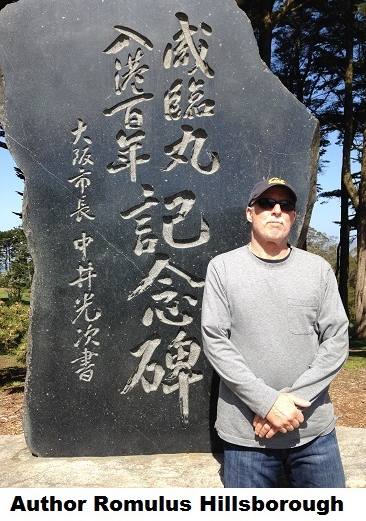
Recently the SA talked to Mr. Hillsborough (pictured here with the memorial tablet presented to San Francisco by Osaka in 1960 to commemorate the 100th anniversary of the Kanrin Maru’s voyage to that city-a voyage captained by Katsu Kaishu) about the book and some of the issues it explores. In the following interview, RH is author Romulus Hillsborough and SA is the Samurai Archives’ Randy Schadel.
Romulus Hillsborough is the author of several popular books dealing with the Bakumatsu/early Meiji period of Japanese history and the personalities that shaped its course. These include Shinsengumi: The Shogun's Last Samurai Corps, Samurai Tales: Courage, Fidelity and Revenge in the Final Years of the Shogun (an expansion of his earlier Samurai Sketches), and the work for which he is perhaps best known, Ryoma: Life of a Renaissance Samurai. Just published is Samurai Revolution: The Dawn of Modern Japan Seen Through the Eyes of the Shogun's Last Samurai. Samurai Revolution tells the story of the final years of the shogunate in the 1850’s and 60’s to the last rebellion of the former samurai class in 1877. It’s largely told through the life and works of Katsu Kaishu, a vassal of the Tokugawa who was both loved and loathed by the shogunate and its Imperial Loyalist enemies. We found it to be not only an excellent biography of Katsu, but an exceedingly well-done, intricate, and clearly written overview of this vital period of Japanese history.
Recently the SA talked to Mr. Hillsborough (pictured here with the memorial tablet presented to San Francisco by Osaka in 1960 to commemorate the 100th anniversary of the Kanrin Maru’s voyage to that city-a voyage captained by Katsu Kaishu) about the book and some of the issues it explores. In the following interview, RH is author Romulus Hillsborough and SA is the Samurai Archives’ Randy Schadel.
 SA: Mr. Hillsborough, congratulations on the publication of Samurai Revolution and thanks for taking the time to discuss the new book with the Samurai Archives. Could you start off by letting our readers know a bit of your background—your career, education, and travels?
RH: First of all, I would like to thank you for the opportunity to speak to the readers of your excellent forum. As for my background, I grew up in Los Angeles, CA. I have a BA in English and an MA in humanities. My passions are writing and reading (mostly, literature, history and philosophy). My favorite writers over the years have been (in reverse chronological order) Friedrich Nietzsche, Eugene O’Neill, Mark Twain, William Butler Yeats, Dylan Thomas, Akutagawa Ryunosuke, Shiba Ryotaro, Ernest Hemingway, and J.R.R. Tolkien. I practiced a Japanese martial art in an organization called Shotokan Karate of America (SKA), chief instructor Tsutomu Ohshima, for more than 30 years—including in Los Angeles, Tokyo and San Francisco. Shortly after graduating from college I went to Japan, where I lived for around 16 years, and where I “came of age” as a writer. In the mid-1980’s I worked for popular Japanese magazines while researching and writing my first book, Ryoma: Life of a Renaissance Samurai, an historical novel. All of my other books were written after I returned to the United States in the 1990’s. My martial arts practice along with my experience living, studying and working in Japan have greatly influenced my writing.
SA: Samurai Revolution is quite the ambitious work, weighing in at 600 pages and giving a comprehensive overview of the decline of the Bakufu (the Tokugawa shogunate) and eventual extinction of the samurai class. It spans the gamut from the earliest rumblings of foreign interference in Japanese affairs that pre-dated Perry’s Black Ships to the last throes of the samurai during the Satsuma Rebellion. It does an excellent job of explaining in an understandable and detailed manner the sometimes confusing shifts of allegiance and philosophy undergone by groups as well as individuals. Did you start off with the idea of writing such a comprehensive and detailed work, or did it take on a life of its own during the writing process?
RH: When I conceived of a book focusing on Katsu Kaishu around the year 2000 (shortly after publishing Samurai Sketches), I intended to write a fictionalized “autobiography.” But after working on it for a while, I abandoned that format for two reasons. One was the dearth of published material about Kaishu in the English language. I thought that there ought to be at least one detailed, historically and culturally accurate non-fiction account of the life and times of such an important and interesting figure published for an international readership. I wanted this book to be the definitive portrait (it is not a biography in the traditional sense) of Katsu Kaishu in English. And I also wanted to make the book more of a comprehensive treatment of the Bakumatsu era than I had originally intended, presenting this history as the human drama that it actually is. To do so I needed to focus on the personalities of its leading players, giving them more attention than I would have in an “autobiography.” These include the last shogun Tokugawa Yoshinobu and his father Tokugawa Nariaki of Mito; their nemesis Ii Naosuke, the dictatorial regent to the boy shogun Iemochi whose assassination in the spring of 1860 was the beginning of the end of the Tokugawa Bakufu; Yoshida Shoin, Takasugi Shinsaku, and Katsura Kogoro, the three most important figures of Choshu during the Bakumatsu, posthumously succeeded by Ito Shunsuke (later Hirobumi, Meiji Japan’s first prime minister) and Inoue Monta (later Kaoru); Kaishu’s and Shoin’s teacher, Sakuma Shozan, perhaps the most brilliant of all, who even before Perry had advised the Bakufu to develop a modern navy to defend against Western imperialism; Saigo Takamori and Okubo Toshimichi of Satsuma, the leaders of the Satsuma clan and collectively the most powerful driving force behind the revolution; Shimazu Nariakira, the revered daimyo of Satsuma who died in his prime, some believe by poisoning by his own vassals; Sakamoto Ryoma and Nakaoka Shintaro, the two political outlaws (ronin) from Tosa who managed to unite Satsuma and Choshu in a political-military alliance that would change history and who were assassinated together shortly after Yoshinobu abdicated based on a plan formulated by Ryoma; and others who I will not mention here but who have also been given ample attention in Samurai Revolution.
And during the eleven years it took me to complete Samurai Revolution (including two periods totaling about two years when I did not work on it), it did “take on a life of its own”—actually it went through several metamorphoses. For example, my original intent was to end the book with the fall of the Bakufu and the peaceful surrender of Edo Castle as negotiated by Kaishu and Saigo. But as I approached the end of the story, I realized I could not simply drop it—and let my readers wonder what happens next in this riveting human drama. So I included Book 2 to chronicle the rise of Imperial Japan. The definitive and culminating event during that era (i.e., the first decade of Meiji) is the Satsuma Rebellion; and the driving personality behind it is Saigo, for whom Kaishu had the courage to continue expressing his undying admiration, never once forgetting their friendship even after Saigo had died as an alleged “traitor,” stripped of his Imperial rank, for his supposed leading role in the Rebellion. I also thought that I would need an Epilogue to complete the manuscript, which at around 325,000 words was substantially longer than the edited published version. And so, in its final form, Samurai Revolution is a detailed examination and analysis of the Bakumatsu era through the eyes of Katsu Kaishu, who seemed to me the best spokesman for the era (for reasons I explain below.) Regarding the reason for the epithet “the shogun’s last samurai,” that is explained in the Epilogue.
SA: Speaking of shifts of allegiance and philosophy, what was the catalyst that caused the Sonno-Joi (Revere the Emperor, Expel the Barbarians) groups to embrace Western learning and technology, dropping Sonno-Joi for Kinno-Tobaku (Imperial Loyalism, Down with the Bakufu)?
RH: The short answer, I think, is an honest acceptance of reality around the summer of 1863, ten years after Perry first showed up. Until then Sonno-Joi had been embraced with religious zeal. In the summer of 1862, Takasugi Shinsaku, one of the leaders of Sonno-Joi in Choshu, traveled to Shanghai during the Taiping Rebellion. Upon arriving he was struck by the large number of foreign ships, many of them warships, in the harbor. And he was deeply troubled to see Chinese kowtowing to white men and the defilement of a Confucian shrine, which was being used as a British military encampment. He also observed modern weaponry, including breech-loading guns, at foreign merchant houses in the city. All of this convinced him of the futility of trying to take on the likes of Great Britain, France and other Western powers without first developing a modern military. He concluded that there was no room for Joi (“Expel the Barbarians”) in the Sonno (“Revere the Emperor”) equation, if the rebels intended to overthrow the Bakufu and create a modern Japanese state under the Emperor, strong enough to deal with Western imperialism from a position of power—as Takasugi’s martyred teacher, Yoshida Shoin, had espoused. But most Choshu samurai remained fanatically anti-foreign—until Choshu was humiliated with the bombardment by foreign ships and brief occupation of its territory on the Shimonoseki coast by French troops in the summer of 1863. This, then, was the catalyst which forced them to accept the reality that Joi was impossible. A few days after the French occupation, Takasugi established the Kiheitai, Japan’s first modern militia—not to “expel the barbarians” but to overthrow the government (i.e., the Bakufu) which had let them in.
Meanwhile, Satsuma, the other leader in the Sonno-Joi movement, experienced a rude awakening of its own when it engaged British naval forces in its own front yard on Kagoshima Bay about a month after the bombardment of Shimonoseki. The British had come to Satsuma to demand reparation for the murder of a British subject, Charles Lennox Richardson, by Satsuma men at Namamugi in the previous year (the notorious Namamugi Incident, also known as the Richardson Affair). Satsuma refused and the British attacked. Though Satsuma put up a good fight, its forces were no match for the superior guns and warships of the British, which, in the words of Ernest Satow, who was aboard one of the ships, “dismounted some of their batteries and laid the town to ruins,” before retreating. As a condition for peace, however, Satsuma agreed to pay an indemnity and punish Richardson’s killers, though the second part of its promise was never fulfilled. As I wrote in Samurai Revolution: “But the Satsuma men learned an important lesson from the whole ordeal, realizing once and for all that they were not equipped to expel the foreigners by military force.” Ironically, the Satsuma men embraced the British as allies to help them build up their military in the gathering revolution.
SA: Mr. Hillsborough, congratulations on the publication of Samurai Revolution and thanks for taking the time to discuss the new book with the Samurai Archives. Could you start off by letting our readers know a bit of your background—your career, education, and travels?
RH: First of all, I would like to thank you for the opportunity to speak to the readers of your excellent forum. As for my background, I grew up in Los Angeles, CA. I have a BA in English and an MA in humanities. My passions are writing and reading (mostly, literature, history and philosophy). My favorite writers over the years have been (in reverse chronological order) Friedrich Nietzsche, Eugene O’Neill, Mark Twain, William Butler Yeats, Dylan Thomas, Akutagawa Ryunosuke, Shiba Ryotaro, Ernest Hemingway, and J.R.R. Tolkien. I practiced a Japanese martial art in an organization called Shotokan Karate of America (SKA), chief instructor Tsutomu Ohshima, for more than 30 years—including in Los Angeles, Tokyo and San Francisco. Shortly after graduating from college I went to Japan, where I lived for around 16 years, and where I “came of age” as a writer. In the mid-1980’s I worked for popular Japanese magazines while researching and writing my first book, Ryoma: Life of a Renaissance Samurai, an historical novel. All of my other books were written after I returned to the United States in the 1990’s. My martial arts practice along with my experience living, studying and working in Japan have greatly influenced my writing.
SA: Samurai Revolution is quite the ambitious work, weighing in at 600 pages and giving a comprehensive overview of the decline of the Bakufu (the Tokugawa shogunate) and eventual extinction of the samurai class. It spans the gamut from the earliest rumblings of foreign interference in Japanese affairs that pre-dated Perry’s Black Ships to the last throes of the samurai during the Satsuma Rebellion. It does an excellent job of explaining in an understandable and detailed manner the sometimes confusing shifts of allegiance and philosophy undergone by groups as well as individuals. Did you start off with the idea of writing such a comprehensive and detailed work, or did it take on a life of its own during the writing process?
RH: When I conceived of a book focusing on Katsu Kaishu around the year 2000 (shortly after publishing Samurai Sketches), I intended to write a fictionalized “autobiography.” But after working on it for a while, I abandoned that format for two reasons. One was the dearth of published material about Kaishu in the English language. I thought that there ought to be at least one detailed, historically and culturally accurate non-fiction account of the life and times of such an important and interesting figure published for an international readership. I wanted this book to be the definitive portrait (it is not a biography in the traditional sense) of Katsu Kaishu in English. And I also wanted to make the book more of a comprehensive treatment of the Bakumatsu era than I had originally intended, presenting this history as the human drama that it actually is. To do so I needed to focus on the personalities of its leading players, giving them more attention than I would have in an “autobiography.” These include the last shogun Tokugawa Yoshinobu and his father Tokugawa Nariaki of Mito; their nemesis Ii Naosuke, the dictatorial regent to the boy shogun Iemochi whose assassination in the spring of 1860 was the beginning of the end of the Tokugawa Bakufu; Yoshida Shoin, Takasugi Shinsaku, and Katsura Kogoro, the three most important figures of Choshu during the Bakumatsu, posthumously succeeded by Ito Shunsuke (later Hirobumi, Meiji Japan’s first prime minister) and Inoue Monta (later Kaoru); Kaishu’s and Shoin’s teacher, Sakuma Shozan, perhaps the most brilliant of all, who even before Perry had advised the Bakufu to develop a modern navy to defend against Western imperialism; Saigo Takamori and Okubo Toshimichi of Satsuma, the leaders of the Satsuma clan and collectively the most powerful driving force behind the revolution; Shimazu Nariakira, the revered daimyo of Satsuma who died in his prime, some believe by poisoning by his own vassals; Sakamoto Ryoma and Nakaoka Shintaro, the two political outlaws (ronin) from Tosa who managed to unite Satsuma and Choshu in a political-military alliance that would change history and who were assassinated together shortly after Yoshinobu abdicated based on a plan formulated by Ryoma; and others who I will not mention here but who have also been given ample attention in Samurai Revolution.
And during the eleven years it took me to complete Samurai Revolution (including two periods totaling about two years when I did not work on it), it did “take on a life of its own”—actually it went through several metamorphoses. For example, my original intent was to end the book with the fall of the Bakufu and the peaceful surrender of Edo Castle as negotiated by Kaishu and Saigo. But as I approached the end of the story, I realized I could not simply drop it—and let my readers wonder what happens next in this riveting human drama. So I included Book 2 to chronicle the rise of Imperial Japan. The definitive and culminating event during that era (i.e., the first decade of Meiji) is the Satsuma Rebellion; and the driving personality behind it is Saigo, for whom Kaishu had the courage to continue expressing his undying admiration, never once forgetting their friendship even after Saigo had died as an alleged “traitor,” stripped of his Imperial rank, for his supposed leading role in the Rebellion. I also thought that I would need an Epilogue to complete the manuscript, which at around 325,000 words was substantially longer than the edited published version. And so, in its final form, Samurai Revolution is a detailed examination and analysis of the Bakumatsu era through the eyes of Katsu Kaishu, who seemed to me the best spokesman for the era (for reasons I explain below.) Regarding the reason for the epithet “the shogun’s last samurai,” that is explained in the Epilogue.
SA: Speaking of shifts of allegiance and philosophy, what was the catalyst that caused the Sonno-Joi (Revere the Emperor, Expel the Barbarians) groups to embrace Western learning and technology, dropping Sonno-Joi for Kinno-Tobaku (Imperial Loyalism, Down with the Bakufu)?
RH: The short answer, I think, is an honest acceptance of reality around the summer of 1863, ten years after Perry first showed up. Until then Sonno-Joi had been embraced with religious zeal. In the summer of 1862, Takasugi Shinsaku, one of the leaders of Sonno-Joi in Choshu, traveled to Shanghai during the Taiping Rebellion. Upon arriving he was struck by the large number of foreign ships, many of them warships, in the harbor. And he was deeply troubled to see Chinese kowtowing to white men and the defilement of a Confucian shrine, which was being used as a British military encampment. He also observed modern weaponry, including breech-loading guns, at foreign merchant houses in the city. All of this convinced him of the futility of trying to take on the likes of Great Britain, France and other Western powers without first developing a modern military. He concluded that there was no room for Joi (“Expel the Barbarians”) in the Sonno (“Revere the Emperor”) equation, if the rebels intended to overthrow the Bakufu and create a modern Japanese state under the Emperor, strong enough to deal with Western imperialism from a position of power—as Takasugi’s martyred teacher, Yoshida Shoin, had espoused. But most Choshu samurai remained fanatically anti-foreign—until Choshu was humiliated with the bombardment by foreign ships and brief occupation of its territory on the Shimonoseki coast by French troops in the summer of 1863. This, then, was the catalyst which forced them to accept the reality that Joi was impossible. A few days after the French occupation, Takasugi established the Kiheitai, Japan’s first modern militia—not to “expel the barbarians” but to overthrow the government (i.e., the Bakufu) which had let them in.
Meanwhile, Satsuma, the other leader in the Sonno-Joi movement, experienced a rude awakening of its own when it engaged British naval forces in its own front yard on Kagoshima Bay about a month after the bombardment of Shimonoseki. The British had come to Satsuma to demand reparation for the murder of a British subject, Charles Lennox Richardson, by Satsuma men at Namamugi in the previous year (the notorious Namamugi Incident, also known as the Richardson Affair). Satsuma refused and the British attacked. Though Satsuma put up a good fight, its forces were no match for the superior guns and warships of the British, which, in the words of Ernest Satow, who was aboard one of the ships, “dismounted some of their batteries and laid the town to ruins,” before retreating. As a condition for peace, however, Satsuma agreed to pay an indemnity and punish Richardson’s killers, though the second part of its promise was never fulfilled. As I wrote in Samurai Revolution: “But the Satsuma men learned an important lesson from the whole ordeal, realizing once and for all that they were not equipped to expel the foreigners by military force.” Ironically, the Satsuma men embraced the British as allies to help them build up their military in the gathering revolution.
 SA: Most works on the Bakumatsu center around figures of the Loyalist factions, most notably Sakamoto Ryoma and Saigo Takamori. However, Samurai Revolution uses Katsu Rintaro (usually known as Katsu Kaishu in the West), a vassal of the Tokugawa shogun, as its focus. What made Katsu the appropriate vessel to carry such a wide-ranging narrative?
RH: Beside my own personal interest in Katsu Kaishu (he’s generally known by this name in the Japanese literature as well) both as a personality and an historical figure, and the lack of accurate and detailed information on him in English, he was one of the few men on the Tokugawa side who commanded the respect and goodwill of the Imperial Loyalists. In fact, he was more popular among the enemy side than among people in the Tokugawa camp, where he was widely reviled as a traitor (though he was not a traitor in any sense of the word)—and this is an overriding theme in my book, as reflected in my use of the term “outsider” to describe him. (“Outsider” is included in the titles of each of the five Parts comprising the book.) And since he had many friends and allies among the Loyalists, including most notably Ryoma and Saigo but also Katsura Kogoro and others from Choshu, Satsuma, and Tosa, and even Anegakoji Kintomo, one of the two leaders of the Sonno-Joi faction at the Imperial Court until his assassination in 1863, Kaishu was able to see things from both perspectives. So much so that he eventually told his superiors in the Bakufu, “The Bakufu must willingly fall,” which is an astonishing pronouncement from a loyal Tokugawa vassal with the high position of commissioner of warships. And it was precisely his flexibility of mind and his moral and physical courage to admit that the Bakufu’s time had run out that earned him the respect of the other side and the enmity of his own camp. But for all of his honesty and pragmatic realism, he was loyal to the Tokugawa family to the bitter end—which, I think, was one of the reasons that he embraced men such as Ryoma and Saigo to do the “dirty work” of actually overthrowing the Bakufu—which as a samurai of the Tokugawa clan he was incapable of—although in his later years he did say about the Bakufu: “Eventually I brought it down myself.”
SA: It’s somewhat ironic that the seeds of the shogunate’s downfall were found in the activities of Mito Han, itself a major Tokugawa branch house. However, despite being a major player in the early stages of the Bakumatsu, they soon were eclipsed by activists from Choshu, Tosa, and Satsuma. What differentiated Mito Han’s brand of Imperial Loyalism from these other han?
RH: As you mention, Mito was one of the Three Tokugawa Branch Houses (the “go-sanke”), the highest ranking of all the han. And so even the most radical of the Loyalists of Mito never opposed the Tokugawa Bakufu itself. But Mito was the cradle of Imperial Loyalism, which sprang from the Mito school of thought called Mitogaku—and the retired daimyo of Mito, Tokugawa Nariaki (Yoshinobu’s father), had coined the term Sonno-Joi. As such, Nariaki, one of the most powerful voices within the Bakufu, was the champion of the early Imperial Loyalism movement. And though Mito would never oppose the Bakufu, it would and certainly did oppose certain elements within the Edo regime that it found reprehensible and anathema to Imperial Loyalism, most notably Ii Naosuke, who was finally assassinated by a band of eighteen ronin, seventeen from Mito and one from Satsuma—though it was the Satsuma man who actually killed the regent, cutting off his head.
Mito Han is very difficult to comprehend, which makes it even more difficult to explain. And since I will include a great deal about Mito Han and Mitogaku in my next book, I will save further commentary about Mito for the future.
SA: One of Mito’s most notorious acts was the assassination of the shogun’s Tairo (Great Elder of the shogunate), Ii Naosuke. Naosuke was the lighting rod around which anti-foreign sentiment seemed to coagulate, both for opening certain ports to foreign trade and the often heavy handed way he dealt with political opponents. Did Ii ever have a realistic chance of garnering support for the way he handled foreign relations, or was any action he took doomed to fail (either by angering the Western nations or the anti-foreign Joi factions)?
RH: Kind of “damned if he did and damned if he didn’t,” right? Yes, I would agree with that. In fact, Ii Naosuke was probably no less anti-foreign at heart than his biggest enemies including the most fervent “barbarian haters” of Mito, Satsuma, Choshu, and Tosa. If he had had his way Japan would have probably remained closed. But, like Katsu Kaishu and other progressive thinkers of the time, Ii Naosuke was a realist. I wrote a lengthy chapter about these issues in Samurai Revolution, in which I argue that Naosuke demonstrated political courage in concluding the foreign trade treaties in defiance of popular opinion and even the Imperial Court itself, and that as the most powerful man in Japan, “he faced a dangerous and crucial decision—and in making that decision it appears that he had the welfare of Japan first and foremost in his heart. And in his mind—and indeed the minds of most if not all of the reactionary feudal lords of the Tokugawa camp—the Bakufu was Japan. But unlike many of his fellow antiforeign reactionaries, Naosuke had the sense to realize that if he refused the Americans’ demands for a trade treaty, he faced the very real danger of a devastating war. On the other hand, if he yielded to those demands, he knew that he would have to deal with a country of hotheaded samurai who violently opposed opening the ports to the barbarians, and that those samurai were led by his nemesis, Nariaki.” And so, he decided to conclude the trade treaties as the lesser of two evils, thus saving Japan from foreign subjugation. And for that and his crackdown on his political enemies, he was eventually killed.
SA: While the men who specialized in spreading violence and murder (from the numerous Loyalist assassins to the Shinsengumi) often become the face of the Bakumatsu in popular culture, many of the intellectual leaders (teachers in particular) had a far greater impact on the course of Japanese history in the 1850’s and 1860’s. Many of the Bakumatsu’s most famous figures (on both sides) received their intellectual training and core values from these teachers. Obviously your central character Katsu Rintaro was one of these teachers, but even the teacher needed to be taught. Could you tell us about a few of the other more notable teachers?
RH: Katsu Kaishu’s two greatest teachers, I think, were Sakuma Shozan of Matsushiro Han and Yokoi Shonan of Kumamoto Han. Sakuma was also the teacher of Yoshida Shoin and many other notable men. He was a compelling character not only for his foresight and brilliance (his influence on Japan can be seen up to WWII) but for his quirky yet strong personality. He married Katsu Rintaro’s younger sister and it was Sakuma who gave Rintaro the pseudonym “Kaishu,” which Sakuma himself had used. One of his cherished slogans was “control the barbarians through barbarian technology,” as he had advised the Bakufu as early as 1850, three years before Perry showed up. I introduce that slogan here because it sums up Sakuma’s ideas of how to deal with the dangers of Western imperialism. I wrote quite a bit about him in Samurai Revolution, including his significant influence on both of Katsu and Yoshida.
SA: Most works on the Bakumatsu center around figures of the Loyalist factions, most notably Sakamoto Ryoma and Saigo Takamori. However, Samurai Revolution uses Katsu Rintaro (usually known as Katsu Kaishu in the West), a vassal of the Tokugawa shogun, as its focus. What made Katsu the appropriate vessel to carry such a wide-ranging narrative?
RH: Beside my own personal interest in Katsu Kaishu (he’s generally known by this name in the Japanese literature as well) both as a personality and an historical figure, and the lack of accurate and detailed information on him in English, he was one of the few men on the Tokugawa side who commanded the respect and goodwill of the Imperial Loyalists. In fact, he was more popular among the enemy side than among people in the Tokugawa camp, where he was widely reviled as a traitor (though he was not a traitor in any sense of the word)—and this is an overriding theme in my book, as reflected in my use of the term “outsider” to describe him. (“Outsider” is included in the titles of each of the five Parts comprising the book.) And since he had many friends and allies among the Loyalists, including most notably Ryoma and Saigo but also Katsura Kogoro and others from Choshu, Satsuma, and Tosa, and even Anegakoji Kintomo, one of the two leaders of the Sonno-Joi faction at the Imperial Court until his assassination in 1863, Kaishu was able to see things from both perspectives. So much so that he eventually told his superiors in the Bakufu, “The Bakufu must willingly fall,” which is an astonishing pronouncement from a loyal Tokugawa vassal with the high position of commissioner of warships. And it was precisely his flexibility of mind and his moral and physical courage to admit that the Bakufu’s time had run out that earned him the respect of the other side and the enmity of his own camp. But for all of his honesty and pragmatic realism, he was loyal to the Tokugawa family to the bitter end—which, I think, was one of the reasons that he embraced men such as Ryoma and Saigo to do the “dirty work” of actually overthrowing the Bakufu—which as a samurai of the Tokugawa clan he was incapable of—although in his later years he did say about the Bakufu: “Eventually I brought it down myself.”
SA: It’s somewhat ironic that the seeds of the shogunate’s downfall were found in the activities of Mito Han, itself a major Tokugawa branch house. However, despite being a major player in the early stages of the Bakumatsu, they soon were eclipsed by activists from Choshu, Tosa, and Satsuma. What differentiated Mito Han’s brand of Imperial Loyalism from these other han?
RH: As you mention, Mito was one of the Three Tokugawa Branch Houses (the “go-sanke”), the highest ranking of all the han. And so even the most radical of the Loyalists of Mito never opposed the Tokugawa Bakufu itself. But Mito was the cradle of Imperial Loyalism, which sprang from the Mito school of thought called Mitogaku—and the retired daimyo of Mito, Tokugawa Nariaki (Yoshinobu’s father), had coined the term Sonno-Joi. As such, Nariaki, one of the most powerful voices within the Bakufu, was the champion of the early Imperial Loyalism movement. And though Mito would never oppose the Bakufu, it would and certainly did oppose certain elements within the Edo regime that it found reprehensible and anathema to Imperial Loyalism, most notably Ii Naosuke, who was finally assassinated by a band of eighteen ronin, seventeen from Mito and one from Satsuma—though it was the Satsuma man who actually killed the regent, cutting off his head.
Mito Han is very difficult to comprehend, which makes it even more difficult to explain. And since I will include a great deal about Mito Han and Mitogaku in my next book, I will save further commentary about Mito for the future.
SA: One of Mito’s most notorious acts was the assassination of the shogun’s Tairo (Great Elder of the shogunate), Ii Naosuke. Naosuke was the lighting rod around which anti-foreign sentiment seemed to coagulate, both for opening certain ports to foreign trade and the often heavy handed way he dealt with political opponents. Did Ii ever have a realistic chance of garnering support for the way he handled foreign relations, or was any action he took doomed to fail (either by angering the Western nations or the anti-foreign Joi factions)?
RH: Kind of “damned if he did and damned if he didn’t,” right? Yes, I would agree with that. In fact, Ii Naosuke was probably no less anti-foreign at heart than his biggest enemies including the most fervent “barbarian haters” of Mito, Satsuma, Choshu, and Tosa. If he had had his way Japan would have probably remained closed. But, like Katsu Kaishu and other progressive thinkers of the time, Ii Naosuke was a realist. I wrote a lengthy chapter about these issues in Samurai Revolution, in which I argue that Naosuke demonstrated political courage in concluding the foreign trade treaties in defiance of popular opinion and even the Imperial Court itself, and that as the most powerful man in Japan, “he faced a dangerous and crucial decision—and in making that decision it appears that he had the welfare of Japan first and foremost in his heart. And in his mind—and indeed the minds of most if not all of the reactionary feudal lords of the Tokugawa camp—the Bakufu was Japan. But unlike many of his fellow antiforeign reactionaries, Naosuke had the sense to realize that if he refused the Americans’ demands for a trade treaty, he faced the very real danger of a devastating war. On the other hand, if he yielded to those demands, he knew that he would have to deal with a country of hotheaded samurai who violently opposed opening the ports to the barbarians, and that those samurai were led by his nemesis, Nariaki.” And so, he decided to conclude the trade treaties as the lesser of two evils, thus saving Japan from foreign subjugation. And for that and his crackdown on his political enemies, he was eventually killed.
SA: While the men who specialized in spreading violence and murder (from the numerous Loyalist assassins to the Shinsengumi) often become the face of the Bakumatsu in popular culture, many of the intellectual leaders (teachers in particular) had a far greater impact on the course of Japanese history in the 1850’s and 1860’s. Many of the Bakumatsu’s most famous figures (on both sides) received their intellectual training and core values from these teachers. Obviously your central character Katsu Rintaro was one of these teachers, but even the teacher needed to be taught. Could you tell us about a few of the other more notable teachers?
RH: Katsu Kaishu’s two greatest teachers, I think, were Sakuma Shozan of Matsushiro Han and Yokoi Shonan of Kumamoto Han. Sakuma was also the teacher of Yoshida Shoin and many other notable men. He was a compelling character not only for his foresight and brilliance (his influence on Japan can be seen up to WWII) but for his quirky yet strong personality. He married Katsu Rintaro’s younger sister and it was Sakuma who gave Rintaro the pseudonym “Kaishu,” which Sakuma himself had used. One of his cherished slogans was “control the barbarians through barbarian technology,” as he had advised the Bakufu as early as 1850, three years before Perry showed up. I introduce that slogan here because it sums up Sakuma’s ideas of how to deal with the dangers of Western imperialism. I wrote quite a bit about him in Samurai Revolution, including his significant influence on both of Katsu and Yoshida.
 Yokoi was the chief political advisor to Matsudaira Shungaku, the powerful daimyo of Fukui (a Tokugawa-related house) who served as the Bakufu’s political director. (Shungaku was also a personal friend and political ally of Kaishu’s.) Kaishu described Yokoi as profound; and in his profundity, Kaishu found him “frightening.” “I’ve seen two frightening men in my life,” Kaishu said years later, in the 1890s. One was Yokoi, the other Saigo. “Yokoi didn’t know that much about the West; I taught him a thing or two [on that subject]. But there were often times, when it came to the high tone of his ideas, that I felt I could never reach [his level]. . . . Although Yokoi was not very good at working on his own, if there was anyone around who could implement his ideas, I thought that the two of them [could accomplish great things.]” As it turned out, two of Kaishu’s closest confidants on the anti-Bakufu side, Ryoma and Saigo, did implement Yokoi’s ideas, which of course changed history.
Sakuma, Yokoi, and Ryoma were assassinated. Saigo too met a violent death in the Satsuma Rebellion. Kaishu himself was nearly assassinated on several occasions. They lived in an exceedingly violent time.
SA: The shogunate failed badly in two abortive attempts to militarily chastise the rebels in Choshu Han. This not only led to a loss of respect among their allied han and foreign nations, but also much resentment among the various han for the seemingly harsh attitude they were taking towards Choshu (who, after all, were seen by many as just trying to carry out the Emperor’s edict of expelling the foreigners). Was this the turning point of the Bakumatsu? Did Choshu’s military abilities, the Bakufu’s failure, and public opinion serve to isolate the Bakufu from all but their most hardcore allies?
Yokoi was the chief political advisor to Matsudaira Shungaku, the powerful daimyo of Fukui (a Tokugawa-related house) who served as the Bakufu’s political director. (Shungaku was also a personal friend and political ally of Kaishu’s.) Kaishu described Yokoi as profound; and in his profundity, Kaishu found him “frightening.” “I’ve seen two frightening men in my life,” Kaishu said years later, in the 1890s. One was Yokoi, the other Saigo. “Yokoi didn’t know that much about the West; I taught him a thing or two [on that subject]. But there were often times, when it came to the high tone of his ideas, that I felt I could never reach [his level]. . . . Although Yokoi was not very good at working on his own, if there was anyone around who could implement his ideas, I thought that the two of them [could accomplish great things.]” As it turned out, two of Kaishu’s closest confidants on the anti-Bakufu side, Ryoma and Saigo, did implement Yokoi’s ideas, which of course changed history.
Sakuma, Yokoi, and Ryoma were assassinated. Saigo too met a violent death in the Satsuma Rebellion. Kaishu himself was nearly assassinated on several occasions. They lived in an exceedingly violent time.
SA: The shogunate failed badly in two abortive attempts to militarily chastise the rebels in Choshu Han. This not only led to a loss of respect among their allied han and foreign nations, but also much resentment among the various han for the seemingly harsh attitude they were taking towards Choshu (who, after all, were seen by many as just trying to carry out the Emperor’s edict of expelling the foreigners). Was this the turning point of the Bakumatsu? Did Choshu’s military abilities, the Bakufu’s failure, and public opinion serve to isolate the Bakufu from all but their most hardcore allies?
 RH: I don’t think it was a turning point in the revolution, the first of which came several years earlier in 1860 with Ii Naosuke’s assassination. The next turning point I think was the Satsuma-Choshu Alliance, concluded in early 1866. Without the Satsuma-Choshu Alliance, and the help of Sakamoto Ryoma’s company in procuring weapons from foreign traders, Choshu would not have had the means to defeat the Bakufu in the war which broke out in the summer of 1866. So more than describing the war as a turning point, I look at it more as a nail in the coffin of the Bakufu, which was already tottering before the war started—which was why Choshu was able to win. But when Yoshinobu became shogun at the end of that year, things started to look better for the Bakufu—and had he played his cards a little differently, and been more lucky at the game, he might have been able to revive the teetering regime that he had inherited. Of course, he did not—but I write about those things in detail in Samurai Revolution.
SA: While the focus usually falls on Choshu Han as the driving force behind the anti-Bakufu factions, in many ways it seemed that it was Satsuma Han that determined the course of the Bakumatsu. From allies of the shogunate and sworn enemies of Choshu they abruptly allied with Choshu—and during the early years of the Meiji Period became enemies of Choshu again. They seemed to be the true wild card of the Bakumatsu, never keeping to a consistent policy but rather adapting to opportunities as they presented themselves. While Sakamoto Ryoma’s part in securing the ‘Satcho’ alliance is well known, why was Satsuma even willing to ally itself with enemies? Did they see parallels between the treatment of Choshu and their own position, and perhaps thought that the increasing influence of Tokugawa Yoshinobu on Bakufu policy (he was not yet shogun) posed a danger to Satsuma?
RH: There were numerous men and factors who influenced Satsuma’s decision (which was actually Saigo’s and Okubo’s decision) to ally itself with Choshu, including the ideas of their late revered daimyo Shimazu Nariakira, Satsuma’s relationship with the British, the ideas of Katsu Kaishu and Sakamoto Ryoma, and Satsuma’s (i.e., Saigo’s and Okubo’s) flexibility to seize an opportunity when it presented itself. The alliance with Choshu was such an opportunity, and the seeds of the alliance were planted in Saigo’s mind by Kaishu; and they were nurtured by Ryoma. But I feel that this question is far too complicated to do justice to in this forum. Therefore I refer readers to Samurai Revolution, in which I discuss in detail Satsuma’s history and ethos (which resembles the ethos of the ancient Spartans in its stoicism), the origins of the Satsuma-Choshu Alliance, and the roles of those two han, among others, in the overthrow of the Bakufu. But let me share one of my favorite Katsu Kaishu quotes here: “The difference between Choshu and Satsuma is that Choshu men make money to gain political power, whereas Satsuma men gain political power to make money. . . . A Choshu man will carefully write down his last will and testament to avoid being misunderstood after death. . . . But a Satsuma man is very straightforward. When he encounters a situation in which he knows he will die, he won’t utter a word.” Here, Kaishu was referring to the Satsuma ethos.
RH: I don’t think it was a turning point in the revolution, the first of which came several years earlier in 1860 with Ii Naosuke’s assassination. The next turning point I think was the Satsuma-Choshu Alliance, concluded in early 1866. Without the Satsuma-Choshu Alliance, and the help of Sakamoto Ryoma’s company in procuring weapons from foreign traders, Choshu would not have had the means to defeat the Bakufu in the war which broke out in the summer of 1866. So more than describing the war as a turning point, I look at it more as a nail in the coffin of the Bakufu, which was already tottering before the war started—which was why Choshu was able to win. But when Yoshinobu became shogun at the end of that year, things started to look better for the Bakufu—and had he played his cards a little differently, and been more lucky at the game, he might have been able to revive the teetering regime that he had inherited. Of course, he did not—but I write about those things in detail in Samurai Revolution.
SA: While the focus usually falls on Choshu Han as the driving force behind the anti-Bakufu factions, in many ways it seemed that it was Satsuma Han that determined the course of the Bakumatsu. From allies of the shogunate and sworn enemies of Choshu they abruptly allied with Choshu—and during the early years of the Meiji Period became enemies of Choshu again. They seemed to be the true wild card of the Bakumatsu, never keeping to a consistent policy but rather adapting to opportunities as they presented themselves. While Sakamoto Ryoma’s part in securing the ‘Satcho’ alliance is well known, why was Satsuma even willing to ally itself with enemies? Did they see parallels between the treatment of Choshu and their own position, and perhaps thought that the increasing influence of Tokugawa Yoshinobu on Bakufu policy (he was not yet shogun) posed a danger to Satsuma?
RH: There were numerous men and factors who influenced Satsuma’s decision (which was actually Saigo’s and Okubo’s decision) to ally itself with Choshu, including the ideas of their late revered daimyo Shimazu Nariakira, Satsuma’s relationship with the British, the ideas of Katsu Kaishu and Sakamoto Ryoma, and Satsuma’s (i.e., Saigo’s and Okubo’s) flexibility to seize an opportunity when it presented itself. The alliance with Choshu was such an opportunity, and the seeds of the alliance were planted in Saigo’s mind by Kaishu; and they were nurtured by Ryoma. But I feel that this question is far too complicated to do justice to in this forum. Therefore I refer readers to Samurai Revolution, in which I discuss in detail Satsuma’s history and ethos (which resembles the ethos of the ancient Spartans in its stoicism), the origins of the Satsuma-Choshu Alliance, and the roles of those two han, among others, in the overthrow of the Bakufu. But let me share one of my favorite Katsu Kaishu quotes here: “The difference between Choshu and Satsuma is that Choshu men make money to gain political power, whereas Satsuma men gain political power to make money. . . . A Choshu man will carefully write down his last will and testament to avoid being misunderstood after death. . . . But a Satsuma man is very straightforward. When he encounters a situation in which he knows he will die, he won’t utter a word.” Here, Kaishu was referring to the Satsuma ethos.
 SA: Yamauchi Yodo, the retired daimyo of Tosa Han, ruthlessly moved to purge the Loyalist element from his domain. He was well known for being an ardent supporter of the shogunate. Yet it was largely because of him that the last shogun, Tokugawa Yoshinobu, resigned from the office and returned power to Emperor Meiji. Why did such a loyal shogunate vassal end up working towards its removal from power?
RH: All I will say here is that Yodo did not work to remove the Bakufu from power. Rather he worked to save the Bakufu and Yoshinobu from destruction by endorsing Sakamoto Ryoma’s plan for the shogun to abdicate peacefully and restore Imperial rule, thereby expecting a place for the former shogun within the new government. The detailed explanation to all of this is in my new book.
Part 2 of our interview with Mr. Hillsborough will be forthcoming shortly and will touch on such topics as the early years of the Meiji Restoration, the Satsuma Rebellion of 1877, the advantages of writing about places an author has explored in person, assassination conspiracy theories, and even a bit of speculative history. For now, you can order “Samurai Revolution” on the SA’s Amazon store HERE or directly from Tuttle Publishing’s website HERE . Visit Romulus Hillsborough’s “Samurai Revolution” website for more about the book along with interesting essays and news items (such as documents recently discovered in Kochi sealed with Sakamoto Ryoma’s blood).
SA: Yamauchi Yodo, the retired daimyo of Tosa Han, ruthlessly moved to purge the Loyalist element from his domain. He was well known for being an ardent supporter of the shogunate. Yet it was largely because of him that the last shogun, Tokugawa Yoshinobu, resigned from the office and returned power to Emperor Meiji. Why did such a loyal shogunate vassal end up working towards its removal from power?
RH: All I will say here is that Yodo did not work to remove the Bakufu from power. Rather he worked to save the Bakufu and Yoshinobu from destruction by endorsing Sakamoto Ryoma’s plan for the shogun to abdicate peacefully and restore Imperial rule, thereby expecting a place for the former shogun within the new government. The detailed explanation to all of this is in my new book.
Part 2 of our interview with Mr. Hillsborough will be forthcoming shortly and will touch on such topics as the early years of the Meiji Restoration, the Satsuma Rebellion of 1877, the advantages of writing about places an author has explored in person, assassination conspiracy theories, and even a bit of speculative history. For now, you can order “Samurai Revolution” on the SA’s Amazon store HERE or directly from Tuttle Publishing’s website HERE . Visit Romulus Hillsborough’s “Samurai Revolution” website for more about the book along with interesting essays and news items (such as documents recently discovered in Kochi sealed with Sakamoto Ryoma’s blood).
 Akabane Sei has problems. He’s a rakugo storyteller, specializing in comic stories designed to send his audience home laughing and feeling good. But things are not easy for a rakugoka in Meiji Japan. Audiences are dwindling as new forms of entertainment become popular. There’s even increased competition in the person of Jack Green-an Englishman who has enchanted crowds with his exotic tales of the West, such as “sailors in search of a golden sheepskin and women whose faces turned men to stone”. Complicating things further are Sei’s troubles with his wife Tae and three daughters. Shigure, an aspiring novelist, has left her husband and returned to Sei’s house. Teru has also returned home, driven from her husband not by another woman, but another man. And oldest daughter Yuri, while still remaining with her husband Kat’chan, has to come to terms with his enchantment with Christianity. Worse, Sei has lost his muse and has a bad case of ‘storyteller’s block’. He needs new material but can’t seem to think of a single thing. What could help bring him out of his midlife crisis? When Sei is approached by the Black Ocean, a secret society devoted to upholding the ‘traditions of the past’, it seems that this might be the key to his professional resurrection. But after being ‘encouraged’ to write a story dealing with Korea that will reinforce the imperialist goals of the Black Ocean, he instead falls afoul of the group after penning “The History of a Nose”. Based on an obscure account written by a 16th century monk, it has the opposite effect and could have a disastrous effect on Sei’s career-not to mention his very life.
Sei is the title character of bestselling author Lian Hearn’s new book, “The Storyteller and His Three Daughters”. Hearn, best known for her “Tales of the Otori” series, has recently turned to tales set in the real-life Japan of the 19th century. “The Storyteller” blends a simple story of family with a look at the early stages of colonialism in the Japanese government. Hearn uses her fictional family along with characters such as Jack Green and Sei’s other acquaintances to explore Japan’s transformation from the days of the Tokugawa Shogunate to a modern, industrialized nation-and its increasingly warlike stance.
Akabane Sei has problems. He’s a rakugo storyteller, specializing in comic stories designed to send his audience home laughing and feeling good. But things are not easy for a rakugoka in Meiji Japan. Audiences are dwindling as new forms of entertainment become popular. There’s even increased competition in the person of Jack Green-an Englishman who has enchanted crowds with his exotic tales of the West, such as “sailors in search of a golden sheepskin and women whose faces turned men to stone”. Complicating things further are Sei’s troubles with his wife Tae and three daughters. Shigure, an aspiring novelist, has left her husband and returned to Sei’s house. Teru has also returned home, driven from her husband not by another woman, but another man. And oldest daughter Yuri, while still remaining with her husband Kat’chan, has to come to terms with his enchantment with Christianity. Worse, Sei has lost his muse and has a bad case of ‘storyteller’s block’. He needs new material but can’t seem to think of a single thing. What could help bring him out of his midlife crisis? When Sei is approached by the Black Ocean, a secret society devoted to upholding the ‘traditions of the past’, it seems that this might be the key to his professional resurrection. But after being ‘encouraged’ to write a story dealing with Korea that will reinforce the imperialist goals of the Black Ocean, he instead falls afoul of the group after penning “The History of a Nose”. Based on an obscure account written by a 16th century monk, it has the opposite effect and could have a disastrous effect on Sei’s career-not to mention his very life.
Sei is the title character of bestselling author Lian Hearn’s new book, “The Storyteller and His Three Daughters”. Hearn, best known for her “Tales of the Otori” series, has recently turned to tales set in the real-life Japan of the 19th century. “The Storyteller” blends a simple story of family with a look at the early stages of colonialism in the Japanese government. Hearn uses her fictional family along with characters such as Jack Green and Sei’s other acquaintances to explore Japan’s transformation from the days of the Tokugawa Shogunate to a modern, industrialized nation-and its increasingly warlike stance.
 The main storyline revolves around the shadow group Black Ocean (an actual historical organization) as it attempts to coerce Sei to produce propaganda that will support their agenda of invading Korea. One of its leaders, former samurai Yamagishi Takayuki, attempts to coerce Sei to write stories that depict Korea in a negative light in order to sway public opinion towards an invasion. Sei, deep in debt, at first reluctantly feels obliged to comply when Takayuki settles his debts. But a chance encounter in a bookstore with the memoirs of a monk, Keinen, gives Sei pause to reconsider. Keinen historically accompanied Toyotomi Hideyoshi’s invasion of Korea in the 1590’s and bore witness to any number of horrors. He likened the slaughter in Korea to the Buddhist Realm of Beasts, and recorded his observations of the atrocities. The spirit of Keinen seems to haunt Sei, tormenting him with visions of carnage and mutilation. The day of the O-bon festival (the festival where the Japanese honor the spirits of the dead) sees Keinen at his most powerful, seemingly calling down the wrath of heaven upon the land and punctuating his abuse of Sei with an earthquake. Is the spirit of Keinen real, or is he just a manifestation of Sei’s conscience? It’s never made clear, but the manuscript mysteriously disappears after Sei decides to reconsider. Instead of an anti-Korean tale, he performs ‘The History of a Nose’, a reference to the thousands of noses cut from slaughtered Koreans during Hideyoshi’s invasion. Rather than a comedic tale written to depict Korea in a negative light, it instead dwells on the horrors of war as related by one of the noses in Kyoto’s Mimizuka (the misnamed ‘ear mound’, which actually contains the noses collected by the samurai invaders during the Korean invasion of the 1590’s). Sei’s story chills his audience and infuriates the Black Ocean. Their influence sees him banned from rakugo and his life is now at risk. Can a man armed only with words prevail against a group more than willing to assassinate its enemies? If this was one of Sei’s stories, he might see his role as the badger against Takayuki’s tiger. And after several more twists, the badger sets out to confront the tiger in its lair.
The adventures of Sei’s daughters bring other cultural issues of the day into the storyline. Shigure doesn’t care about a woman’s traditional role and only wants to pursue her career as a novelist. Teru, who takes up Western style knitting as a moneymaking venture, only wants to please her husband but is at a loss as to how. Yuri’s stable relationship is threatened by her husband’s religious awakening. The elimination of the ban on Christianity, the birth of the women’s rights movement in Japan, the colonization of the northern island of Ezo/Hokkaido, and sexual roles in the changing times (if indeed it changed at all) are all examined in the story on a personal level where the effects of national issues on an individual can be seen. In an amusing scene, there’s even what could be called an example of early cosplay at work! Other characters serve the same function, such as Okuda Satoshi. A scholar of all things France, he runs into trouble with the government for his anti-warfare stance as part of the People’s Rights movement and is imprisoned. There’s also a stunningly handsome Korean stagehand, Kyu, that becomes an integral part of the Black Ocean’s schemes and who may become the focus of anti-Korean sentiment.
The English storyteller Jack Green serves as the symbolic embodiment of the Western invasion of Japanese culture-and also how the Japanese were able to absorb it into that culture while maintaining much of the old ways. He also provides a character that Western audiences can use as their entry into Sei’s world. Jack becomes an important character in Sei’s life, far and beyond his effect on Sei’s professional career. A man who initially aroused only jealousy and anger in Sei becomes an important ally, and perhaps a friend.
From this tapestry of events, Sei draws the inspiration for the work he is to become most famous for-“The Silk Kimono”. In the world of “The Storyteller”, life doesn’t simply imitate art, it becomes art.
Hearn uses an interesting writing technique that she learned from researching early Meiji period novels. Many of these novels would present conversations between characters in a format similar to a stage play (or a modern-day film script). Her protagonist Sei uses this method to record his personal conversations. It’s an interesting departure from the traditional Western novel, giving it a ‘period feel’ that adds to the reader’s immersion into the culture of the times. In this way it’s much like Royall Tyler’s recent translation of the “Heike Monogatari (The Tale of the Heike)” where he renders the text much as it would have been narrated by a biwa hoshi (blind lute priests that performed the Heike for audiences). In “The Storyteller”, it also has the effect of drawing the reader into the story. Readers become silent participants in his conversations, giving them a sense of immediacy and realism.
The main storyline revolves around the shadow group Black Ocean (an actual historical organization) as it attempts to coerce Sei to produce propaganda that will support their agenda of invading Korea. One of its leaders, former samurai Yamagishi Takayuki, attempts to coerce Sei to write stories that depict Korea in a negative light in order to sway public opinion towards an invasion. Sei, deep in debt, at first reluctantly feels obliged to comply when Takayuki settles his debts. But a chance encounter in a bookstore with the memoirs of a monk, Keinen, gives Sei pause to reconsider. Keinen historically accompanied Toyotomi Hideyoshi’s invasion of Korea in the 1590’s and bore witness to any number of horrors. He likened the slaughter in Korea to the Buddhist Realm of Beasts, and recorded his observations of the atrocities. The spirit of Keinen seems to haunt Sei, tormenting him with visions of carnage and mutilation. The day of the O-bon festival (the festival where the Japanese honor the spirits of the dead) sees Keinen at his most powerful, seemingly calling down the wrath of heaven upon the land and punctuating his abuse of Sei with an earthquake. Is the spirit of Keinen real, or is he just a manifestation of Sei’s conscience? It’s never made clear, but the manuscript mysteriously disappears after Sei decides to reconsider. Instead of an anti-Korean tale, he performs ‘The History of a Nose’, a reference to the thousands of noses cut from slaughtered Koreans during Hideyoshi’s invasion. Rather than a comedic tale written to depict Korea in a negative light, it instead dwells on the horrors of war as related by one of the noses in Kyoto’s Mimizuka (the misnamed ‘ear mound’, which actually contains the noses collected by the samurai invaders during the Korean invasion of the 1590’s). Sei’s story chills his audience and infuriates the Black Ocean. Their influence sees him banned from rakugo and his life is now at risk. Can a man armed only with words prevail against a group more than willing to assassinate its enemies? If this was one of Sei’s stories, he might see his role as the badger against Takayuki’s tiger. And after several more twists, the badger sets out to confront the tiger in its lair.
The adventures of Sei’s daughters bring other cultural issues of the day into the storyline. Shigure doesn’t care about a woman’s traditional role and only wants to pursue her career as a novelist. Teru, who takes up Western style knitting as a moneymaking venture, only wants to please her husband but is at a loss as to how. Yuri’s stable relationship is threatened by her husband’s religious awakening. The elimination of the ban on Christianity, the birth of the women’s rights movement in Japan, the colonization of the northern island of Ezo/Hokkaido, and sexual roles in the changing times (if indeed it changed at all) are all examined in the story on a personal level where the effects of national issues on an individual can be seen. In an amusing scene, there’s even what could be called an example of early cosplay at work! Other characters serve the same function, such as Okuda Satoshi. A scholar of all things France, he runs into trouble with the government for his anti-warfare stance as part of the People’s Rights movement and is imprisoned. There’s also a stunningly handsome Korean stagehand, Kyu, that becomes an integral part of the Black Ocean’s schemes and who may become the focus of anti-Korean sentiment.
The English storyteller Jack Green serves as the symbolic embodiment of the Western invasion of Japanese culture-and also how the Japanese were able to absorb it into that culture while maintaining much of the old ways. He also provides a character that Western audiences can use as their entry into Sei’s world. Jack becomes an important character in Sei’s life, far and beyond his effect on Sei’s professional career. A man who initially aroused only jealousy and anger in Sei becomes an important ally, and perhaps a friend.
From this tapestry of events, Sei draws the inspiration for the work he is to become most famous for-“The Silk Kimono”. In the world of “The Storyteller”, life doesn’t simply imitate art, it becomes art.
Hearn uses an interesting writing technique that she learned from researching early Meiji period novels. Many of these novels would present conversations between characters in a format similar to a stage play (or a modern-day film script). Her protagonist Sei uses this method to record his personal conversations. It’s an interesting departure from the traditional Western novel, giving it a ‘period feel’ that adds to the reader’s immersion into the culture of the times. In this way it’s much like Royall Tyler’s recent translation of the “Heike Monogatari (The Tale of the Heike)” where he renders the text much as it would have been narrated by a biwa hoshi (blind lute priests that performed the Heike for audiences). In “The Storyteller”, it also has the effect of drawing the reader into the story. Readers become silent participants in his conversations, giving them a sense of immediacy and realism.
 In our opinion, Hearn writes the best researched, most accurate Japanese historical fiction to be had. Her previous book, “Blossoms and Shadows”, is the last word in historical fiction dealing with Japan (and one of its characters-medical student Itasaki Michi-is a major character in “The Storyteller”). It was a masterpiece of blending fiction and fact. The level of research and her ability to weave it into the threads of her storyline was unsurpassed, and she’s brought the same approach to “The Storyteller”. However, “The Storyteller” is a far more accessible tale, not requiring the level of Japanese historical knowledge from the reader that “Blossoms” at times did. Here the history tends to confine itself to cultural details and the day to day life of the characters rather than the major events of the day, blending in unobtrusively with the story but infusing it with a sense of authenticity. She also works in several classical rakugo tales as well as some of her own. It also alludes to the assassination of the Korean Empress Myeongseon in 1895 and an obscure but delightful theory that the Meiji Emperor was not the son of Emperor Komei but a substitute. But Hearn gives it a light touch, never allowing the historical connections to draw attention from the story.
While historical accuracy can greatly enhance any work of fiction, the real test is whether it provides an engaging tale with characters the reader can become invested in. And here “The Storyteller” excels. Sei is a character that the reader can easily identify with. He has the same sort of financial, professional, and family problems that we experience 130 years later. He’s hardly the perfect hero, lying, running up debts, ignoring his wife, and in general acting a lot like a real human being. But underlying it all is his deep sense of sincerity and real affection for his loved ones. Sei even marches into the den of the tiger, risking his life to come to the aid of a helpless friend. When all is said and done, Sei does not sell out his art and integrity, and helps his family see their various crises through-albeit at times with some very non-traditional solutions! It’s a lovely story where you can feel the conflicts, the worries, and the joy of a cast of diverse and well thought-out characters.
In our opinion, Hearn writes the best researched, most accurate Japanese historical fiction to be had. Her previous book, “Blossoms and Shadows”, is the last word in historical fiction dealing with Japan (and one of its characters-medical student Itasaki Michi-is a major character in “The Storyteller”). It was a masterpiece of blending fiction and fact. The level of research and her ability to weave it into the threads of her storyline was unsurpassed, and she’s brought the same approach to “The Storyteller”. However, “The Storyteller” is a far more accessible tale, not requiring the level of Japanese historical knowledge from the reader that “Blossoms” at times did. Here the history tends to confine itself to cultural details and the day to day life of the characters rather than the major events of the day, blending in unobtrusively with the story but infusing it with a sense of authenticity. She also works in several classical rakugo tales as well as some of her own. It also alludes to the assassination of the Korean Empress Myeongseon in 1895 and an obscure but delightful theory that the Meiji Emperor was not the son of Emperor Komei but a substitute. But Hearn gives it a light touch, never allowing the historical connections to draw attention from the story.
While historical accuracy can greatly enhance any work of fiction, the real test is whether it provides an engaging tale with characters the reader can become invested in. And here “The Storyteller” excels. Sei is a character that the reader can easily identify with. He has the same sort of financial, professional, and family problems that we experience 130 years later. He’s hardly the perfect hero, lying, running up debts, ignoring his wife, and in general acting a lot like a real human being. But underlying it all is his deep sense of sincerity and real affection for his loved ones. Sei even marches into the den of the tiger, risking his life to come to the aid of a helpless friend. When all is said and done, Sei does not sell out his art and integrity, and helps his family see their various crises through-albeit at times with some very non-traditional solutions! It’s a lovely story where you can feel the conflicts, the worries, and the joy of a cast of diverse and well thought-out characters.
 An interesting non-fiction companion piece to read in conjunction with “The Storyteller” is Ian McArthur’s new book “Henry Black: On Stage in Meiji Japan”. Black was Hearn’s inspiration for the Jack Green character in “The Storyteller”, and both Hearn and McArthur discovered Black while reading an article on him in Monumenta Nipponica (they’ve also appeared together to co-promote their books). Black was an Australian national who lived in Japan from the time he was three in 1861. Unlike many Westerners in the Meiji period who had little interest in learning Japanese culture, Black embraced it, eventually becoming the first foreign-born Kabuki actor and rakugoka. He specialized in telling Western tales adapted for his Japanese audience. Black was fluent in spoken Japanese, married a Japanese woman and eventually became a Japanese citizen. He lived a fascinating, sometimes tragic life. McArthur’s book will not only enhance your enjoyment of “The Storyteller” but provide a great read on its own.
“The Storyteller and His Three Daughters” manages to combine a story of intrigue and national issues with a simple tale of a family’s love and the bonds between them. It provides a microcosm of how Japan dealt with the rapidly changing times of the Meiji period. There aren’t any ninja, huge pitched battles, or scenes of mass conflict-just the simple moral dilemma of the badger facing the jaws of the tiger. When Sei ends his story with the traditional rakugo ending of “And now I leave you in the capable hands of the next story”, one only wants to hear that next story. We hope that Lian Hearn will oblige.
An interesting non-fiction companion piece to read in conjunction with “The Storyteller” is Ian McArthur’s new book “Henry Black: On Stage in Meiji Japan”. Black was Hearn’s inspiration for the Jack Green character in “The Storyteller”, and both Hearn and McArthur discovered Black while reading an article on him in Monumenta Nipponica (they’ve also appeared together to co-promote their books). Black was an Australian national who lived in Japan from the time he was three in 1861. Unlike many Westerners in the Meiji period who had little interest in learning Japanese culture, Black embraced it, eventually becoming the first foreign-born Kabuki actor and rakugoka. He specialized in telling Western tales adapted for his Japanese audience. Black was fluent in spoken Japanese, married a Japanese woman and eventually became a Japanese citizen. He lived a fascinating, sometimes tragic life. McArthur’s book will not only enhance your enjoyment of “The Storyteller” but provide a great read on its own.
“The Storyteller and His Three Daughters” manages to combine a story of intrigue and national issues with a simple tale of a family’s love and the bonds between them. It provides a microcosm of how Japan dealt with the rapidly changing times of the Meiji period. There aren’t any ninja, huge pitched battles, or scenes of mass conflict-just the simple moral dilemma of the badger facing the jaws of the tiger. When Sei ends his story with the traditional rakugo ending of “And now I leave you in the capable hands of the next story”, one only wants to hear that next story. We hope that Lian Hearn will oblige.
 “The Storyteller and His Three Daughters” is available for Kindle through Amazon HERE, or get a copy of the Australian print version HERE. You can download an excerpt HERE.
The Kindle format has several advantages over a print version, the most important of which is that it can be updated with new content. In this case, Hearn has expanded the historical notes and added contemporary photographs and artwork. The Kindle version also has a new and more interesting cover. One of the nice things is that you don’t actually need a Kindle to read the story-there are free Kindle Reader apps for PC, Mac, Android, and IPhone/IPad so virtually any electronic device with access to the net can be used.
“The Storyteller and His Three Daughters” is available for Kindle through Amazon HERE, or get a copy of the Australian print version HERE. You can download an excerpt HERE.
The Kindle format has several advantages over a print version, the most important of which is that it can be updated with new content. In this case, Hearn has expanded the historical notes and added contemporary photographs and artwork. The Kindle version also has a new and more interesting cover. One of the nice things is that you don’t actually need a Kindle to read the story-there are free Kindle Reader apps for PC, Mac, Android, and IPhone/IPad so virtually any electronic device with access to the net can be used.
 December has always been the month where the 47 Ronin enter the stream of modern Japanese consciousness. The assault by the Ronin on Lord Kira’s estate took place on the “fourteenth day of the twelfth month” in the year of Genroku 15. While this actually corresponds to January 30th of the Western calendar, the Japanese have traditionally recognized it on December 14th. The Ronin appear in commercials, special events and observances are held at Sengakuji Temple (where the Ronin’s graves are located), and the airwaves tend to screen a goodly number of the dozens of TV shows and movies that have depicted the event over the decades. And this year, the Ronin will be making their presence felt in December in the West. Most obvious is the big-budget fantasy film “47 Ronin” starring Keanu Reeves that will be making its US debut Christmas day. Filled with CGI monsters and having little to do with the real 47 Ronin, it remains to be seen how the movie going public will react to it. But Shambhala Publications has also recently released a graphic novel version of the traditional 47 Ronin tale, just in time to join the festivities. The team of writer Sean Michael Wilson and artist Shimojima Akiko (along with letterer Ben Dickson) have combined to put together an adaptation of Chushingura (roughly ‘treasury of loyal retainers’, the fictional account of the historical incident that has been the subject of hundreds of kabuki plays, puppet plays, films, manga, novels, and artwork over the centuries) that exceeds anything yet done in the West (including the recent failed Dark Horse adaptation). It’s a solid adaptation that faithfully brings out the story’s many facets, perfectly complimented by accurate, simple, and clean artwork.
One issue that needs to be addressed up front is the press releases/publicity for the book. While the full versions make it clear that the graphic novel is a depiction of Chushingura (the heavily fictionalized account of the 47 Ronin incident that became popular in Edo period Japan), the shorter versions only state that it’s “…the first historically accurate graphic-novel version of a legendary event in Japanese history”. Just to be clear, the graphic novel is indeed based on the Chushingura legend, not the facts of the historical incident. Since we’ve examined these differences at length in other articles, we’ll just touch on them here. Some of the more important differences between Chushingura and actual history include:
-Chushingura contains many fictional characters, such as Kamei and ‘Urata from Satsuma’ AKA the Satsuma man.
-it also contains many fictional incidents-for example, after the assault, the Ronin pass through the streets of Edo stopping to be praised and feted by the populace. They actually moved expeditiously to their final goal of Sengakuji Temple as they feared an assault by the Uesugi and certainly weren't being embraced by the townspeople.
-Asano is shown in Chushingura as the embodiment of samurai values and virtue, whereas in real life he was a drunken womanizer with no skills to speak of (as we like to say, the 'Brick McBurly of his day').
-Oishi (the leader of the Ronin) is depicted as a loyal and brilliant retainer, but was also a man of few skills aside from drinking and procuring women for Asano.
-Kira Yoshihisa (often referred to as ‘Yoshinaka’) is shown as a grasping, greedy villain but there is no historical evidence to support it. He was more of a typical bakufu bureaucrat.
-Asano Naganori’s assault is provoked by Kira’s greed and rudeness, but the truth is that no one has a clue why he did it.
-the Ronin are shown in Chushingura to be taking great care to take no innocent lives, but during the assault they slaughtered many of Kira’s household staff.
 There are lots more differences-if you’re interested, you can read about them here, here, or here. We’re also assuming our readership is acquainted with the general details of the 47 Ronin-but if not, here’s the ‘Cliffs Notes’ version. Asano Naganori, daimyo of Ako han, was assigned to study court etiquette under the tutelage of Kira Yoshihisa in order to attend Imperial envoys visiting the Shogun’s court. For some unknown reason (rudeness on Kira’s part due to not being bribed? Resentment over being properly chastised on Asano’s part?), Asano attacked Kira with his sword inside the Shogun’s Edo Castle-an act punishable by death. Asano was forced to commit ritual suicide, his lands were confiscated, and his family and retainers turned out. 47 of these retainers banded together and a year or so later assaulted Kira’s mansion, in effect ‘finishing Asano’s work’, killing Kira in what amounted to a feudal drive-by. But let’s get to the graphic novel…
Author Sean Michael Wilson sticks closely to the traditional accounts, not embellishing the Ronin with further exploits or fawning hero worship. This being the case, Kira is the villain, Asano a victim, and the Ronin are the true heroes of the story. Unlike many Western authors, however, Wilson doesn’t omit some of the darker threads of the old legends that are often dropped. One of these is Oishi’s implied criticism of Asano-“I hope I can be allowed to express some doubt as to the wisdom of our Lord’s actions. But it is done now and we must act well. If the Shogun will allow Asano Daigaku to become the new Lord, then we can continue the house with honor”. This short discourse brings an entirely new dimension to the Ronin’s vendetta, and is further embellished by Wilson presenting it as a conversation between the two factions of the Ako Ronin. In a little over two pages, much is explained. The feuding factions of the Ronin (the radicals led by Horibe Yasubei who wanted to kill Kira at once and Oishi’s moderates who only wanted the Asano family to remain in control of Ako) that almost resulted in the assault being called off, the waiting period of a year between Asano’s suicide and the raid (not because the Ronin were trying to lull Kira’s suspicions, but because they were waiting on the Shogun’s decision), the question of whether the Ronin were truly loyal to Asano Naganori or just to their positions within the house of Asano-they’re set up effortlessly and subtly. The Ronin’s callous manipulation of women and employers, and the cruelty of Oishi’s rejection of his wife and family (albeit for a good reason) are shown for all to see. By not editing these incidents from the proceedings, Wilson manages to turn the Ronin from cardboard heroes into human beings with realistic motivations and feelings. It’s also closer to real history, as most historians believe the Ronin acted to preserve their individual honor rather than out of any loyalty to Asano (who the majority had never even met). Even some of Kira’s retainers are allowed their moment to shine, with a small group of three holding back the Ronin.
Also given time to develop is the friendship between ‘Kamei-sama’ and Asano. Traditionally, Kamei is shown as the real hothead of the pair and is only saved from Asano’s fate by the quick thinking of two of his retainers (behind Kamei’s back, they bribe Kira, ending his verbal abuse of Kamei). Wilson depicts Asano’s efforts to connect with Kamei in an effort to keep him from assaulting their teacher. The friendship between the two daimyo again helps to make them believable, and as Kira turns the full of his scorn on Asano, it makes Asano’s transition from the voice of reason to unbridled rage all the more shocking and unexpected. Combined with the graphic portrayal of his seppuku (ritual suicide), it makes him a far more sympathetic character. This Asano is not perfect, but one can understand his frustration, confusion, and anger.
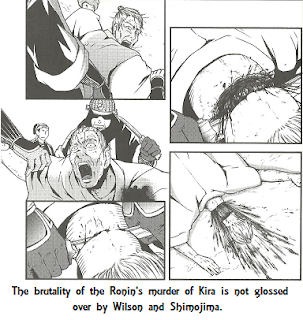 Many works dealing with the 47 Ronin tend to be bloodless affairs, concentrating on the ‘glory’ of the assault and glossing over the violence that was a part of it. Kira’s murder and Asano’s seppuku usually take place ‘off-screen’ or are not described in anything but the most general terms. Not so here. They’re depicted in all their ugliness, giving this version of the story a more visceral impact that tends to rip away more of the fairy tale aspect of the story and make it much more realistic. When stripped to its essentials, the tale of the Ronin is nothing more than the tragic retaliatory murder of a largely blameless old man (described by historian James McMullen as an '...atavistic, violent, and futile incident' involving '...reductive morality and brittle sense of honor that sanctioned such pointless sacrifice'), and nothing brings this home more than Oishi’s beheading of Kira.
For the most part the tale flows smoothly from one incident to another, although there is a bit of a rough transition from a scene between Kira and Asano to Asano’s later assault on Kira in Edo castle. It comes across as one incident, although the costuming and situation soon make it obvious such is not the case. Chushingura is a LONG story-kabuki plays can take days, movies several hours. Compressing everything into 150 pages or so is not an easy job, but Wilson manages to include all of the high points along with many of the sub-plots (most famously the ‘side jobs’ of the Ronin in Edo as they spy on Kira in the guise of workmen and merchants) without making things seem rushed. Dialogue takes the proper tone-a rather old-fashioned and formal way of speaking that reflects as best as it can in English the tone that a samurai would be employing in everyday speech.
 Artist Shimojima Akiko’s black and white artwork is a breath of fresh air, showing an excellent level of accurate cultural and historical detail that was lacking in the Dark Horse version of the Ronin. In our opinion, it’s also far more suited to this serious story than the more whimsical and cartoonish artwork featured in the Dark Horse effort. Her double splash page spread of Edo Castle (home of the Shogun and the setting for Asano’s assault) is a perfect example, showing a grasp of Edo period Japanese architecture and castle layout that evades most artists in the West (many of whom seemingly take their cues from Chinese Wuxia films). It gives the story an authentic air that helps the reader to immerse themselves in the story rather than distract them.
As well as technical ability, she also displays a subtle touch, such as several illustrations of a spider in its web slowly being revealed as being over Asano’s shoulder-a nice bit of symbolism. The simple look of heartfelt hurt on the face of Oishi’s young daughter as he disowns her is heartbreaking. While Shimojima’s depiction of the Ronin’s assault on Kira’s mansion is done in the best frenetic manga style, there are quiet moments interspaced-such as when Kira’s chief retainer is struck down and his essence slowly drifts into the sky. For him, this battle is over and no longer matters. It imparts the sense of the transitory and impermanent nature of things inherent in Buddhism. Interestingly, this concept is stood on its head in the final scene, where the dying body of the Satsuma Man fades away to show a modern family paying homage to the Ronin’s graves at Sengakuji. While the body might pass on, the legend continues to live in perpetuity.
Shimojima also does her best to make the individual characters identifiable. The Shogun’s court stressed conformity and standardization (one reason Asano needed instruction in the highly intricate and detailed sphere of court etiquette). Hairstyles were also tightly regulated. This means that everyone had a rather generic look. Shimojima manages within this context to give cues to the reader-the differing crests on the formal kataginu, small differences in hairstyles, the shading and patterns of clothes, even things as subtle as eyebrow thickness all help in picking out the key players. It also rewards sharp-eyed readers who can spot characters from earlier in the story showing up later.
One mild criticism of the book is that it would have benefited from a short text piece such as was included in Wilson’s two other graphic novels for Shambhala. Many cultural and historical issues that Western audiences might find confusing could have been explained here, such as why Asano became homicidal when asked to tie the ribbon on Kira’s sock or why Oishi would have been so brutal in dealing with his wife (casting her out meant his family would not be held responsible for his actions and punished). Why do all in the samurai in the castle have ‘pants’ on that are twice as long as their legs (this was used to keep them from moving quickly and designed to forestall possible assassination attempts on the Shogun)? It also could have been used to give more background on the historical incident.
So if you’re looking for an adaptation of the Chushingura legend that sticks to the story and doesn’t include fantasy monsters, witches, giants, or gaijin actors shoehorned into the tale, you won’t find a better executed one than Wilson’s and Shimojima’s “The 47 Ronin”. It’s an adaptation that manages to infuse both the Ronin and their foes with humanity. Author Wilson makes you feel Asano’s outrage, Kira’s panic, the conflicting views of Asano’s retainers, and the excitement of the raid. Artist Shimojima gives us a period-accurate Japan laced with dynamic action and quiet moments in turn. They’ve taken what is often depicted as a morality tale filled with two dimensional characters and given it depth and texture. During this season of the Ronin, ‘tis the book ye be looking for.
The 47 Ronin is available directly from Shambhala or from Amazon.
All artwork courtesy and copyright 2103 Shambhala Publications. It may not be reproduced, in any form or by any means, electronic or mechanical, including photocopying, recording, or by any information storage and retrieval system, without permission in writing from the publisher.
Recently on the Samurai Archives Forum, there was a discussion about making the myth of the ninja the subject of a future podcast. Part of the discussion centered on just how the myths of ninja clans such as Koga and Iga came into being and the image of the black-clad super assassin found its way into Western pop culture. Writer Stephen Turnbull and 'ninjer master' Stephen K. Hayes were two popular suspects.
 Actually, the whole ninja craze in the West got started with the 1962 Japanese TV series "Onmitsu Kenshi" (Spy Swordsman), which featured the titular character fighting hordes of ninja clans through 10 seasons. It was dubbed in English and released on TV as "Shintaro The Samurai" in Australia in 1964, where it became a super smash hit on the level of the Batman TV series in America. The actor who played Shintaro (Ose Koichi) did a live action 'concert tour' of Oz and got bigger crowds than the Beatles. Kids in Oz emulated the ninja (leading to a Superman-like disclaimer that they shouldn't be trying this at home).
 Then things really caught fire with the 1967 James Bond movie "You Only Live Twice" (where Bond masterfully passed himself off as a native Japanese by getting his hair cut and having a couple of prosthetic eyelids glued on). Tiger Tanaka's sekrit ninjer organization was based in Himeji Castle. Himeji let them film on site but regretted it when the film crew started tearing up the woodwork with throwing stars-the castle had recently been completely disassembled and restored and had just reopened, and those damn ninja were tearing it up!
 Mainly because of the movie, phony ninja masters (like Hayes) began to pop up in the late 60's and 70's, spreading their crap among gullible would-be martial artists. And then the 1980 'Shogun' miniseries came along with the 'Amida Tong' (hoo boy-I've seen this cited online as an historical ninja organization) and hordes of ninjer and there was no turning back-the dam broke. It gave birth to all those Sho Kosugi movies, American Ninja, dumbass Ric Meyers and his series of ninjer novels and film disinformation, Eric Van Lustbader's execrable 'Ninja' series of novels, and oh so much more. Turnbull really just 'rode the wave' of all this.
 Historian Pierre Souyri wrote "The World Turned Upside Down" in the late 90's. It's a very well written history of Japan from the Genpei War through the end of the Sengoku. Syouri looks at all levels of society, not just what the daimyo were doing, and has a lot of info on culture,art, and politics. He includes a short chapter on how communities in the Iga area formed self-governing collectives during this time. Combined with the rough terrain and remoteness of the area, they were highly successful in doing so. As fellow mod LtDomer mentioned, it does show how the whole 'ninja clan' myth got started. In reality, they weren't much different than Ikko-shu groups minus the religious element.
So there you have it-a short examination of where all the disinformation surrounding ninja in the West got its start. Japan is obviously a major culprit in this as they too have a long tradition of fictional ninjer nonsense which both fueled the Western version and in turn was fueled by it.
Historian Pierre Souyri wrote "The World Turned Upside Down" in the late 90's. It's a very well written history of Japan from the Genpei War through the end of the Sengoku. Syouri looks at all levels of society, not just what the daimyo were doing, and has a lot of info on culture,art, and politics. He includes a short chapter on how communities in the Iga area formed self-governing collectives during this time. Combined with the rough terrain and remoteness of the area, they were highly successful in doing so. As fellow mod LtDomer mentioned, it does show how the whole 'ninja clan' myth got started. In reality, they weren't much different than Ikko-shu groups minus the religious element.
So there you have it-a short examination of where all the disinformation surrounding ninja in the West got its start. Japan is obviously a major culprit in this as they too have a long tradition of fictional ninjer nonsense which both fueled the Western version and in turn was fueled by it.
 While manga treatments of famous works of Japanese literature are common in Japan, they’re virtually unknown in the West. Part of this is due to the long-standing prejudice in Western societies that ‘comics’ are nothing more than entertainment for children. Over the past 25 years or so, the graphic novel has changed that way of thinking. While they often provide the adventures of our favorite super-heroes, they’ve also provided a venue for talented writers and artists to craft serious stories aimed squarely at adults. As the square bound graphic novel has become accepted reading matter for adults, works that one would never have imagined appearing in comics form have appeared-among those two recent black-and-white releases from Shambhala Publications. Today we’ll be examining how the ‘graphic approach’ has worked out for Musashi Miyamoto’s “The Book of Five Rings” and Chozanshi Issai’s “The Demon’s Sermon on the Martial Arts”.
 Most readers will already be familiar with swordsman Musashi Miyamoto and his famed Edo period sword treatise “The Book of Five Rings” (“Go Rin No Sho”). Using the format of the traditional five Japanese elements of earth, wind, water, fire, and emptiness (often expressed as the void or the sky), Musashi presents the thoughts behind his style of martial arts and also how they can be applied in life to virtually any situation. The ‘Earth’ chapter gives an overview of the martial arts and weaponry in general. Musashi explains the techniques and philosophy of his style, ‘Niten Ichi-ryu’ (‘two heavens as one’, the famous two swords style), in ‘Water’. Warfare (as opposed to dueling) is the subject of ‘Fire’. The shortcomings of other sword styles as Musashi sees them are presented in ‘Wind’. The proper frame of mind for learning comprises the final chapter, ‘Emptiness’. We’ll give some thoughts on Musashi’s work itself before we look at how it is affected by being put into comics form.
While Musashi claims that he “…neither borrowed the ancient words of Buddhism or Confucianism”, he did indeed borrow heavily from their concepts-Buddhism in particular, using the idea of ‘attachment’ as its core. Over and over he stresses that one should strive to make their mind free of attachments-in effect, to be able to adapt quickly and easily to any situation. Whether it’s your opponent, his weapon, his style, the environment, one should never dwell on one aspect but rather open your mind and take everything in. The esoteric Buddhist ideal of ‘enlightenment’ coming from one’s own efforts (rather than being contingent on a holy being) is reflected by Musashi’s exhortations to “See everything for yourself” and “you should investigate this thoroughly”.
The text also tells us much about the realities and practical nature of the samurai. Musashi doesn’t fill his work with glowing words about honor and bushido-it stresses that the entire point of combat is not to fight honorably but to win, using whatever means possible. Far from considering guns a ‘coward’s weapon’, Musashi proclaims them the ultimate weapon for a castle defense and on an open battlefield before closing with the enemy. He stresses that every weapon has its benefits and drawbacks and one should learn to master them all. The role of the sword in peacetime Edo is stressed when Musashi proclaims “it is by virtue of the sword that both society and oneself are put in order”. As warfare and its weapons disappeared from the life of the samurai, they increasingly began to infuse their sword training with concepts borrowed from Buddhism and Confucianism to enrich their spiritual life and change their focus to civilian administration (the idea of turning away from the ‘death-giving sword’ to the ‘life-giving sword’, the subject of an upcoming review we’ll be doing). This spiritual aspect was a very real part of Edo period sword training as explained by historian Karl Friday in an interview he did with the SA. Surprisingly, Musashi has contempt for most formal martial arts, denigrating them as promoting ‘style over substance’, being overly concerned with making themselves saleable and raking in money, and limiting their students to a single technique (sounds a lot like he was speaking of many modern martial arts schools, doesn’t it?).
Most readers will already be familiar with swordsman Musashi Miyamoto and his famed Edo period sword treatise “The Book of Five Rings” (“Go Rin No Sho”). Using the format of the traditional five Japanese elements of earth, wind, water, fire, and emptiness (often expressed as the void or the sky), Musashi presents the thoughts behind his style of martial arts and also how they can be applied in life to virtually any situation. The ‘Earth’ chapter gives an overview of the martial arts and weaponry in general. Musashi explains the techniques and philosophy of his style, ‘Niten Ichi-ryu’ (‘two heavens as one’, the famous two swords style), in ‘Water’. Warfare (as opposed to dueling) is the subject of ‘Fire’. The shortcomings of other sword styles as Musashi sees them are presented in ‘Wind’. The proper frame of mind for learning comprises the final chapter, ‘Emptiness’. We’ll give some thoughts on Musashi’s work itself before we look at how it is affected by being put into comics form.
While Musashi claims that he “…neither borrowed the ancient words of Buddhism or Confucianism”, he did indeed borrow heavily from their concepts-Buddhism in particular, using the idea of ‘attachment’ as its core. Over and over he stresses that one should strive to make their mind free of attachments-in effect, to be able to adapt quickly and easily to any situation. Whether it’s your opponent, his weapon, his style, the environment, one should never dwell on one aspect but rather open your mind and take everything in. The esoteric Buddhist ideal of ‘enlightenment’ coming from one’s own efforts (rather than being contingent on a holy being) is reflected by Musashi’s exhortations to “See everything for yourself” and “you should investigate this thoroughly”.
The text also tells us much about the realities and practical nature of the samurai. Musashi doesn’t fill his work with glowing words about honor and bushido-it stresses that the entire point of combat is not to fight honorably but to win, using whatever means possible. Far from considering guns a ‘coward’s weapon’, Musashi proclaims them the ultimate weapon for a castle defense and on an open battlefield before closing with the enemy. He stresses that every weapon has its benefits and drawbacks and one should learn to master them all. The role of the sword in peacetime Edo is stressed when Musashi proclaims “it is by virtue of the sword that both society and oneself are put in order”. As warfare and its weapons disappeared from the life of the samurai, they increasingly began to infuse their sword training with concepts borrowed from Buddhism and Confucianism to enrich their spiritual life and change their focus to civilian administration (the idea of turning away from the ‘death-giving sword’ to the ‘life-giving sword’, the subject of an upcoming review we’ll be doing). This spiritual aspect was a very real part of Edo period sword training as explained by historian Karl Friday in an interview he did with the SA. Surprisingly, Musashi has contempt for most formal martial arts, denigrating them as promoting ‘style over substance’, being overly concerned with making themselves saleable and raking in money, and limiting their students to a single technique (sounds a lot like he was speaking of many modern martial arts schools, doesn’t it?).
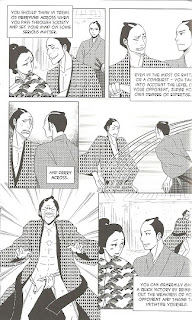 “The Book of Five Rings” is far from the only sword treatise penned by an itinerant swordsman during the Edo period, but it’s certainly the most famous, aided immensely by Musashi becoming famous through his exposure in Yoshikawa’s Eiji’s 1930’s novel ’Musashi’. One often hears of it being used by Japanese sararimen to find success in business as well as life. Is there any justification for this? Insofar as Musashi points out that the concepts behind his philosophy can be applied to any job or career, sure. Hard work, constant practice, a hands on style, an aggressive (but not careless) attitude, and above all, adaptability to changing circumstances will help to make one successful in virtually any endeavor. These values are certainly not limited to the martial arts, nor are the Buddhist and Confucian concepts behind them. However, we suppose it’s as good a place to learn them as any-and as shown here, you can even use the sword techniques to impress the chicks!
Sean Michael Wilson is the writer responsible for adapting Musashi’s work into graphic novel form (based on William Scott Wilson’s translation). Displaying a great deal of respect for and knowledge of the original work, he has managed to boil it down to its essentials. Some concepts just don’t lend themselves to visual form, but here the text is greatly enriched by the illustrations. It would be interesting to find out how closely Wilson worked with the artist and how much of the symbolism and visualizations came from him. We’re guessing it was the majority. The finished work is multilayered and will yield greater insights with each reading. In fact, it DEMANDS to be reread. Make no mistake, this is no simple comic that can easily be blown through in a few minutes and then forgotten.
The only complaint from a historical standpoint one might have is that Musashi is usually rendered as a clean, well groomed samurai, not the filthy, unkempt ‘vagabond’ he was for most of his years. However, as he is shown during his time as a vassal of the Hosokawa, one would imagine that he would have been far better tricked out than he was in his years on the road. Otherwise, illustrator Kutsuwada Chie’s artwork is a perfect example of the style being well suited for the work. Her stark, high contrast visuals veer towards the angular and are filled with strong vertical, horizontal, and diagonal lines. This lends itself well to conveying Musashi’s highly aggressive and direct approach to life and the philosophy behind it. It also matches the simple, Spartan lifestyle he enjoyed. The synergy between adapter Wilson and the artist is also in evidence as well. One of our favorite sections is in the ‘Emptiness’ chapter. While Musashi carves an unseen image, he summarizes his approach to the martial arts (and by extension, life) and the true meaning of the ‘heart of emptiness’. Panels of emptiness begin to pop into his explanations, increasing in frequency along with the reader’s understanding. Finally, there is nothing left but ‘emptiness’ after Musashi exhorts his reader to “make emptiness the way and see the way as emptiness”.
“The Book of Five Rings” is far from the only sword treatise penned by an itinerant swordsman during the Edo period, but it’s certainly the most famous, aided immensely by Musashi becoming famous through his exposure in Yoshikawa’s Eiji’s 1930’s novel ’Musashi’. One often hears of it being used by Japanese sararimen to find success in business as well as life. Is there any justification for this? Insofar as Musashi points out that the concepts behind his philosophy can be applied to any job or career, sure. Hard work, constant practice, a hands on style, an aggressive (but not careless) attitude, and above all, adaptability to changing circumstances will help to make one successful in virtually any endeavor. These values are certainly not limited to the martial arts, nor are the Buddhist and Confucian concepts behind them. However, we suppose it’s as good a place to learn them as any-and as shown here, you can even use the sword techniques to impress the chicks!
Sean Michael Wilson is the writer responsible for adapting Musashi’s work into graphic novel form (based on William Scott Wilson’s translation). Displaying a great deal of respect for and knowledge of the original work, he has managed to boil it down to its essentials. Some concepts just don’t lend themselves to visual form, but here the text is greatly enriched by the illustrations. It would be interesting to find out how closely Wilson worked with the artist and how much of the symbolism and visualizations came from him. We’re guessing it was the majority. The finished work is multilayered and will yield greater insights with each reading. In fact, it DEMANDS to be reread. Make no mistake, this is no simple comic that can easily be blown through in a few minutes and then forgotten.
The only complaint from a historical standpoint one might have is that Musashi is usually rendered as a clean, well groomed samurai, not the filthy, unkempt ‘vagabond’ he was for most of his years. However, as he is shown during his time as a vassal of the Hosokawa, one would imagine that he would have been far better tricked out than he was in his years on the road. Otherwise, illustrator Kutsuwada Chie’s artwork is a perfect example of the style being well suited for the work. Her stark, high contrast visuals veer towards the angular and are filled with strong vertical, horizontal, and diagonal lines. This lends itself well to conveying Musashi’s highly aggressive and direct approach to life and the philosophy behind it. It also matches the simple, Spartan lifestyle he enjoyed. The synergy between adapter Wilson and the artist is also in evidence as well. One of our favorite sections is in the ‘Emptiness’ chapter. While Musashi carves an unseen image, he summarizes his approach to the martial arts (and by extension, life) and the true meaning of the ‘heart of emptiness’. Panels of emptiness begin to pop into his explanations, increasing in frequency along with the reader’s understanding. Finally, there is nothing left but ‘emptiness’ after Musashi exhorts his reader to “make emptiness the way and see the way as emptiness”.
 We now move on from the practical world of Musashi to a whimsical world of demons and talking animals in “The Demon’s Sermon on the Martial Arts” (“Tengu Geijutson”). The author of this Edo period work was (the pen name of Niwa Tadaaki), a samurai from Sekiyado han in Shimosa province. Chozanshi, while interested in swordsmanship, was primarily known as a bunjin (what we’d call a ‘man of letters’ in the West). “Demon’s Sermon” is actually somewhat of a compilation of two of his efforts-the title work along with a selection of short stories from his “Inaka Soshi” (The Hayseed Taoist). These stories, despite the book’s title, are far more concerned with Buddhist and Confucian concepts than the techniques and execution of swordsmanship (most of the martial arts discussion takes place between the tengu).
 The story revolves around a young would-be swordsman who ventures into the deep woods to seek the instruction of the tengu, the mythical bird-men of Japan who were said to have instructed the legendary hero Minamoto no Yoshitsune in the ways of warfare. Coming across a group of them holding a discussion in a tree, he settles in to eavesdrop and benefit from their wisdom. The title is somewhat of a misnomer-tengu aren’t demons in the Western sense of the word (that being malevolent beings or spirits from Hell) but more like ‘forest spirits’. Wilson here chooses to break “The Demon’s Sermon” into several parts and use it as a framework to structure the shorter stories. This allows the short stories to reinforce and expand upon the concepts brought up by the tengu, as well as letting the tengu introduce the concepts to be spotlighted in the short stories. An interesting choice by Wilson, it helps to tie the work together as a unified whole rather than a series of stories. Many of the ideas are the same as those looked at by Musashi in “Five Rings”, again showing how Buddhist and Confucian ideals found their way into sword training. The tengu discuss the concept of no-mind or emptiness, using your chi (the energy that flows through everything) correctly, the importance of practice and discipline, and how adaptability and lack of attachment are vital. Humorously, the tengu also find most martial arts schools to be lacking in their instruction with too great an emphasis on rigid technique.
 The short stories are primarily Buddhist parables told through the eyes of a variety of talking animals. Using animals to illustrate life lessons is a well-known aspect of Western storytelling, and it was the same in Japan. Yose (storytelling) theater was quite popular in the Edo period and many of its stories were exactly like the selections included in “Demon’s Sermon”. Included are Transformation of the Sparrow and the Butterfly, Meeting the Gods of Poverty in a Dream, The Greatest Joys of the Cicada and Its Cast-Off Shell, The Owl’s Understanding, The Centipede Questions the Snake, The Toad’s Way of the Gods, and The Mysterious Technique of the Cat. The animals (for the most part not goofy looking anamorphic creatures but what they look like in nature) delve into matters such as being content with one’s station in life, the impermanent nature of all things, the shortcomings of learned technique, and again, the importance of being able to adapt to changing circumstances. The most well-known story of the bunch is The Mysterious Technique of the Cat. When an exceptionally gifted rat invades the ramshackle home of a ronin, the rodent proves itself to be a superior foe, evading all attempts to capture or kill it. When even the most talented mousers in the area fall to the rat’s vicious attacks, it falls to an enfeebled older cat to confront the rat. It defeats it effortlessly to the amazement of all, leading to pleas from the other cats for an explanation of his amazing technique. And as will be of no surprise to readers of the other stories, he accomplished it by using ‘no technique’. Parables such as this were intended to make somewhat complex Buddhist concepts relatable and understandable to commoners and were a large part of the repertoire of traveling monks and priests. From a sociological standpoint they also were a way for the monks and samurai to make the peasants happy with their social status and not try to better their positions by rebelling against those above them.
Wilson’s presentation of the stories (again, based on a translation by William Scott Wilson) is excellent. As previously mentioned, the narrative flows smoothly from one tale to the next, and the center point of each is brought out in a subtle and effective manner. There’s a fine line between simplifying things to the point of making them kid’s stories and making them so complex as to defy comprehension, and Wilson navigates it well. The book is warmer, charming, and more endearing than “Five Rings”. How could it not be with all those talking animals? Wilson allows their personalities and foibles to shine through rather than just make them into another ‘Musashi’. As with “Five Rings”, readers will be rewarded with greater insight on each reading.
“Demon’s Sermon” employs a different illustrator than “Five Rings”, but one that is every bit as suited to the subject matter. Morikawa Michiru’s artwork is softer, more detailed, and employs more elaborate shading. It’s perfect for the Buddhist and Confucian concepts being expounded. It also helps to make the talking animals, insects, and demons in the story to be as natural and acceptable to the reader as the humans. Morikawa excels at infusing her work with subtle symbolism, as when a battle between a rat and a cat forms a classic Taoist taijitu (the ‘yin-yang’ symbol). We also enjoyed how Morikawa gave each of the tengu a distinctly different look, reflecting how the concepts and depictions of tengu in Japanese art varied throughout the centuries.
Both graphic novels also contain afterwords by William Scott Wilson (the well-known scholar and writer who did the translations of the original Japanese language texts). His comments give well thought-out examinations of the characters of original authors Musashi and Chozanshi, as well as helping clarify and structure some of the points brought out in the texts. While afterwords in books often have little of substance to add, readers should definitely take the time to peruse these.
Shambhala Publications is to be complimented for their support of this non-traditional format for very traditional and serious texts. There are more graphic novels in the works, and one in particular has caught our interest-a treatment of the 47 Ronin, due out in November. Again featuring Sean Wilson at the helm, it features artwork by Shimojima Akiko and states without reservation that it will be “a historically factual portrait”, “accurate and …compelling”, and featuring characters that are “nuanced and relatable”. This would be a welcome development, particularly in the wake of Dark Horse’s recent botched attempt at presenting the story in comics form. We have to admit to being skeptical that the end result will indeed stick to the historical facts and not mirror the fictional Chushingura version of the Ako ronin. However, based on the excellent job Wilson has done to date, if anyone can pull it off, he can.
While both books are condensed versions of the originals, the artwork in effect makes them an expanded version, helping to underscore the original text and also to bring out new facets of these classic works. They’ll be of interest to many fields in pre-modern Japanese studies-religious studies, martial arts, philosophy, and culture. Serious and well thought out adaptations, they illustrate how the right creators paired with timeless source material can utilize the comics/manga format to enhance an existing work (rather than simply dumb it down for the purposes of creating disposable entertainment). This ‘graphic approach’ to Musashi and demons will hopefully introduce these classic works to a new audience as well as breathe life into them for the old one. After reading these two works we’ll co-opt one of Musashi’s sentiments and say “You should investigate (these) thoroughly”.
You can pick “Five Rings” and “Demon’s Sermon” directly from Shambhala or from Amazon via the SA Store.
All artwork courtesy and copyright 2012/2103 Shambhala Publications. It may not be reproduced, in any form or by any means, electronic or mechanical, including photocopying, recording, or by any information storage and retrieval system, without permission in writing from the publisher.
The short stories are primarily Buddhist parables told through the eyes of a variety of talking animals. Using animals to illustrate life lessons is a well-known aspect of Western storytelling, and it was the same in Japan. Yose (storytelling) theater was quite popular in the Edo period and many of its stories were exactly like the selections included in “Demon’s Sermon”. Included are Transformation of the Sparrow and the Butterfly, Meeting the Gods of Poverty in a Dream, The Greatest Joys of the Cicada and Its Cast-Off Shell, The Owl’s Understanding, The Centipede Questions the Snake, The Toad’s Way of the Gods, and The Mysterious Technique of the Cat. The animals (for the most part not goofy looking anamorphic creatures but what they look like in nature) delve into matters such as being content with one’s station in life, the impermanent nature of all things, the shortcomings of learned technique, and again, the importance of being able to adapt to changing circumstances. The most well-known story of the bunch is The Mysterious Technique of the Cat. When an exceptionally gifted rat invades the ramshackle home of a ronin, the rodent proves itself to be a superior foe, evading all attempts to capture or kill it. When even the most talented mousers in the area fall to the rat’s vicious attacks, it falls to an enfeebled older cat to confront the rat. It defeats it effortlessly to the amazement of all, leading to pleas from the other cats for an explanation of his amazing technique. And as will be of no surprise to readers of the other stories, he accomplished it by using ‘no technique’. Parables such as this were intended to make somewhat complex Buddhist concepts relatable and understandable to commoners and were a large part of the repertoire of traveling monks and priests. From a sociological standpoint they also were a way for the monks and samurai to make the peasants happy with their social status and not try to better their positions by rebelling against those above them.
Wilson’s presentation of the stories (again, based on a translation by William Scott Wilson) is excellent. As previously mentioned, the narrative flows smoothly from one tale to the next, and the center point of each is brought out in a subtle and effective manner. There’s a fine line between simplifying things to the point of making them kid’s stories and making them so complex as to defy comprehension, and Wilson navigates it well. The book is warmer, charming, and more endearing than “Five Rings”. How could it not be with all those talking animals? Wilson allows their personalities and foibles to shine through rather than just make them into another ‘Musashi’. As with “Five Rings”, readers will be rewarded with greater insight on each reading.
“Demon’s Sermon” employs a different illustrator than “Five Rings”, but one that is every bit as suited to the subject matter. Morikawa Michiru’s artwork is softer, more detailed, and employs more elaborate shading. It’s perfect for the Buddhist and Confucian concepts being expounded. It also helps to make the talking animals, insects, and demons in the story to be as natural and acceptable to the reader as the humans. Morikawa excels at infusing her work with subtle symbolism, as when a battle between a rat and a cat forms a classic Taoist taijitu (the ‘yin-yang’ symbol). We also enjoyed how Morikawa gave each of the tengu a distinctly different look, reflecting how the concepts and depictions of tengu in Japanese art varied throughout the centuries.
Both graphic novels also contain afterwords by William Scott Wilson (the well-known scholar and writer who did the translations of the original Japanese language texts). His comments give well thought-out examinations of the characters of original authors Musashi and Chozanshi, as well as helping clarify and structure some of the points brought out in the texts. While afterwords in books often have little of substance to add, readers should definitely take the time to peruse these.
Shambhala Publications is to be complimented for their support of this non-traditional format for very traditional and serious texts. There are more graphic novels in the works, and one in particular has caught our interest-a treatment of the 47 Ronin, due out in November. Again featuring Sean Wilson at the helm, it features artwork by Shimojima Akiko and states without reservation that it will be “a historically factual portrait”, “accurate and …compelling”, and featuring characters that are “nuanced and relatable”. This would be a welcome development, particularly in the wake of Dark Horse’s recent botched attempt at presenting the story in comics form. We have to admit to being skeptical that the end result will indeed stick to the historical facts and not mirror the fictional Chushingura version of the Ako ronin. However, based on the excellent job Wilson has done to date, if anyone can pull it off, he can.
While both books are condensed versions of the originals, the artwork in effect makes them an expanded version, helping to underscore the original text and also to bring out new facets of these classic works. They’ll be of interest to many fields in pre-modern Japanese studies-religious studies, martial arts, philosophy, and culture. Serious and well thought out adaptations, they illustrate how the right creators paired with timeless source material can utilize the comics/manga format to enhance an existing work (rather than simply dumb it down for the purposes of creating disposable entertainment). This ‘graphic approach’ to Musashi and demons will hopefully introduce these classic works to a new audience as well as breathe life into them for the old one. After reading these two works we’ll co-opt one of Musashi’s sentiments and say “You should investigate (these) thoroughly”.
You can pick “Five Rings” and “Demon’s Sermon” directly from Shambhala or from Amazon via the SA Store.
All artwork courtesy and copyright 2012/2103 Shambhala Publications. It may not be reproduced, in any form or by any means, electronic or mechanical, including photocopying, recording, or by any information storage and retrieval system, without permission in writing from the publisher.


