 December has always been the month where the 47 Ronin enter the stream of modern Japanese consciousness. The assault by the Ronin on Lord Kira’s estate took place on the “fourteenth day of the twelfth month” in the year of Genroku 15. While this actually corresponds to January 30th of the Western calendar, the Japanese have traditionally recognized it on December 14th. The Ronin appear in commercials, special events and observances are held at Sengakuji Temple (where the Ronin’s graves are located), and the airwaves tend to screen a goodly number of the dozens of TV shows and movies that have depicted the event over the decades. And this year, the Ronin will be making their presence felt in December in the West. Most obvious is the big-budget fantasy film “47 Ronin” starring Keanu Reeves that will be making its US debut Christmas day. Filled with CGI monsters and having little to do with the real 47 Ronin, it remains to be seen how the movie going public will react to it. But Shambhala Publications has also recently released a graphic novel version of the traditional 47 Ronin tale, just in time to join the festivities. The team of writer Sean Michael Wilson and artist Shimojima Akiko (along with letterer Ben Dickson) have combined to put together an adaptation of Chushingura (roughly ‘treasury of loyal retainers’, the fictional account of the historical incident that has been the subject of hundreds of kabuki plays, puppet plays, films, manga, novels, and artwork over the centuries) that exceeds anything yet done in the West (including the recent failed Dark Horse adaptation). It’s a solid adaptation that faithfully brings out the story’s many facets, perfectly complimented by accurate, simple, and clean artwork.
One issue that needs to be addressed up front is the press releases/publicity for the book. While the full versions make it clear that the graphic novel is a depiction of Chushingura (the heavily fictionalized account of the 47 Ronin incident that became popular in Edo period Japan), the shorter versions only state that it’s “…the first historically accurate graphic-novel version of a legendary event in Japanese history”. Just to be clear, the graphic novel is indeed based on the Chushingura legend, not the facts of the historical incident. Since we’ve examined these differences at length in other articles, we’ll just touch on them here. Some of the more important differences between Chushingura and actual history include:
-Chushingura contains many fictional characters, such as Kamei and ‘Urata from Satsuma’ AKA the Satsuma man.
-it also contains many fictional incidents-for example, after the assault, the Ronin pass through the streets of Edo stopping to be praised and feted by the populace. They actually moved expeditiously to their final goal of Sengakuji Temple as they feared an assault by the Uesugi and certainly weren't being embraced by the townspeople.
-Asano is shown in Chushingura as the embodiment of samurai values and virtue, whereas in real life he was a drunken womanizer with no skills to speak of (as we like to say, the 'Brick McBurly of his day').
-Oishi (the leader of the Ronin) is depicted as a loyal and brilliant retainer, but was also a man of few skills aside from drinking and procuring women for Asano.
-Kira Yoshihisa (often referred to as ‘Yoshinaka’) is shown as a grasping, greedy villain but there is no historical evidence to support it. He was more of a typical bakufu bureaucrat.
-Asano Naganori’s assault is provoked by Kira’s greed and rudeness, but the truth is that no one has a clue why he did it.
-the Ronin are shown in Chushingura to be taking great care to take no innocent lives, but during the assault they slaughtered many of Kira’s household staff.
 There are lots more differences-if you’re interested, you can read about them here, here, or here. We’re also assuming our readership is acquainted with the general details of the 47 Ronin-but if not, here’s the ‘Cliffs Notes’ version. Asano Naganori, daimyo of Ako han, was assigned to study court etiquette under the tutelage of Kira Yoshihisa in order to attend Imperial envoys visiting the Shogun’s court. For some unknown reason (rudeness on Kira’s part due to not being bribed? Resentment over being properly chastised on Asano’s part?), Asano attacked Kira with his sword inside the Shogun’s Edo Castle-an act punishable by death. Asano was forced to commit ritual suicide, his lands were confiscated, and his family and retainers turned out. 47 of these retainers banded together and a year or so later assaulted Kira’s mansion, in effect ‘finishing Asano’s work’, killing Kira in what amounted to a feudal drive-by. But let’s get to the graphic novel…
Author Sean Michael Wilson sticks closely to the traditional accounts, not embellishing the Ronin with further exploits or fawning hero worship. This being the case, Kira is the villain, Asano a victim, and the Ronin are the true heroes of the story. Unlike many Western authors, however, Wilson doesn’t omit some of the darker threads of the old legends that are often dropped. One of these is Oishi’s implied criticism of Asano-“I hope I can be allowed to express some doubt as to the wisdom of our Lord’s actions. But it is done now and we must act well. If the Shogun will allow Asano Daigaku to become the new Lord, then we can continue the house with honor”. This short discourse brings an entirely new dimension to the Ronin’s vendetta, and is further embellished by Wilson presenting it as a conversation between the two factions of the Ako Ronin. In a little over two pages, much is explained. The feuding factions of the Ronin (the radicals led by Horibe Yasubei who wanted to kill Kira at once and Oishi’s moderates who only wanted the Asano family to remain in control of Ako) that almost resulted in the assault being called off, the waiting period of a year between Asano’s suicide and the raid (not because the Ronin were trying to lull Kira’s suspicions, but because they were waiting on the Shogun’s decision), the question of whether the Ronin were truly loyal to Asano Naganori or just to their positions within the house of Asano-they’re set up effortlessly and subtly. The Ronin’s callous manipulation of women and employers, and the cruelty of Oishi’s rejection of his wife and family (albeit for a good reason) are shown for all to see. By not editing these incidents from the proceedings, Wilson manages to turn the Ronin from cardboard heroes into human beings with realistic motivations and feelings. It’s also closer to real history, as most historians believe the Ronin acted to preserve their individual honor rather than out of any loyalty to Asano (who the majority had never even met). Even some of Kira’s retainers are allowed their moment to shine, with a small group of three holding back the Ronin.
Also given time to develop is the friendship between ‘Kamei-sama’ and Asano. Traditionally, Kamei is shown as the real hothead of the pair and is only saved from Asano’s fate by the quick thinking of two of his retainers (behind Kamei’s back, they bribe Kira, ending his verbal abuse of Kamei). Wilson depicts Asano’s efforts to connect with Kamei in an effort to keep him from assaulting their teacher. The friendship between the two daimyo again helps to make them believable, and as Kira turns the full of his scorn on Asano, it makes Asano’s transition from the voice of reason to unbridled rage all the more shocking and unexpected. Combined with the graphic portrayal of his seppuku (ritual suicide), it makes him a far more sympathetic character. This Asano is not perfect, but one can understand his frustration, confusion, and anger.
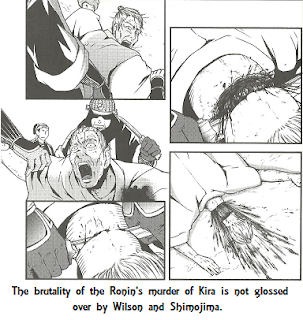 Many works dealing with the 47 Ronin tend to be bloodless affairs, concentrating on the ‘glory’ of the assault and glossing over the violence that was a part of it. Kira’s murder and Asano’s seppuku usually take place ‘off-screen’ or are not described in anything but the most general terms. Not so here. They’re depicted in all their ugliness, giving this version of the story a more visceral impact that tends to rip away more of the fairy tale aspect of the story and make it much more realistic. When stripped to its essentials, the tale of the Ronin is nothing more than the tragic retaliatory murder of a largely blameless old man (described by historian James McMullen as an '...atavistic, violent, and futile incident' involving '...reductive morality and brittle sense of honor that sanctioned such pointless sacrifice'), and nothing brings this home more than Oishi’s beheading of Kira.
For the most part the tale flows smoothly from one incident to another, although there is a bit of a rough transition from a scene between Kira and Asano to Asano’s later assault on Kira in Edo castle. It comes across as one incident, although the costuming and situation soon make it obvious such is not the case. Chushingura is a LONG story-kabuki plays can take days, movies several hours. Compressing everything into 150 pages or so is not an easy job, but Wilson manages to include all of the high points along with many of the sub-plots (most famously the ‘side jobs’ of the Ronin in Edo as they spy on Kira in the guise of workmen and merchants) without making things seem rushed. Dialogue takes the proper tone-a rather old-fashioned and formal way of speaking that reflects as best as it can in English the tone that a samurai would be employing in everyday speech.
 Artist Shimojima Akiko’s black and white artwork is a breath of fresh air, showing an excellent level of accurate cultural and historical detail that was lacking in the Dark Horse version of the Ronin. In our opinion, it’s also far more suited to this serious story than the more whimsical and cartoonish artwork featured in the Dark Horse effort. Her double splash page spread of Edo Castle (home of the Shogun and the setting for Asano’s assault) is a perfect example, showing a grasp of Edo period Japanese architecture and castle layout that evades most artists in the West (many of whom seemingly take their cues from Chinese Wuxia films). It gives the story an authentic air that helps the reader to immerse themselves in the story rather than distract them.
As well as technical ability, she also displays a subtle touch, such as several illustrations of a spider in its web slowly being revealed as being over Asano’s shoulder-a nice bit of symbolism. The simple look of heartfelt hurt on the face of Oishi’s young daughter as he disowns her is heartbreaking. While Shimojima’s depiction of the Ronin’s assault on Kira’s mansion is done in the best frenetic manga style, there are quiet moments interspaced-such as when Kira’s chief retainer is struck down and his essence slowly drifts into the sky. For him, this battle is over and no longer matters. It imparts the sense of the transitory and impermanent nature of things inherent in Buddhism. Interestingly, this concept is stood on its head in the final scene, where the dying body of the Satsuma Man fades away to show a modern family paying homage to the Ronin’s graves at Sengakuji. While the body might pass on, the legend continues to live in perpetuity.
Shimojima also does her best to make the individual characters identifiable. The Shogun’s court stressed conformity and standardization (one reason Asano needed instruction in the highly intricate and detailed sphere of court etiquette). Hairstyles were also tightly regulated. This means that everyone had a rather generic look. Shimojima manages within this context to give cues to the reader-the differing crests on the formal kataginu, small differences in hairstyles, the shading and patterns of clothes, even things as subtle as eyebrow thickness all help in picking out the key players. It also rewards sharp-eyed readers who can spot characters from earlier in the story showing up later.
One mild criticism of the book is that it would have benefited from a short text piece such as was included in Wilson’s two other graphic novels for Shambhala. Many cultural and historical issues that Western audiences might find confusing could have been explained here, such as why Asano became homicidal when asked to tie the ribbon on Kira’s sock or why Oishi would have been so brutal in dealing with his wife (casting her out meant his family would not be held responsible for his actions and punished). Why do all in the samurai in the castle have ‘pants’ on that are twice as long as their legs (this was used to keep them from moving quickly and designed to forestall possible assassination attempts on the Shogun)? It also could have been used to give more background on the historical incident.
So if you’re looking for an adaptation of the Chushingura legend that sticks to the story and doesn’t include fantasy monsters, witches, giants, or gaijin actors shoehorned into the tale, you won’t find a better executed one than Wilson’s and Shimojima’s “The 47 Ronin”. It’s an adaptation that manages to infuse both the Ronin and their foes with humanity. Author Wilson makes you feel Asano’s outrage, Kira’s panic, the conflicting views of Asano’s retainers, and the excitement of the raid. Artist Shimojima gives us a period-accurate Japan laced with dynamic action and quiet moments in turn. They’ve taken what is often depicted as a morality tale filled with two dimensional characters and given it depth and texture. During this season of the Ronin, ‘tis the book ye be looking for.
The 47 Ronin is available directly from Shambhala or from Amazon.
All artwork courtesy and copyright 2103 Shambhala Publications. It may not be reproduced, in any form or by any means, electronic or mechanical, including photocopying, recording, or by any information storage and retrieval system, without permission in writing from the publisher.
 While manga treatments of famous works of Japanese literature are common in Japan, they’re virtually unknown in the West. Part of this is due to the long-standing prejudice in Western societies that ‘comics’ are nothing more than entertainment for children. Over the past 25 years or so, the graphic novel has changed that way of thinking. While they often provide the adventures of our favorite super-heroes, they’ve also provided a venue for talented writers and artists to craft serious stories aimed squarely at adults. As the square bound graphic novel has become accepted reading matter for adults, works that one would never have imagined appearing in comics form have appeared-among those two recent black-and-white releases from Shambhala Publications. Today we’ll be examining how the ‘graphic approach’ has worked out for Musashi Miyamoto’s “The Book of Five Rings” and Chozanshi Issai’s “The Demon’s Sermon on the Martial Arts”.
 Most readers will already be familiar with swordsman Musashi Miyamoto and his famed Edo period sword treatise “The Book of Five Rings” (“Go Rin No Sho”). Using the format of the traditional five Japanese elements of earth, wind, water, fire, and emptiness (often expressed as the void or the sky), Musashi presents the thoughts behind his style of martial arts and also how they can be applied in life to virtually any situation. The ‘Earth’ chapter gives an overview of the martial arts and weaponry in general. Musashi explains the techniques and philosophy of his style, ‘Niten Ichi-ryu’ (‘two heavens as one’, the famous two swords style), in ‘Water’. Warfare (as opposed to dueling) is the subject of ‘Fire’. The shortcomings of other sword styles as Musashi sees them are presented in ‘Wind’. The proper frame of mind for learning comprises the final chapter, ‘Emptiness’. We’ll give some thoughts on Musashi’s work itself before we look at how it is affected by being put into comics form.
While Musashi claims that he “…neither borrowed the ancient words of Buddhism or Confucianism”, he did indeed borrow heavily from their concepts-Buddhism in particular, using the idea of ‘attachment’ as its core. Over and over he stresses that one should strive to make their mind free of attachments-in effect, to be able to adapt quickly and easily to any situation. Whether it’s your opponent, his weapon, his style, the environment, one should never dwell on one aspect but rather open your mind and take everything in. The esoteric Buddhist ideal of ‘enlightenment’ coming from one’s own efforts (rather than being contingent on a holy being) is reflected by Musashi’s exhortations to “See everything for yourself” and “you should investigate this thoroughly”.
The text also tells us much about the realities and practical nature of the samurai. Musashi doesn’t fill his work with glowing words about honor and bushido-it stresses that the entire point of combat is not to fight honorably but to win, using whatever means possible. Far from considering guns a ‘coward’s weapon’, Musashi proclaims them the ultimate weapon for a castle defense and on an open battlefield before closing with the enemy. He stresses that every weapon has its benefits and drawbacks and one should learn to master them all. The role of the sword in peacetime Edo is stressed when Musashi proclaims “it is by virtue of the sword that both society and oneself are put in order”. As warfare and its weapons disappeared from the life of the samurai, they increasingly began to infuse their sword training with concepts borrowed from Buddhism and Confucianism to enrich their spiritual life and change their focus to civilian administration (the idea of turning away from the ‘death-giving sword’ to the ‘life-giving sword’, the subject of an upcoming review we’ll be doing). This spiritual aspect was a very real part of Edo period sword training as explained by historian Karl Friday in an interview he did with the SA. Surprisingly, Musashi has contempt for most formal martial arts, denigrating them as promoting ‘style over substance’, being overly concerned with making themselves saleable and raking in money, and limiting their students to a single technique (sounds a lot like he was speaking of many modern martial arts schools, doesn’t it?).
Most readers will already be familiar with swordsman Musashi Miyamoto and his famed Edo period sword treatise “The Book of Five Rings” (“Go Rin No Sho”). Using the format of the traditional five Japanese elements of earth, wind, water, fire, and emptiness (often expressed as the void or the sky), Musashi presents the thoughts behind his style of martial arts and also how they can be applied in life to virtually any situation. The ‘Earth’ chapter gives an overview of the martial arts and weaponry in general. Musashi explains the techniques and philosophy of his style, ‘Niten Ichi-ryu’ (‘two heavens as one’, the famous two swords style), in ‘Water’. Warfare (as opposed to dueling) is the subject of ‘Fire’. The shortcomings of other sword styles as Musashi sees them are presented in ‘Wind’. The proper frame of mind for learning comprises the final chapter, ‘Emptiness’. We’ll give some thoughts on Musashi’s work itself before we look at how it is affected by being put into comics form.
While Musashi claims that he “…neither borrowed the ancient words of Buddhism or Confucianism”, he did indeed borrow heavily from their concepts-Buddhism in particular, using the idea of ‘attachment’ as its core. Over and over he stresses that one should strive to make their mind free of attachments-in effect, to be able to adapt quickly and easily to any situation. Whether it’s your opponent, his weapon, his style, the environment, one should never dwell on one aspect but rather open your mind and take everything in. The esoteric Buddhist ideal of ‘enlightenment’ coming from one’s own efforts (rather than being contingent on a holy being) is reflected by Musashi’s exhortations to “See everything for yourself” and “you should investigate this thoroughly”.
The text also tells us much about the realities and practical nature of the samurai. Musashi doesn’t fill his work with glowing words about honor and bushido-it stresses that the entire point of combat is not to fight honorably but to win, using whatever means possible. Far from considering guns a ‘coward’s weapon’, Musashi proclaims them the ultimate weapon for a castle defense and on an open battlefield before closing with the enemy. He stresses that every weapon has its benefits and drawbacks and one should learn to master them all. The role of the sword in peacetime Edo is stressed when Musashi proclaims “it is by virtue of the sword that both society and oneself are put in order”. As warfare and its weapons disappeared from the life of the samurai, they increasingly began to infuse their sword training with concepts borrowed from Buddhism and Confucianism to enrich their spiritual life and change their focus to civilian administration (the idea of turning away from the ‘death-giving sword’ to the ‘life-giving sword’, the subject of an upcoming review we’ll be doing). This spiritual aspect was a very real part of Edo period sword training as explained by historian Karl Friday in an interview he did with the SA. Surprisingly, Musashi has contempt for most formal martial arts, denigrating them as promoting ‘style over substance’, being overly concerned with making themselves saleable and raking in money, and limiting their students to a single technique (sounds a lot like he was speaking of many modern martial arts schools, doesn’t it?).
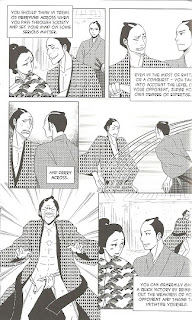 “The Book of Five Rings” is far from the only sword treatise penned by an itinerant swordsman during the Edo period, but it’s certainly the most famous, aided immensely by Musashi becoming famous through his exposure in Yoshikawa’s Eiji’s 1930’s novel ’Musashi’. One often hears of it being used by Japanese sararimen to find success in business as well as life. Is there any justification for this? Insofar as Musashi points out that the concepts behind his philosophy can be applied to any job or career, sure. Hard work, constant practice, a hands on style, an aggressive (but not careless) attitude, and above all, adaptability to changing circumstances will help to make one successful in virtually any endeavor. These values are certainly not limited to the martial arts, nor are the Buddhist and Confucian concepts behind them. However, we suppose it’s as good a place to learn them as any-and as shown here, you can even use the sword techniques to impress the chicks!
Sean Michael Wilson is the writer responsible for adapting Musashi’s work into graphic novel form (based on William Scott Wilson’s translation). Displaying a great deal of respect for and knowledge of the original work, he has managed to boil it down to its essentials. Some concepts just don’t lend themselves to visual form, but here the text is greatly enriched by the illustrations. It would be interesting to find out how closely Wilson worked with the artist and how much of the symbolism and visualizations came from him. We’re guessing it was the majority. The finished work is multilayered and will yield greater insights with each reading. In fact, it DEMANDS to be reread. Make no mistake, this is no simple comic that can easily be blown through in a few minutes and then forgotten.
The only complaint from a historical standpoint one might have is that Musashi is usually rendered as a clean, well groomed samurai, not the filthy, unkempt ‘vagabond’ he was for most of his years. However, as he is shown during his time as a vassal of the Hosokawa, one would imagine that he would have been far better tricked out than he was in his years on the road. Otherwise, illustrator Kutsuwada Chie’s artwork is a perfect example of the style being well suited for the work. Her stark, high contrast visuals veer towards the angular and are filled with strong vertical, horizontal, and diagonal lines. This lends itself well to conveying Musashi’s highly aggressive and direct approach to life and the philosophy behind it. It also matches the simple, Spartan lifestyle he enjoyed. The synergy between adapter Wilson and the artist is also in evidence as well. One of our favorite sections is in the ‘Emptiness’ chapter. While Musashi carves an unseen image, he summarizes his approach to the martial arts (and by extension, life) and the true meaning of the ‘heart of emptiness’. Panels of emptiness begin to pop into his explanations, increasing in frequency along with the reader’s understanding. Finally, there is nothing left but ‘emptiness’ after Musashi exhorts his reader to “make emptiness the way and see the way as emptiness”.
“The Book of Five Rings” is far from the only sword treatise penned by an itinerant swordsman during the Edo period, but it’s certainly the most famous, aided immensely by Musashi becoming famous through his exposure in Yoshikawa’s Eiji’s 1930’s novel ’Musashi’. One often hears of it being used by Japanese sararimen to find success in business as well as life. Is there any justification for this? Insofar as Musashi points out that the concepts behind his philosophy can be applied to any job or career, sure. Hard work, constant practice, a hands on style, an aggressive (but not careless) attitude, and above all, adaptability to changing circumstances will help to make one successful in virtually any endeavor. These values are certainly not limited to the martial arts, nor are the Buddhist and Confucian concepts behind them. However, we suppose it’s as good a place to learn them as any-and as shown here, you can even use the sword techniques to impress the chicks!
Sean Michael Wilson is the writer responsible for adapting Musashi’s work into graphic novel form (based on William Scott Wilson’s translation). Displaying a great deal of respect for and knowledge of the original work, he has managed to boil it down to its essentials. Some concepts just don’t lend themselves to visual form, but here the text is greatly enriched by the illustrations. It would be interesting to find out how closely Wilson worked with the artist and how much of the symbolism and visualizations came from him. We’re guessing it was the majority. The finished work is multilayered and will yield greater insights with each reading. In fact, it DEMANDS to be reread. Make no mistake, this is no simple comic that can easily be blown through in a few minutes and then forgotten.
The only complaint from a historical standpoint one might have is that Musashi is usually rendered as a clean, well groomed samurai, not the filthy, unkempt ‘vagabond’ he was for most of his years. However, as he is shown during his time as a vassal of the Hosokawa, one would imagine that he would have been far better tricked out than he was in his years on the road. Otherwise, illustrator Kutsuwada Chie’s artwork is a perfect example of the style being well suited for the work. Her stark, high contrast visuals veer towards the angular and are filled with strong vertical, horizontal, and diagonal lines. This lends itself well to conveying Musashi’s highly aggressive and direct approach to life and the philosophy behind it. It also matches the simple, Spartan lifestyle he enjoyed. The synergy between adapter Wilson and the artist is also in evidence as well. One of our favorite sections is in the ‘Emptiness’ chapter. While Musashi carves an unseen image, he summarizes his approach to the martial arts (and by extension, life) and the true meaning of the ‘heart of emptiness’. Panels of emptiness begin to pop into his explanations, increasing in frequency along with the reader’s understanding. Finally, there is nothing left but ‘emptiness’ after Musashi exhorts his reader to “make emptiness the way and see the way as emptiness”.
 We now move on from the practical world of Musashi to a whimsical world of demons and talking animals in “The Demon’s Sermon on the Martial Arts” (“Tengu Geijutson”). The author of this Edo period work was (the pen name of Niwa Tadaaki), a samurai from Sekiyado han in Shimosa province. Chozanshi, while interested in swordsmanship, was primarily known as a bunjin (what we’d call a ‘man of letters’ in the West). “Demon’s Sermon” is actually somewhat of a compilation of two of his efforts-the title work along with a selection of short stories from his “Inaka Soshi” (The Hayseed Taoist). These stories, despite the book’s title, are far more concerned with Buddhist and Confucian concepts than the techniques and execution of swordsmanship (most of the martial arts discussion takes place between the tengu).
 The story revolves around a young would-be swordsman who ventures into the deep woods to seek the instruction of the tengu, the mythical bird-men of Japan who were said to have instructed the legendary hero Minamoto no Yoshitsune in the ways of warfare. Coming across a group of them holding a discussion in a tree, he settles in to eavesdrop and benefit from their wisdom. The title is somewhat of a misnomer-tengu aren’t demons in the Western sense of the word (that being malevolent beings or spirits from Hell) but more like ‘forest spirits’. Wilson here chooses to break “The Demon’s Sermon” into several parts and use it as a framework to structure the shorter stories. This allows the short stories to reinforce and expand upon the concepts brought up by the tengu, as well as letting the tengu introduce the concepts to be spotlighted in the short stories. An interesting choice by Wilson, it helps to tie the work together as a unified whole rather than a series of stories. Many of the ideas are the same as those looked at by Musashi in “Five Rings”, again showing how Buddhist and Confucian ideals found their way into sword training. The tengu discuss the concept of no-mind or emptiness, using your chi (the energy that flows through everything) correctly, the importance of practice and discipline, and how adaptability and lack of attachment are vital. Humorously, the tengu also find most martial arts schools to be lacking in their instruction with too great an emphasis on rigid technique.
 The short stories are primarily Buddhist parables told through the eyes of a variety of talking animals. Using animals to illustrate life lessons is a well-known aspect of Western storytelling, and it was the same in Japan. Yose (storytelling) theater was quite popular in the Edo period and many of its stories were exactly like the selections included in “Demon’s Sermon”. Included are Transformation of the Sparrow and the Butterfly, Meeting the Gods of Poverty in a Dream, The Greatest Joys of the Cicada and Its Cast-Off Shell, The Owl’s Understanding, The Centipede Questions the Snake, The Toad’s Way of the Gods, and The Mysterious Technique of the Cat. The animals (for the most part not goofy looking anamorphic creatures but what they look like in nature) delve into matters such as being content with one’s station in life, the impermanent nature of all things, the shortcomings of learned technique, and again, the importance of being able to adapt to changing circumstances. The most well-known story of the bunch is The Mysterious Technique of the Cat. When an exceptionally gifted rat invades the ramshackle home of a ronin, the rodent proves itself to be a superior foe, evading all attempts to capture or kill it. When even the most talented mousers in the area fall to the rat’s vicious attacks, it falls to an enfeebled older cat to confront the rat. It defeats it effortlessly to the amazement of all, leading to pleas from the other cats for an explanation of his amazing technique. And as will be of no surprise to readers of the other stories, he accomplished it by using ‘no technique’. Parables such as this were intended to make somewhat complex Buddhist concepts relatable and understandable to commoners and were a large part of the repertoire of traveling monks and priests. From a sociological standpoint they also were a way for the monks and samurai to make the peasants happy with their social status and not try to better their positions by rebelling against those above them.
Wilson’s presentation of the stories (again, based on a translation by William Scott Wilson) is excellent. As previously mentioned, the narrative flows smoothly from one tale to the next, and the center point of each is brought out in a subtle and effective manner. There’s a fine line between simplifying things to the point of making them kid’s stories and making them so complex as to defy comprehension, and Wilson navigates it well. The book is warmer, charming, and more endearing than “Five Rings”. How could it not be with all those talking animals? Wilson allows their personalities and foibles to shine through rather than just make them into another ‘Musashi’. As with “Five Rings”, readers will be rewarded with greater insight on each reading.
“Demon’s Sermon” employs a different illustrator than “Five Rings”, but one that is every bit as suited to the subject matter. Morikawa Michiru’s artwork is softer, more detailed, and employs more elaborate shading. It’s perfect for the Buddhist and Confucian concepts being expounded. It also helps to make the talking animals, insects, and demons in the story to be as natural and acceptable to the reader as the humans. Morikawa excels at infusing her work with subtle symbolism, as when a battle between a rat and a cat forms a classic Taoist taijitu (the ‘yin-yang’ symbol). We also enjoyed how Morikawa gave each of the tengu a distinctly different look, reflecting how the concepts and depictions of tengu in Japanese art varied throughout the centuries.
Both graphic novels also contain afterwords by William Scott Wilson (the well-known scholar and writer who did the translations of the original Japanese language texts). His comments give well thought-out examinations of the characters of original authors Musashi and Chozanshi, as well as helping clarify and structure some of the points brought out in the texts. While afterwords in books often have little of substance to add, readers should definitely take the time to peruse these.
Shambhala Publications is to be complimented for their support of this non-traditional format for very traditional and serious texts. There are more graphic novels in the works, and one in particular has caught our interest-a treatment of the 47 Ronin, due out in November. Again featuring Sean Wilson at the helm, it features artwork by Shimojima Akiko and states without reservation that it will be “a historically factual portrait”, “accurate and …compelling”, and featuring characters that are “nuanced and relatable”. This would be a welcome development, particularly in the wake of Dark Horse’s recent botched attempt at presenting the story in comics form. We have to admit to being skeptical that the end result will indeed stick to the historical facts and not mirror the fictional Chushingura version of the Ako ronin. However, based on the excellent job Wilson has done to date, if anyone can pull it off, he can.
While both books are condensed versions of the originals, the artwork in effect makes them an expanded version, helping to underscore the original text and also to bring out new facets of these classic works. They’ll be of interest to many fields in pre-modern Japanese studies-religious studies, martial arts, philosophy, and culture. Serious and well thought out adaptations, they illustrate how the right creators paired with timeless source material can utilize the comics/manga format to enhance an existing work (rather than simply dumb it down for the purposes of creating disposable entertainment). This ‘graphic approach’ to Musashi and demons will hopefully introduce these classic works to a new audience as well as breathe life into them for the old one. After reading these two works we’ll co-opt one of Musashi’s sentiments and say “You should investigate (these) thoroughly”.
You can pick “Five Rings” and “Demon’s Sermon” directly from Shambhala or from Amazon via the SA Store.
All artwork courtesy and copyright 2012/2103 Shambhala Publications. It may not be reproduced, in any form or by any means, electronic or mechanical, including photocopying, recording, or by any information storage and retrieval system, without permission in writing from the publisher.
The short stories are primarily Buddhist parables told through the eyes of a variety of talking animals. Using animals to illustrate life lessons is a well-known aspect of Western storytelling, and it was the same in Japan. Yose (storytelling) theater was quite popular in the Edo period and many of its stories were exactly like the selections included in “Demon’s Sermon”. Included are Transformation of the Sparrow and the Butterfly, Meeting the Gods of Poverty in a Dream, The Greatest Joys of the Cicada and Its Cast-Off Shell, The Owl’s Understanding, The Centipede Questions the Snake, The Toad’s Way of the Gods, and The Mysterious Technique of the Cat. The animals (for the most part not goofy looking anamorphic creatures but what they look like in nature) delve into matters such as being content with one’s station in life, the impermanent nature of all things, the shortcomings of learned technique, and again, the importance of being able to adapt to changing circumstances. The most well-known story of the bunch is The Mysterious Technique of the Cat. When an exceptionally gifted rat invades the ramshackle home of a ronin, the rodent proves itself to be a superior foe, evading all attempts to capture or kill it. When even the most talented mousers in the area fall to the rat’s vicious attacks, it falls to an enfeebled older cat to confront the rat. It defeats it effortlessly to the amazement of all, leading to pleas from the other cats for an explanation of his amazing technique. And as will be of no surprise to readers of the other stories, he accomplished it by using ‘no technique’. Parables such as this were intended to make somewhat complex Buddhist concepts relatable and understandable to commoners and were a large part of the repertoire of traveling monks and priests. From a sociological standpoint they also were a way for the monks and samurai to make the peasants happy with their social status and not try to better their positions by rebelling against those above them.
Wilson’s presentation of the stories (again, based on a translation by William Scott Wilson) is excellent. As previously mentioned, the narrative flows smoothly from one tale to the next, and the center point of each is brought out in a subtle and effective manner. There’s a fine line between simplifying things to the point of making them kid’s stories and making them so complex as to defy comprehension, and Wilson navigates it well. The book is warmer, charming, and more endearing than “Five Rings”. How could it not be with all those talking animals? Wilson allows their personalities and foibles to shine through rather than just make them into another ‘Musashi’. As with “Five Rings”, readers will be rewarded with greater insight on each reading.
“Demon’s Sermon” employs a different illustrator than “Five Rings”, but one that is every bit as suited to the subject matter. Morikawa Michiru’s artwork is softer, more detailed, and employs more elaborate shading. It’s perfect for the Buddhist and Confucian concepts being expounded. It also helps to make the talking animals, insects, and demons in the story to be as natural and acceptable to the reader as the humans. Morikawa excels at infusing her work with subtle symbolism, as when a battle between a rat and a cat forms a classic Taoist taijitu (the ‘yin-yang’ symbol). We also enjoyed how Morikawa gave each of the tengu a distinctly different look, reflecting how the concepts and depictions of tengu in Japanese art varied throughout the centuries.
Both graphic novels also contain afterwords by William Scott Wilson (the well-known scholar and writer who did the translations of the original Japanese language texts). His comments give well thought-out examinations of the characters of original authors Musashi and Chozanshi, as well as helping clarify and structure some of the points brought out in the texts. While afterwords in books often have little of substance to add, readers should definitely take the time to peruse these.
Shambhala Publications is to be complimented for their support of this non-traditional format for very traditional and serious texts. There are more graphic novels in the works, and one in particular has caught our interest-a treatment of the 47 Ronin, due out in November. Again featuring Sean Wilson at the helm, it features artwork by Shimojima Akiko and states without reservation that it will be “a historically factual portrait”, “accurate and …compelling”, and featuring characters that are “nuanced and relatable”. This would be a welcome development, particularly in the wake of Dark Horse’s recent botched attempt at presenting the story in comics form. We have to admit to being skeptical that the end result will indeed stick to the historical facts and not mirror the fictional Chushingura version of the Ako ronin. However, based on the excellent job Wilson has done to date, if anyone can pull it off, he can.
While both books are condensed versions of the originals, the artwork in effect makes them an expanded version, helping to underscore the original text and also to bring out new facets of these classic works. They’ll be of interest to many fields in pre-modern Japanese studies-religious studies, martial arts, philosophy, and culture. Serious and well thought out adaptations, they illustrate how the right creators paired with timeless source material can utilize the comics/manga format to enhance an existing work (rather than simply dumb it down for the purposes of creating disposable entertainment). This ‘graphic approach’ to Musashi and demons will hopefully introduce these classic works to a new audience as well as breathe life into them for the old one. After reading these two works we’ll co-opt one of Musashi’s sentiments and say “You should investigate (these) thoroughly”.
You can pick “Five Rings” and “Demon’s Sermon” directly from Shambhala or from Amazon via the SA Store.
All artwork courtesy and copyright 2012/2103 Shambhala Publications. It may not be reproduced, in any form or by any means, electronic or mechanical, including photocopying, recording, or by any information storage and retrieval system, without permission in writing from the publisher.
 December has always been the month where the 47 Ronin enter the stream of modern Japanese consciousness. The assault by the Ronin on Lord Kira’s estate took place on the “fourteenth day of the twelfth month” in the year of Genroku 15. While this actually corresponds to January 30th of the Western calendar, the Japanese have traditionally recognized it on December 14th. The Ronin appear in commercials, special events and observances are held at Sengakuji Temple (where the Ronin’s graves are located), and the airwaves tend to screen a goodly number of the dozens of TV shows and movies that have depicted the event over the decades. And this year, the Ronin will be making their presence felt in December in the West. Most obvious is the big-budget fantasy film “47 Ronin” starring Keanu Reeves that will be making its US debut Christmas day. Filled with CGI monsters and having little to do with the real 47 Ronin, it remains to be seen how the movie going public will react to it. But Shambhala Publications has also recently released a graphic novel version of the traditional 47 Ronin tale, just in time to join the festivities. The team of writer Sean Michael Wilson and artist Shimojima Akiko (along with letterer Ben Dickson) have combined to put together an adaptation of Chushingura (roughly ‘treasury of loyal retainers’, the fictional account of the historical incident that has been the subject of hundreds of kabuki plays, puppet plays, films, manga, novels, and artwork over the centuries) that exceeds anything yet done in the West (including the recent failed Dark Horse adaptation). It’s a solid adaptation that faithfully brings out the story’s many facets, perfectly complimented by accurate, simple, and clean artwork.
 There are lots more differences-if you’re interested, you can read about them here, here, or here. We’re also assuming our readership is acquainted with the general details of the 47 Ronin-but if not, here’s the ‘Cliffs Notes’ version. Asano Naganori, daimyo of Ako han, was assigned to study court etiquette under the tutelage of Kira Yoshihisa in order to attend Imperial envoys visiting the Shogun’s court. For some unknown reason (rudeness on Kira’s part due to not being bribed? Resentment over being properly chastised on Asano’s part?), Asano attacked Kira with his sword inside the Shogun’s Edo Castle-an act punishable by death. Asano was forced to commit ritual suicide, his lands were confiscated, and his family and retainers turned out. 47 of these retainers banded together and a year or so later assaulted Kira’s mansion, in effect ‘finishing Asano’s work’, killing Kira in what amounted to a feudal drive-by. But let’s get to the graphic novel…
 Many works dealing with the 47 Ronin tend to be bloodless affairs, concentrating on the ‘glory’ of the assault and glossing over the violence that was a part of it. Kira’s murder and Asano’s seppuku usually take place ‘off-screen’ or are not described in anything but the most general terms. Not so here. They’re depicted in all their ugliness, giving this version of the story a more visceral impact that tends to rip away more of the fairy tale aspect of the story and make it much more realistic. When stripped to its essentials, the tale of the Ronin is nothing more than the tragic retaliatory murder of a largely blameless old man (described by historian James McMullen as an '...atavistic, violent, and futile incident' involving '...reductive morality and brittle sense of honor that sanctioned such pointless sacrifice'), and nothing brings this home more than Oishi’s beheading of Kira.
 Artist Shimojima Akiko’s black and white artwork is a breath of fresh air, showing an excellent level of accurate cultural and historical detail that was lacking in the Dark Horse version of the Ronin. In our opinion, it’s also far more suited to this serious story than the more whimsical and cartoonish artwork featured in the Dark Horse effort. Her double splash page spread of Edo Castle (home of the Shogun and the setting for Asano’s assault) is a perfect example, showing a grasp of Edo period Japanese architecture and castle layout that evades most artists in the West (many of whom seemingly take their cues from Chinese Wuxia films). It gives the story an authentic air that helps the reader to immerse themselves in the story rather than distract them.


