 OK, finally saw this. Narukagami's review on the Samurai Archives Film Forum covered much of what I also think, so I'll limit myself to new avenues.
As expected, about a 2 on a 100 based accuracy scale. A Lord Asano attacks an unarmed Lord Kira, is sentenced to seppuku, and a group of 47 of his former vassals led by Oishi Yoshio murder Kira. Everything, and I do mean EVERYTHING, else is wrong. Even small details that were changed seemingly only for the sake of doing so. Culturally, they managed to get virtually everything wrong too, stressing the fantasy vibe. I mention this only in passing, because the movie claims to only be BASED on the story, and no sane person could watch the trailer and expect real history. So accuracy wasn't an issue for me. Does make you wonder why they hired Stephen Turnbull as an historical consultant and kept him on the set for months, because it appears they ignored any advice he might have given them. I need that gig.
OK, finally saw this. Narukagami's review on the Samurai Archives Film Forum covered much of what I also think, so I'll limit myself to new avenues.
As expected, about a 2 on a 100 based accuracy scale. A Lord Asano attacks an unarmed Lord Kira, is sentenced to seppuku, and a group of 47 of his former vassals led by Oishi Yoshio murder Kira. Everything, and I do mean EVERYTHING, else is wrong. Even small details that were changed seemingly only for the sake of doing so. Culturally, they managed to get virtually everything wrong too, stressing the fantasy vibe. I mention this only in passing, because the movie claims to only be BASED on the story, and no sane person could watch the trailer and expect real history. So accuracy wasn't an issue for me. Does make you wonder why they hired Stephen Turnbull as an historical consultant and kept him on the set for months, because it appears they ignored any advice he might have given them. I need that gig.
 Keanu Reeves was GODAWFUL. It might have been the worst performance I've ever seen in a big budget movie. I get that he's supposed to be stoic, but Japanese actors can pull this off and still be interesting in the process. Reeves just looked eternally befuddled and mentally challenged, with his character coming across as the village idiot. And this is what's supposed to turn on the Great Lord Asano's daughter? Which brings us to...
The Great Lord Asano's daughter Mika and the love story, which as Narukagami mentioned is shoehorned in for no discernible reason. Why any woman would find Reeves's character attractive is beyond me, and Mika is by far the most unlikeable female lead/primary love interest I've ever seen in a 'samurai' film. There is no chemistry between the two and you just want to see them die painfully, preferably at each other’s hand. With a chainsaw.
Keanu Reeves was GODAWFUL. It might have been the worst performance I've ever seen in a big budget movie. I get that he's supposed to be stoic, but Japanese actors can pull this off and still be interesting in the process. Reeves just looked eternally befuddled and mentally challenged, with his character coming across as the village idiot. And this is what's supposed to turn on the Great Lord Asano's daughter? Which brings us to...
The Great Lord Asano's daughter Mika and the love story, which as Narukagami mentioned is shoehorned in for no discernible reason. Why any woman would find Reeves's character attractive is beyond me, and Mika is by far the most unlikeable female lead/primary love interest I've ever seen in a 'samurai' film. There is no chemistry between the two and you just want to see them die painfully, preferably at each other’s hand. With a chainsaw.
 This unlikablilty spills over to the rest of the cast. You're supposed to be CHEERING for the 47 Ronin, but they are so arrogant, intolerant (accurate here, as historically they booted out one of their members for being of insufficient rank), dishonest (even to their Lord), and downright mean spirited and nasty, you want to see them all die too (at least the film delivers here). Oishi is particularly loathsome. Granted, this is probably the way samurai were in real life, but in a fantasy epic, you want the heroes to be heroes. Flawed, yes, but not complete and unredeemable bastards. Conversely, Kira and his fox-witch are virtually the only engaging characters in the film. I did enjoy the fact that they role-reversed the usual depictions and made Kira a young, vibrant man and Asano the wrinkled and decrepit old Lord.
 And they spent 175 mil on this? Where? It sure isn't up on the screen. The CG wasn't as bad as I feared-the Kirin in the beginning was awful, and the Oni that Reeves fights in the UFC pit on Dejima (I was REALLY hoping for a Don Frye cameo) is almost as bad. Still, the effects they did for the 'swirling cloth' Tengu and the witch were well done, and the water dragon looked fine. The real problem with the CG is they did a very poor job of staging things so the actors looked like they were interacting with the fantasy creatures. This was particularly noticeable in the opening Kirin hunt and Reeves's battle with the water dragon. They'd have been much better off using practical effects-the few in the film (such as the Tengu makeup) were well done.
 The film also wasted some of its biggest assets. Kira's super-samurai is set up for a climactic battle against...someone, but is unsatisfactorily thrown away during the final fight. And the cool skull headed gun-toting tattooed dude featured prominently in advertising is given almost nothing to do, appearing for only a few seconds during the Dejima sequence during which he has zero impact on the proceedings.
 Having said all that, I actually did enjoy the movie as a fantasy epic. It moved along well, Kikuchi Rinko gives a great over-the-top performance as Kira’s witch that fits the mood a fantasy should have, the sets and costuming are goofy but impressively so, and the fighting that doesn’t involve monsters is pretty well done. If you approach this the same way as you would a late 50’s/early 60’s Ray Harryhausen style fantasy/quest film, I believe most fans of the genre would find it a pleasant enough way to pass two hours. And like most fantasy flicks, the problems with it only result in a so-bad-it’s-good vibe. It’s probably not worth buying the DVD/Blu-ray for most people, but definitely worth a spot on your Netflix queue.
 Speaking of which, the extras on the DVD/Blu-ray were a major disappointment. Basing this on a real story, you’d think they’d at least have a pseudo-documentary of the historical incident, but it rates barely a passing mention. If nothing else, it would have given Turnbull a chance to earn whatever they were paying him. Instead, you get several of your typical ‘behind-the-scenes-crew-member-with-a-video-camera’ vignettes. These look to have originally been part of a whole that was chopped up in order to give the appearance of more ‘extras’. There are a handful of deleted scenes, and that’s it. No commentary track or any sort of in-depth examination of the film-can’t say I blame them. They likely didn’t want to throw more money into a losing effort. The short vignettes spend much of their time having cast and crew gush about how awesomely talented and brilliant Reeves is and how they just loved working with him and having him on the set, and how he was seemingly in command of everything that went on from costuming to plot (so now we know who REALLY gets the blame for this box-office disaster). Yes, people will lie through their teeth to remain gainfully employed. If you want to hear anything about the Japanese cast, sorry, these aren’t the extras you’re looking for, because they receive only a few brief sentences. There are some hilariously jaw-dropping moments during the extras, such as when one of the ‘artistes’ claims that they’ve designed a film that visually is historically authentic and accurate but that yet brings it refreshingly into the present day and gives it a totally modern look. I like to think some mischievous editor dropped that into the proceedings for the sole purpose of amusing me.
So enjoy the 47 Ronin for what it is-a mess of a film that features enough monsters, witchery, ass-kicking, and absurdity to make it worth a rental. And about as authentic and realistic as most of the other films that feature the 47 Ronin-which is to say not at all.
Speaking of which, the extras on the DVD/Blu-ray were a major disappointment. Basing this on a real story, you’d think they’d at least have a pseudo-documentary of the historical incident, but it rates barely a passing mention. If nothing else, it would have given Turnbull a chance to earn whatever they were paying him. Instead, you get several of your typical ‘behind-the-scenes-crew-member-with-a-video-camera’ vignettes. These look to have originally been part of a whole that was chopped up in order to give the appearance of more ‘extras’. There are a handful of deleted scenes, and that’s it. No commentary track or any sort of in-depth examination of the film-can’t say I blame them. They likely didn’t want to throw more money into a losing effort. The short vignettes spend much of their time having cast and crew gush about how awesomely talented and brilliant Reeves is and how they just loved working with him and having him on the set, and how he was seemingly in command of everything that went on from costuming to plot (so now we know who REALLY gets the blame for this box-office disaster). Yes, people will lie through their teeth to remain gainfully employed. If you want to hear anything about the Japanese cast, sorry, these aren’t the extras you’re looking for, because they receive only a few brief sentences. There are some hilariously jaw-dropping moments during the extras, such as when one of the ‘artistes’ claims that they’ve designed a film that visually is historically authentic and accurate but that yet brings it refreshingly into the present day and gives it a totally modern look. I like to think some mischievous editor dropped that into the proceedings for the sole purpose of amusing me.
So enjoy the 47 Ronin for what it is-a mess of a film that features enough monsters, witchery, ass-kicking, and absurdity to make it worth a rental. And about as authentic and realistic as most of the other films that feature the 47 Ronin-which is to say not at all.
 December has always been the month where the 47 Ronin enter the stream of modern Japanese consciousness. The assault by the Ronin on Lord Kira’s estate took place on the “fourteenth day of the twelfth month” in the year of Genroku 15. While this actually corresponds to January 30th of the Western calendar, the Japanese have traditionally recognized it on December 14th. The Ronin appear in commercials, special events and observances are held at Sengakuji Temple (where the Ronin’s graves are located), and the airwaves tend to screen a goodly number of the dozens of TV shows and movies that have depicted the event over the decades. And this year, the Ronin will be making their presence felt in December in the West. Most obvious is the big-budget fantasy film “47 Ronin” starring Keanu Reeves that will be making its US debut Christmas day. Filled with CGI monsters and having little to do with the real 47 Ronin, it remains to be seen how the movie going public will react to it. But Shambhala Publications has also recently released a graphic novel version of the traditional 47 Ronin tale, just in time to join the festivities. The team of writer Sean Michael Wilson and artist Shimojima Akiko (along with letterer Ben Dickson) have combined to put together an adaptation of Chushingura (roughly ‘treasury of loyal retainers’, the fictional account of the historical incident that has been the subject of hundreds of kabuki plays, puppet plays, films, manga, novels, and artwork over the centuries) that exceeds anything yet done in the West (including the recent failed Dark Horse adaptation). It’s a solid adaptation that faithfully brings out the story’s many facets, perfectly complimented by accurate, simple, and clean artwork.
One issue that needs to be addressed up front is the press releases/publicity for the book. While the full versions make it clear that the graphic novel is a depiction of Chushingura (the heavily fictionalized account of the 47 Ronin incident that became popular in Edo period Japan), the shorter versions only state that it’s “…the first historically accurate graphic-novel version of a legendary event in Japanese history”. Just to be clear, the graphic novel is indeed based on the Chushingura legend, not the facts of the historical incident. Since we’ve examined these differences at length in other articles, we’ll just touch on them here. Some of the more important differences between Chushingura and actual history include:
-Chushingura contains many fictional characters, such as Kamei and ‘Urata from Satsuma’ AKA the Satsuma man.
-it also contains many fictional incidents-for example, after the assault, the Ronin pass through the streets of Edo stopping to be praised and feted by the populace. They actually moved expeditiously to their final goal of Sengakuji Temple as they feared an assault by the Uesugi and certainly weren't being embraced by the townspeople.
-Asano is shown in Chushingura as the embodiment of samurai values and virtue, whereas in real life he was a drunken womanizer with no skills to speak of (as we like to say, the 'Brick McBurly of his day').
-Oishi (the leader of the Ronin) is depicted as a loyal and brilliant retainer, but was also a man of few skills aside from drinking and procuring women for Asano.
-Kira Yoshihisa (often referred to as ‘Yoshinaka’) is shown as a grasping, greedy villain but there is no historical evidence to support it. He was more of a typical bakufu bureaucrat.
-Asano Naganori’s assault is provoked by Kira’s greed and rudeness, but the truth is that no one has a clue why he did it.
-the Ronin are shown in Chushingura to be taking great care to take no innocent lives, but during the assault they slaughtered many of Kira’s household staff.
 There are lots more differences-if you’re interested, you can read about them here, here, or here. We’re also assuming our readership is acquainted with the general details of the 47 Ronin-but if not, here’s the ‘Cliffs Notes’ version. Asano Naganori, daimyo of Ako han, was assigned to study court etiquette under the tutelage of Kira Yoshihisa in order to attend Imperial envoys visiting the Shogun’s court. For some unknown reason (rudeness on Kira’s part due to not being bribed? Resentment over being properly chastised on Asano’s part?), Asano attacked Kira with his sword inside the Shogun’s Edo Castle-an act punishable by death. Asano was forced to commit ritual suicide, his lands were confiscated, and his family and retainers turned out. 47 of these retainers banded together and a year or so later assaulted Kira’s mansion, in effect ‘finishing Asano’s work’, killing Kira in what amounted to a feudal drive-by. But let’s get to the graphic novel…
Author Sean Michael Wilson sticks closely to the traditional accounts, not embellishing the Ronin with further exploits or fawning hero worship. This being the case, Kira is the villain, Asano a victim, and the Ronin are the true heroes of the story. Unlike many Western authors, however, Wilson doesn’t omit some of the darker threads of the old legends that are often dropped. One of these is Oishi’s implied criticism of Asano-“I hope I can be allowed to express some doubt as to the wisdom of our Lord’s actions. But it is done now and we must act well. If the Shogun will allow Asano Daigaku to become the new Lord, then we can continue the house with honor”. This short discourse brings an entirely new dimension to the Ronin’s vendetta, and is further embellished by Wilson presenting it as a conversation between the two factions of the Ako Ronin. In a little over two pages, much is explained. The feuding factions of the Ronin (the radicals led by Horibe Yasubei who wanted to kill Kira at once and Oishi’s moderates who only wanted the Asano family to remain in control of Ako) that almost resulted in the assault being called off, the waiting period of a year between Asano’s suicide and the raid (not because the Ronin were trying to lull Kira’s suspicions, but because they were waiting on the Shogun’s decision), the question of whether the Ronin were truly loyal to Asano Naganori or just to their positions within the house of Asano-they’re set up effortlessly and subtly. The Ronin’s callous manipulation of women and employers, and the cruelty of Oishi’s rejection of his wife and family (albeit for a good reason) are shown for all to see. By not editing these incidents from the proceedings, Wilson manages to turn the Ronin from cardboard heroes into human beings with realistic motivations and feelings. It’s also closer to real history, as most historians believe the Ronin acted to preserve their individual honor rather than out of any loyalty to Asano (who the majority had never even met). Even some of Kira’s retainers are allowed their moment to shine, with a small group of three holding back the Ronin.
Also given time to develop is the friendship between ‘Kamei-sama’ and Asano. Traditionally, Kamei is shown as the real hothead of the pair and is only saved from Asano’s fate by the quick thinking of two of his retainers (behind Kamei’s back, they bribe Kira, ending his verbal abuse of Kamei). Wilson depicts Asano’s efforts to connect with Kamei in an effort to keep him from assaulting their teacher. The friendship between the two daimyo again helps to make them believable, and as Kira turns the full of his scorn on Asano, it makes Asano’s transition from the voice of reason to unbridled rage all the more shocking and unexpected. Combined with the graphic portrayal of his seppuku (ritual suicide), it makes him a far more sympathetic character. This Asano is not perfect, but one can understand his frustration, confusion, and anger.
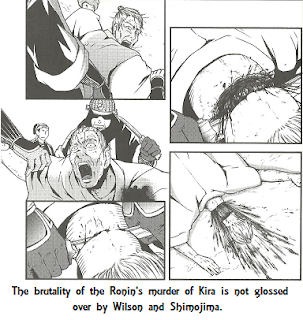 Many works dealing with the 47 Ronin tend to be bloodless affairs, concentrating on the ‘glory’ of the assault and glossing over the violence that was a part of it. Kira’s murder and Asano’s seppuku usually take place ‘off-screen’ or are not described in anything but the most general terms. Not so here. They’re depicted in all their ugliness, giving this version of the story a more visceral impact that tends to rip away more of the fairy tale aspect of the story and make it much more realistic. When stripped to its essentials, the tale of the Ronin is nothing more than the tragic retaliatory murder of a largely blameless old man (described by historian James McMullen as an '...atavistic, violent, and futile incident' involving '...reductive morality and brittle sense of honor that sanctioned such pointless sacrifice'), and nothing brings this home more than Oishi’s beheading of Kira.
For the most part the tale flows smoothly from one incident to another, although there is a bit of a rough transition from a scene between Kira and Asano to Asano’s later assault on Kira in Edo castle. It comes across as one incident, although the costuming and situation soon make it obvious such is not the case. Chushingura is a LONG story-kabuki plays can take days, movies several hours. Compressing everything into 150 pages or so is not an easy job, but Wilson manages to include all of the high points along with many of the sub-plots (most famously the ‘side jobs’ of the Ronin in Edo as they spy on Kira in the guise of workmen and merchants) without making things seem rushed. Dialogue takes the proper tone-a rather old-fashioned and formal way of speaking that reflects as best as it can in English the tone that a samurai would be employing in everyday speech.
 Artist Shimojima Akiko’s black and white artwork is a breath of fresh air, showing an excellent level of accurate cultural and historical detail that was lacking in the Dark Horse version of the Ronin. In our opinion, it’s also far more suited to this serious story than the more whimsical and cartoonish artwork featured in the Dark Horse effort. Her double splash page spread of Edo Castle (home of the Shogun and the setting for Asano’s assault) is a perfect example, showing a grasp of Edo period Japanese architecture and castle layout that evades most artists in the West (many of whom seemingly take their cues from Chinese Wuxia films). It gives the story an authentic air that helps the reader to immerse themselves in the story rather than distract them.
As well as technical ability, she also displays a subtle touch, such as several illustrations of a spider in its web slowly being revealed as being over Asano’s shoulder-a nice bit of symbolism. The simple look of heartfelt hurt on the face of Oishi’s young daughter as he disowns her is heartbreaking. While Shimojima’s depiction of the Ronin’s assault on Kira’s mansion is done in the best frenetic manga style, there are quiet moments interspaced-such as when Kira’s chief retainer is struck down and his essence slowly drifts into the sky. For him, this battle is over and no longer matters. It imparts the sense of the transitory and impermanent nature of things inherent in Buddhism. Interestingly, this concept is stood on its head in the final scene, where the dying body of the Satsuma Man fades away to show a modern family paying homage to the Ronin’s graves at Sengakuji. While the body might pass on, the legend continues to live in perpetuity.
Shimojima also does her best to make the individual characters identifiable. The Shogun’s court stressed conformity and standardization (one reason Asano needed instruction in the highly intricate and detailed sphere of court etiquette). Hairstyles were also tightly regulated. This means that everyone had a rather generic look. Shimojima manages within this context to give cues to the reader-the differing crests on the formal kataginu, small differences in hairstyles, the shading and patterns of clothes, even things as subtle as eyebrow thickness all help in picking out the key players. It also rewards sharp-eyed readers who can spot characters from earlier in the story showing up later.
One mild criticism of the book is that it would have benefited from a short text piece such as was included in Wilson’s two other graphic novels for Shambhala. Many cultural and historical issues that Western audiences might find confusing could have been explained here, such as why Asano became homicidal when asked to tie the ribbon on Kira’s sock or why Oishi would have been so brutal in dealing with his wife (casting her out meant his family would not be held responsible for his actions and punished). Why do all in the samurai in the castle have ‘pants’ on that are twice as long as their legs (this was used to keep them from moving quickly and designed to forestall possible assassination attempts on the Shogun)? It also could have been used to give more background on the historical incident.
So if you’re looking for an adaptation of the Chushingura legend that sticks to the story and doesn’t include fantasy monsters, witches, giants, or gaijin actors shoehorned into the tale, you won’t find a better executed one than Wilson’s and Shimojima’s “The 47 Ronin”. It’s an adaptation that manages to infuse both the Ronin and their foes with humanity. Author Wilson makes you feel Asano’s outrage, Kira’s panic, the conflicting views of Asano’s retainers, and the excitement of the raid. Artist Shimojima gives us a period-accurate Japan laced with dynamic action and quiet moments in turn. They’ve taken what is often depicted as a morality tale filled with two dimensional characters and given it depth and texture. During this season of the Ronin, ‘tis the book ye be looking for.
The 47 Ronin is available directly from Shambhala or from Amazon.
All artwork courtesy and copyright 2103 Shambhala Publications. It may not be reproduced, in any form or by any means, electronic or mechanical, including photocopying, recording, or by any information storage and retrieval system, without permission in writing from the publisher.


