Showing posts with label Meiji. Show all posts

Saturday, April 26, 2014

Katsu Kaishu, Navigator Of Chaos: An Interview With Romulus Hillsborough, Author Of “Samurai Revolution”, Pt. 2

We’re happy to present our readers with the conclusion of our two-part interview with Romulus Hillsborough, author of the recently published Samurai Revolution: The Dawn of Modern Japan Seen Through the Eyes of the Shogun's Last Samurai. You can read part one of the interview HERE. In the following interview, RH is author Romulus Hillsborough and SA is the Samurai Archives’ Randy Schadel. 

SA: One of the more difficult concepts for newcomers to Bakumatsu studies to understand is why the new Imperial Government felt the need to use military force against the Tokugawa after Yoshinobu had resigned the office of Shogun and returned power to the Emperor in 1867. Satsuma and Choshu (in conjunction with some highly placed Court nobles) even went so far as to forge an Imperial edict to attack the Tokugawa and put together phony Imperial flags for the Satcho army. Was this simply a case of the Loyalists led by Satsuma and Choshu wanting to ensure that the Tokugawa would be eliminated from national politics beyond a shadow of a doubt? Or was there evidence that Yoshinobu still had plans to retain his primacy in the political arena? 

RH: Regarding this complicated issue, I refer readers to Samurai Revolution since I wrote quite a bit about it there. Let me just say here that the Imperial Court refused Yoshinobu’s request to abdicate and restore Imperial rule in the Tenth Month of Keio 3 (1867) because it wasn’t yet ready to accept the burden of governing; then after the coup in Kyoto in the next month, by which the Bakufu was abolished, Yoshinobu was deposed and a new provisional government was established under the Emperor, Yoshinobu no longer intended to step aside peacefully-which was why he sent 15,000 troops from Osaka to crush 5,000 enemy troops, mostly of Choshu and Satsuma. They clashed at Toba-Fushimi on the way to Kyoto and, of course, the Bakufu side was defeated. 

SA: Throughout Samurai Revolution you’re also quoting extensively from the accounts of foreign diplomats and officials, giving their contemporary viewpoint on the Bakumatsu. This gives a valuable outsider’s look at the proceedings and just what the ‘foreign devils’ responsible for much of the unrest thought of what was transpiring. Despite the fact that the English actively supported the Loyalists and the French the Shogunate (with the Dutch watching their own interests, the Russians chipping away at territories north of Japan, and the Americans largely staying out of things due to being involved in their own Civil War) when the actual fighting began in the Boshin War, the Western nations agreed to not become involved and remain neutral. What was it that kept the Western nations out of the conflict and perhaps spared Japan the fate that China suffered at the hands of the European and American powers? 

RH: I will not state the reasons that the foreign governments agreed to stay out of the internal conflict in Japan. However, I will say a little about France and Great Britain. Napoleon III, it seems, lost his stomach for overseas adventure, which was why the Bakufu lost France’s support in the latter part of Keio 3 (1867). Great Britain, on the other hand, wanted to secure its lucrative Japan trade, which was predicated on political stability in Japan. This was part of the reason that Ernest Satow published his essays, “English Policy,” in the Japan Times in 1865-66, in which he argued that the best means of assuring political stability in Japan was through a council of powerful feudal lords, including the shogun and his senior councilors, under the authority of the Emperor. Of course this resembles Sakamoto Ryoma’s great plan for the shogun’s abdication and restoration of Imperial rule, which he wrote down aboard ship in the summer of Keio 3 (1867). 

SA: The dramatic highlight of the book comes when your two central figures, Katsu Rintaro of the Shogunate and Saigo Takamori of the Imperialists, come together in early 1868 to save the city of Edo from destruction. While it is often assumed that Katsu was negotiating from a hopelessly weak position and threw the city’s fate on the mercy of the Imperial faction, it actually appears as if he had quite a bit to bargain with militarily-particularly the Tokugawa navy. There was also the fact that of all the Tokugawa vassals, he had the best relationship with the leaders of the Imperialists. Nonetheless, the negotiations were dicey with the behavior of extremists on both sides threatening to escalate the situation into all-out warfare. Through it all, Katsu continued to work towards ensuring Tokugawa Yoshinobu’s safety and the financial/political security of Tokugawa vassals. Had there not been such a strong preexisting bond between Katsu and Saigo (or had some other leaders headed up negotiations), was it likely that the city of Edo would have been destroyed-perhaps triggering an all-out civil war rather than the scattered fighting of the Boshin War? 

RH: The short answer is yes, I think so. Katsu Kaishu himself stated as much in his narrative, Kainanroku, which he wrote in 1884. And later in the 1890’s in an interview he said that had the Imperial Army sent anyone other than Saigo to speak with him, that person would have laid the blame for the dangerous situation on the Tokugawa, or on Yoshinobu, or on the troops who had fled the city, or on Kaishu himself, and “the talks would have broken down immediately.” However, like so many other things in history, nothing (or I should say, very little) is black and white. Consider this: Saigo had been forewarned by Sir Harry Parkes, the British minister to Japan (Satow’s boss), not to punish Yoshinobu or attack Edo, since the former shogun had already given up. “Killing the former leader of the nation, Parkes asserted, would violate international law. In the eyes of the rest of the world, as long as the Tokugawa agreed to surrender the castle, the Imperial Army lacked a moral justification to attack. Furthermore, Parkes warned, to launch an attack without first officially notifying the foreign representatives in Yokohama and safeguarding the lives and property of the foreign community smacked of anarchy.” (Samurai Revolution

SA: One of our favorite quotes from the book comes on page 522 courtesy of Saigo Takamori. In responding to a Satsuma man in the Meiji period who remarked that they would now be able to get rid of the foreigners, he states “Are you still talking about that? That was just an excuse to overthrow the Bakufu”. Among the higher-ups in actual positions of power among the various Loyalist han, do you believe that disenfranchising the Tokugawa was always the central goal and that Joi was only a means to garner support? 

RH: Originally, no-but after the summer of 1863, yes. Remember what occurred in Satsuma and Choshu that summer. Both of those han, leaders in the “expel the barbarians” movement, were punished by foreign warships in their own backyards – Satsuma by the British, and Choshu by American and French forces. After that they realized that Joi was impossible without first modernizing their militaries, for which they needed to trade with foreign nations. For further details, I refer readers to Samurai Revolution

SA: Saigo’s Rebellion (the Satsuma Rebellion/Seinan Sensou/Southwest Campaign of 1878) is usually seen as the last stand of the samurai, lashing out at the Meiji government for their loss in status and other assorted grievances. Saigo is often portrayed as aggressively spearheading the movement, most notably in works of pop culture like the film “The Last Samurai” (in the person of his cinematic ‘stand-in’, Katsumoto). But historically, it seems that Saigo ended up as the leader of the anti-Meiji forces almost by accident. Was he the reluctant leader he appears to have been, and if so, how did he end up in that position? 

RH: I wouldn’t say it was by accident but rather by circumstance. Saigo, after all, was probably the single most powerful driving force behind the revolution. And, as you will recall, he was hailed as a hero and natural leader by disgruntled samurai not only in Satsuma but throughout Japan. And, as I have explained in the book, Saigo was an extremely complex and enigmatic personality. Analyzing him is extremely difficult and sometimes he is impossible to understand. But as I write, he had “a genuine and reciprocated affection” for the Emperor. I quote Donald Keene that “absolutely nothing suggests that Saigo . . . had hoped another form of government might replace the monarchy,” based on his Confucian ethic that (in my own words) “the Emperor must rule according to Heaven’s will.” But he hated the corruption in the Meiji government. His ultimate objective in the Satsuma Rebellion (even if he did not actually start it) was, according to Keene, “to rid the emperor of the corrupt officials surrounding him so that he might rule undisturbed by their evil influence.” 

SA: The assassination of Sakamoto Ryoma in many ways is the Japanese version of the Kennedy assassination in America. While Shinsengumi chief Kondo Isami was unjustly executed for the crime and Imai Noburo of the Mimawarigumi later confessed to it, there are seemingly dozens of theories as to who the perpetrators were. A popular one is that it was agents of Satsuma or Choshu (Ryoma’s ostensible allies) who were concerned that Ryoma meant to work to include the Tokugawa in the new Imperial government or that Ryoma actually intended to maneuver himself into the government’s top spot (in effect, filling in the ‘three blank circles’ on one of his manifestos). What is your preferred theory? 

RH: I don’t have a preferred theory. 

SA: In your opinion, what impact might it have had on Japanese history if Tokugawa Yoshinobu been named Shogun instead of Tokugawa Iemochi in 1858? 

RH: I think it is safe to say that had Yoshinobu become shogun at that time, Ii Naosuke would have been defanged, and therefore would not have been able to purge his enemies from the government or to conclude the trade treaties without Imperial sanction. Therefore, he would not have been assassinated. And since his assassination marked the beginning of the end of the Tokugawa Bakufu . . . well, I think you can see where I’m headed with this logic. However, I prefer not to elaborate further in this forum, because I will discuss this in detail in my next book. 

SA: As well as providing an engaging narrative, we found Samurai Revolution to be an excellent reference work. It has extensive footnotes, a glossary of important terms, domains, and figures, a bibliography filled with excellent Japanese sources, and a sizable index. What were some of the issues you faced trying to balance the two-keeping the narrative interesting while making sure the book retained its usefulness as an historical text? In a related point, how did you handle the issue of bias among your sources-how to determine whether to take them at face value or read between the lines? 

RH: Writing requires technique, which, for me, has developed over many years. In other words, it is a craft that needs to be learned. Maintaining historical accuracy is an academic task. Writing a narrative to hold readers’ interest, maintaining historical and cultural accuracy, and presenting the humanity of my characters have been my overriding objectives in all my books. As you know, my first book, Ryoma: Life of a Renaissance Samurai, is an historical novel. As such, I did not cite my sources in that book. And while most of the dialogue is my own creation, it is based on historical documents including Ryoma’s letters, and definitive biographies of Ryoma and other main characters in the book. I took as much care to maintain historical and cultural accuracy in that book as I have in all subsequent books, including the historical narrative (i.e., nonfiction) Samurai Revolution, which is my best book thus far. 

Regarding your second question about taking my sources at face value or reading between the lines, I will limit my answer to a brief discussion of two compilations of interviews of Katsu Kaishu, from which I quote extensively in Samurai Revolution. As I explained in the Appendix, one of these, Hikawa Seiwa, is a compilation of interviews that originally appeared in newspapers and magazines. They were erroneously edited and partially rewritten by the editor of the original 1897 publication. Katsu Kaishu’s most authoritative biographer, Matsuura Rei, meticulously researched the original interviews to correct those errors. Matsuura’s annotated edition of Hikawa Seiwa, published by Kodansha in 1973, was my source. The other compilation of Kaishu interviews, Kaishu Goroku, was the work of one person, who conducted all of the interviews himself. As such, the original 1899 publication, which appeared shortly after Katsu Kaishu’s death, was a more reliable source than Hikawa Seiwa before the Kodansha edition. The Kaishu interviews are “oral histories,” recounted in the 1890s, decades after the fact. As such, they may be viewed with skepticism. But, as I write in my new book, their credibility “is reinforced by their agreement with Katsu Kaishu’s journals, written memoirs, and histories–as if he had drawn on them for the interviews–and by the fact that the contents in both volumes, though recorded, edited, and published separately, often replicate each other.” 

SA: You were a long term resident of Japan and made it a point to visit many of the locales and historical sites where the events described in Samurai Revolution took place. What advantages did that give you in the writing process over someone who had only read about them in documents and books?

RH: I won’t speak for other writers, but I would not have been able to write any of my books in the style that I have chosen, had I not been able to visualize certain of the historical events and places depicted. Visiting and observing–and feeling–the actual sites, not only buildings and other man-made structures but also the natural surroundings and topography of the places, aided in the visualization process. It also helped me to better understand the men who lived and died in those places.

SA: Now that you’ve written a comprehensive examination of the Bakumatsu and books on several of its most well-known figures and organizations, what projects can we expect from you in the future? 

RH: I am currently working on a new book of the same historical era. I hope to finish the manuscript this year. 

SA: Thank you, Mr. Hillsborough, for your insights and thoughts on this pivotal period of Japanese history, and best of luck on all your future projects. 

You can order Samurai Revolution on the SA’s Amazon store HERE or directly from Tuttle Publishing’s website HERE . Visit Romulus Hillsborough’s Samurai Revolution website for more about the book along with interesting essays and news items (such as documents recently discovered in Kochi sealed with Sakamoto Ryoma’s blood).

Friday, March 28, 2014

Katsu Kaishu, Navigator Of Chaos: An Interview With Romulus Hillsborough, Author Of “Samurai Revolution”, Pt. 1

Romulus Hillsborough is the author of several popular books dealing with the Bakumatsu/early Meiji period of Japanese history and the personalities that shaped its course. These include Shinsengumi: The Shogun's Last Samurai Corps, Samurai Tales: Courage, Fidelity and Revenge in the Final Years of the Shogun (an expansion of his earlier Samurai Sketches), and the work for which he is perhaps best known, Ryoma: Life of a Renaissance Samurai. Just published is Samurai Revolution: The Dawn of Modern Japan Seen Through the Eyes of the Shogun's Last Samurai. Samurai Revolution tells the story of the final years of the shogunate in the 1850’s and 60’s to the last rebellion of the former samurai class in 1877. It’s largely told through the life and works of Katsu Kaishu, a vassal of the Tokugawa who was both loved and loathed by the shogunate and its Imperial Loyalist enemies. We found it to be not only an excellent biography of Katsu, but an exceedingly well-done, intricate, and clearly written overview of this vital period of Japanese history. 

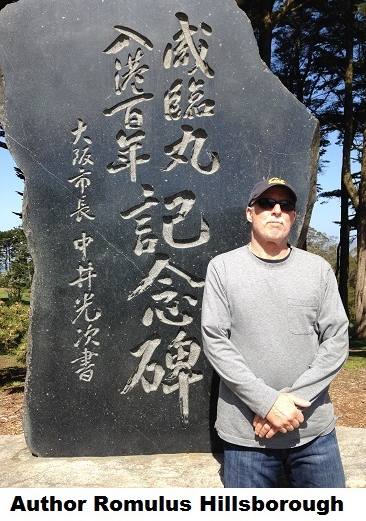
Recently the SA talked to Mr. Hillsborough (pictured here with the memorial tablet presented to San Francisco by Osaka in 1960 to commemorate the 100th anniversary of the Kanrin Maru’s voyage to that city-a voyage captained by Katsu Kaishu) about the book and some of the issues it explores. In the following interview, RH is author Romulus Hillsborough and SA is the Samurai Archives’ Randy Schadel. 


SA: Mr. Hillsborough, congratulations on the publication of Samurai Revolution and thanks for taking the time to discuss the new book with the Samurai Archives. Could you start off by letting our readers know a bit of your backgroundyour career, education, and travels?

RH: First of all, I would like to thank you for the opportunity to speak to the readers of your excellent forum. As for my background, I grew up in Los Angeles, CA. I have a BA in English and an MA in humanities. My passions are writing and reading (mostly, literature, history and philosophy). My favorite writers over the years have been (in reverse chronological order) Friedrich Nietzsche, Eugene O’Neill, Mark Twain, William Butler Yeats, Dylan Thomas, Akutagawa Ryunosuke, Shiba Ryotaro, Ernest Hemingway, and J.R.R. Tolkien. I practiced a Japanese martial art in an organization called Shotokan Karate of America (SKA), chief instructor Tsutomu Ohshima, for more than 30 yearsincluding in Los Angeles, Tokyo and San Francisco. Shortly after graduating from college I went to Japan, where I lived for around 16 years, and where I “came of age” as a writer. In the mid-1980’s I worked for popular Japanese magazines while researching and writing my first book, Ryoma: Life of a Renaissance Samurai, an historical novel. All of my other books were written after I returned to the United States in the 1990’s. My martial arts practice along with my experience living, studying and working in Japan have greatly influenced my writing. 

SA: Samurai Revolution is quite the ambitious work, weighing in at 600 pages and giving a comprehensive overview of the decline of the Bakufu (the Tokugawa shogunate) and eventual extinction of the samurai class. It spans the gamut from the earliest rumblings of foreign interference in Japanese affairs that pre-dated Perry’s Black Ships to the last throes of the samurai during the Satsuma Rebellion. It does an excellent job of explaining in an understandable and detailed manner the sometimes confusing shifts of allegiance and philosophy undergone by groups as well as individuals. Did you start off with the idea of writing such a comprehensive and detailed work, or did it take on a life of its own during the writing process? 

RH: When I conceived of a book focusing on Katsu Kaishu around the year 2000 (shortly after publishing Samurai Sketches), I intended to write a fictionalized “autobiography.” But after working on it for a while, I abandoned that format for two reasons. One was the dearth of published material about Kaishu in the English language. I thought that there ought to be at least one detailed, historically and culturally accurate non-fiction account of the life and times of such an important and interesting figure published for an international readership. I wanted this book to be the definitive portrait (it is not a biography in the traditional sense) of Katsu Kaishu in English. And I also wanted to make the book more of a comprehensive treatment of the Bakumatsu era than I had originally intended, presenting this history as the human drama that it actually is. To do so I needed to focus on the personalities of its leading players, giving them more attention than I would have in an “autobiography.” These include the last shogun Tokugawa Yoshinobu and his father Tokugawa Nariaki of Mito; their nemesis Ii Naosuke, the dictatorial regent to the boy shogun Iemochi whose assassination in the spring of 1860 was the beginning of the end of the Tokugawa Bakufu; Yoshida Shoin, Takasugi Shinsaku, and Katsura Kogoro, the three most important figures of Choshu during the Bakumatsu, posthumously succeeded by Ito Shunsuke (later Hirobumi, Meiji Japan’s first prime minister) and Inoue Monta (later Kaoru); Kaishu’s and Shoin’s teacher, Sakuma Shozan, perhaps the most brilliant of all, who even before Perry had advised the Bakufu to develop a modern navy to defend against Western imperialism; Saigo Takamori and Okubo Toshimichi of Satsuma, the leaders of the Satsuma clan and collectively the most powerful driving force behind the revolution; Shimazu Nariakira, the revered daimyo of Satsuma who died in his prime, some believe by poisoning by his own vassals; Sakamoto Ryoma and Nakaoka Shintaro, the two political outlaws (ronin) from Tosa who managed to unite Satsuma and Choshu in a political-military alliance that would change history and who were assassinated together shortly after Yoshinobu abdicated based on a plan formulated by Ryoma; and others who I will not mention here but who have also been given ample attention in Samurai Revolution

And during the eleven years it took me to complete Samurai Revolution (including two periods totaling about two years when I did not work on it), it did “take on a life of its own”actually it went through several metamorphoses. For example, my original intent was to end the book with the fall of the Bakufu and the peaceful surrender of Edo Castle as negotiated by Kaishu and Saigo. But as I approached the end of the story, I realized I could not simply drop itand let my readers wonder what happens next in this riveting human drama. So I included Book 2 to chronicle the rise of Imperial Japan. The definitive and culminating event during that era (i.e., the first decade of Meiji) is the Satsuma Rebellion; and the driving personality behind it is Saigo, for whom Kaishu had the courage to continue expressing his undying admiration, never once forgetting their friendship even after Saigo had died as an alleged “traitor,” stripped of his Imperial rank, for his supposed leading role in the Rebellion. I also thought that I would need an Epilogue to complete the manuscript, which at around 325,000 words was substantially longer than the edited published version. And so, in its final form, Samurai Revolution is a detailed examination and analysis of the Bakumatsu era through the eyes of Katsu Kaishu, who seemed to me the best spokesman for the era (for reasons I explain below.) Regarding the reason for the epithet “the shogun’s last samurai,” that is explained in the Epilogue. 

SA: Speaking of shifts of allegiance and philosophy, what was the catalyst that caused the Sonno-Joi (Revere the Emperor, Expel the Barbarians) groups to embrace Western learning and technology, dropping Sonno-Joi for Kinno-Tobaku (Imperial Loyalism, Down with the Bakufu)? 

RH: The short answer, I think, is an honest acceptance of reality around the summer of 1863, ten years after Perry first showed up. Until then Sonno-Joi had been embraced with religious zeal. In the summer of 1862, Takasugi Shinsaku, one of the leaders of Sonno-Joi in Choshu, traveled to Shanghai during the Taiping Rebellion. Upon arriving he was struck by the large number of foreign ships, many of them warships, in the harbor. And he was deeply troubled to see Chinese kowtowing to white men and the defilement of a Confucian shrine, which was being used as a British military encampment. He also observed modern weaponry, including breech-loading guns, at foreign merchant houses in the city. All of this convinced him of the futility of trying to take on the likes of Great Britain, France and other Western powers without first developing a modern military. He concluded that there was no room for Joi (“Expel the Barbarians”) in the Sonno (“Revere the Emperor”) equation, if the rebels intended to overthrow the Bakufu and create a modern Japanese state under the Emperor, strong enough to deal with Western imperialism from a position of poweras Takasugi’s martyred teacher, Yoshida Shoin, had espoused. But most Choshu samurai remained fanatically anti-foreignuntil Choshu was humiliated with the bombardment by foreign ships and brief occupation of its territory on the Shimonoseki coast by French troops in the summer of 1863. This, then, was the catalyst which forced them to accept the reality that Joi was impossible. A few days after the French occupation, Takasugi established the Kiheitai, Japan’s first modern militianot to “expel the barbarians” but to overthrow the government (i.e., the Bakufu) which had let them in. 

Meanwhile, Satsuma, the other leader in the Sonno-Joi movement, experienced a rude awakening of its own when it engaged British naval forces in its own front yard on Kagoshima Bay about a month after the bombardment of Shimonoseki. The British had come to Satsuma to demand reparation for the murder of a British subject, Charles Lennox Richardson, by Satsuma men at Namamugi in the previous year (the notorious Namamugi Incident, also known as the Richardson Affair). Satsuma refused and the British attacked. Though Satsuma put up a good fight, its forces were no match for the superior guns and warships of the British, which, in the words of Ernest Satow, who was aboard one of the ships, “dismounted some of their batteries and laid the town to ruins,” before retreating. As a condition for peace, however, Satsuma agreed to pay an indemnity and punish Richardson’s killers, though the second part of its promise was never fulfilled. As I wrote in Samurai Revolution: “But the Satsuma men learned an important lesson from the whole ordeal, realizing once and for all that they were not equipped to expel the foreigners by military force.” Ironically, the Satsuma men embraced the British as allies to help them build up their military in the gathering revolution. 

SA: Most works on the Bakumatsu center around figures of the Loyalist factions, most notably Sakamoto Ryoma and Saigo Takamori. However, Samurai Revolution uses Katsu Rintaro (usually known as Katsu Kaishu in the West), a vassal of the Tokugawa shogun, as its focus. What made Katsu the appropriate vessel to carry such a wide-ranging narrative? 

RH: Beside my own personal interest in Katsu Kaishu (he’s generally known by this name in the Japanese literature as well) both as a personality and an historical figure, and the lack of accurate and detailed information on him in English, he was one of the few men on the Tokugawa side who commanded the respect and goodwill of the Imperial Loyalists. In fact, he was more popular among the enemy side than among people in the Tokugawa camp, where he was widely reviled as a traitor (though he was not a traitor in any sense of the word)and this is an overriding theme in my book, as reflected in my use of the term “outsider” to describe him. (“Outsider” is included in the titles of each of the five Parts comprising the book.) And since he had many friends and allies among the Loyalists, including most notably Ryoma and Saigo but also Katsura Kogoro and others from Choshu, Satsuma, and Tosa, and even Anegakoji Kintomo, one of the two leaders of the Sonno-Joi faction at the Imperial Court until his assassination in 1863, Kaishu was able to see things from both perspectives. So much so that he eventually told his superiors in the Bakufu, “The Bakufu must willingly fall,” which is an astonishing pronouncement from a loyal Tokugawa vassal with the high position of commissioner of warships. And it was precisely his flexibility of mind and his moral and physical courage to admit that the Bakufu’s time had run out that earned him the respect of the other side and the enmity of his own camp. But for all of his honesty and pragmatic realism, he was loyal to the Tokugawa family to the bitter endwhich, I think, was one of the reasons that he embraced men such as Ryoma and Saigo to do the “dirty work” of actually overthrowing the Bakufuwhich as a samurai of the Tokugawa clan he was incapable ofalthough in his later years he did say about the Bakufu: “Eventually I brought it down myself.” 

SA: It’s somewhat ironic that the seeds of the shogunate’s downfall were found in the activities of Mito Han, itself a major Tokugawa branch house. However, despite being a major player in the early stages of the Bakumatsu, they soon were eclipsed by activists from Choshu, Tosa, and Satsuma. What differentiated Mito Han’s brand of Imperial Loyalism from these other han? 

RH: As you mention, Mito was one of the Three Tokugawa Branch Houses (the “go-sanke”), the highest ranking of all the han. And so even the most radical of the Loyalists of Mito never opposed the Tokugawa Bakufu itself. But Mito was the cradle of Imperial Loyalism, which sprang from the Mito school of thought called Mitogakuand the retired daimyo of Mito, Tokugawa Nariaki (Yoshinobu’s father), had coined the term Sonno-Joi. As such, Nariaki, one of the most powerful voices within the Bakufu, was the champion of the early Imperial Loyalism movement. And though Mito would never oppose the Bakufu, it would and certainly did oppose certain elements within the Edo regime that it found reprehensible and anathema to Imperial Loyalism, most notably Ii Naosuke, who was finally assassinated by a band of eighteen ronin, seventeen from Mito and one from Satsumathough it was the Satsuma man who actually killed the regent, cutting off his head. 

Mito Han is very difficult to comprehend, which makes it even more difficult to explain. And since I will include a great deal about Mito Han and Mitogaku in my next book, I will save further commentary about Mito for the future. 

SA: One of Mito’s most notorious acts was the assassination of the shogun’s Tairo (Great Elder of the shogunate), Ii Naosuke. Naosuke was the lighting rod around which anti-foreign sentiment seemed to coagulate, both for opening certain ports to foreign trade and the often heavy handed way he dealt with political opponents. Did Ii ever have a realistic chance of garnering support for the way he handled foreign relations, or was any action he took doomed to fail (either by angering the Western nations or the anti-foreign Joi factions)?  

RH: Kind of “damned if he did and damned if he didn’t,” right? Yes, I would agree with that. In fact, Ii Naosuke was probably no less anti-foreign at heart than his biggest enemies including the most fervent “barbarian haters” of Mito, Satsuma, Choshu, and Tosa. If he had had his way Japan would have probably remained closed. But, like Katsu Kaishu and other progressive thinkers of the time, Ii Naosuke was a realist. I wrote a lengthy chapter about these issues in Samurai Revolution, in which I argue that Naosuke demonstrated political courage in concluding the foreign trade treaties in defiance of popular opinion and even the Imperial Court itself, and that as the most powerful man in Japan, “he faced a dangerous and crucial decision—and in making that decision it appears that he had the welfare of Japan first and foremost in his heart. And in his mind—and indeed the minds of most if not all of the reactionary feudal lords of the Tokugawa camp—the Bakufu was Japan. But unlike many of his fellow antiforeign reactionaries, Naosuke had the sense to realize that if he refused the Americans’ demands for a trade treaty, he faced the very real danger of a devastating war. On the other hand, if he yielded to those demands, he knew that he would have to deal with a country of hotheaded samurai who violently opposed opening the ports to the barbarians, and that those samurai were led by his nemesis, Nariaki.” And so, he decided to conclude the trade treaties as the lesser of two evils, thus saving Japan from foreign subjugation. And for that and his crackdown on his political enemies, he was eventually killed. 

SA: While the men who specialized in spreading violence and murder (from the numerous Loyalist assassins to the Shinsengumi) often become the face of the Bakumatsu in popular culture, many of the intellectual leaders (teachers in particular) had a far greater impact on the course of Japanese history in the 1850’s and 1860’s. Many of the Bakumatsu’s most famous figures (on both sides) received their intellectual training and core values from these teachers. Obviously your central character Katsu Rintaro was one of these teachers, but even the teacher needed to be taught. Could you tell us about a few of the other more notable teachers?  

RH: Katsu Kaishu’s two greatest teachers, I think, were Sakuma Shozan of Matsushiro Han and Yokoi Shonan of Kumamoto Han. Sakuma was also the teacher of Yoshida Shoin and many other notable men. He was a compelling character not only for his foresight and brilliance (his influence on Japan can be seen up to WWII) but for his quirky yet strong personality. He married Katsu Rintaro’s younger sister and it was Sakuma who gave Rintaro the pseudonym “Kaishu,” which Sakuma himself had used. One of his cherished slogans was “control the barbarians through barbarian technology,” as he had advised the Bakufu as early as 1850, three years before Perry showed up. I introduce that slogan here because it sums up Sakuma’s ideas of how to deal with the dangers of Western imperialism. I wrote quite a bit about him in Samurai Revolution, including his significant influence on both of Katsu and Yoshida. 

Yokoi was the chief political advisor to Matsudaira Shungaku, the powerful daimyo of Fukui (a Tokugawa-related house) who served as the Bakufu’s political director. (Shungaku was also a personal friend and political ally of Kaishu’s.) Kaishu described Yokoi as profound; and in his profundity, Kaishu found him “frightening.” “I’ve seen two frightening men in my life,” Kaishu said years later, in the 1890s. One was Yokoi, the other Saigo. “Yokoi didn’t know that much about the West; I taught him a thing or two [on that subject]. But there were often times, when it came to the high tone of his ideas, that I felt I could never reach [his level]. . . . Although Yokoi was not very good at working on his own, if there was anyone around who could implement his ideas, I thought that the two of them [could accomplish great things.]” As it turned out, two of Kaishu’s closest confidants on the anti-Bakufu side, Ryoma and Saigo, did implement Yokoi’s ideas, which of course changed history. 

Sakuma, Yokoi, and Ryoma were assassinated. Saigo too met a violent death in the Satsuma Rebellion. Kaishu himself was nearly assassinated on several occasions. They lived in an exceedingly violent time. 

SA: The shogunate failed badly in two abortive attempts to militarily chastise the rebels in Choshu Han. This not only led to a loss of respect among their allied han and foreign nations, but also much resentment among the various han for the seemingly harsh attitude they were taking towards Choshu (who, after all, were seen by many as just trying to carry out the Emperor’s edict of expelling the foreigners). Was this the turning point of the Bakumatsu? Did Choshu’s military abilities, the Bakufu’s failure, and public opinion serve to isolate the Bakufu from all but their most hardcore allies?  

RH: I don’t think it was a turning point in the revolution, the first of which came several years earlier in 1860 with Ii Naosuke’s assassination. The next turning point I think was the Satsuma-Choshu Alliance, concluded in early 1866. Without the Satsuma-Choshu Alliance, and the help of Sakamoto Ryoma’s company in procuring weapons from foreign traders, Choshu would not have had the means to defeat the Bakufu in the war which broke out in the summer of 1866. So more than describing the war as a turning point, I look at it more as a nail in the coffin of the Bakufu, which was already tottering before the war startedwhich was why Choshu was able to win. But when Yoshinobu became shogun at the end of that year, things started to look better for the Bakufuand had he played his cards a little differently, and been more lucky at the game, he might have been able to revive the teetering regime that he had inherited. Of course, he did notbut I write about those things in detail in Samurai Revolution

SA: While the focus usually falls on Choshu Han as the driving force behind the anti-Bakufu factions, in many ways it seemed that it was Satsuma Han that determined the course of the Bakumatsu. From allies of the shogunate and sworn enemies of Choshu they abruptly allied with Choshuand during the early years of the Meiji Period became enemies of Choshu again. They seemed to be the true wild card of the Bakumatsu, never keeping to a consistent policy but rather adapting to opportunities as they presented themselves. While Sakamoto Ryoma’s part in securing the ‘Satcho’ alliance is well known, why was Satsuma even willing to ally itself with enemies? Did they see parallels between the treatment of Choshu and their own position, and perhaps thought that the increasing influence of Tokugawa Yoshinobu on Bakufu policy (he was not yet shogun) posed a danger to Satsuma?  

RH: There were numerous men and factors who influenced Satsuma’s decision (which was actually Saigo’s and Okubo’s decision) to ally itself with Choshu, including the ideas of their late revered daimyo Shimazu Nariakira, Satsuma’s relationship with the British, the ideas of Katsu Kaishu and Sakamoto Ryoma, and Satsuma’s (i.e., Saigo’s and Okubo’s) flexibility to seize an opportunity when it presented itself. The alliance with Choshu was such an opportunity, and the seeds of the alliance were planted in Saigo’s mind by Kaishu; and they were nurtured by Ryoma. But I feel that this question is far too complicated to do justice to in this forum. Therefore I refer readers to Samurai Revolution, in which I discuss in detail Satsuma’s history and ethos (which resembles the ethos of the ancient Spartans in its stoicism), the origins of the Satsuma-Choshu Alliance, and the roles of those two han, among others, in the overthrow of the Bakufu. But let me share one of my favorite Katsu Kaishu quotes here: “The difference between Choshu and Satsuma is that Choshu men make money to gain political power, whereas Satsuma men gain political power to make money. . . . A Choshu man will carefully write down his last will and testament to avoid being misunderstood after death. . . . But a Satsuma man is very straightforward. When he encounters a situation in which he knows he will die, he won’t utter a word.” Here, Kaishu was referring to the Satsuma ethos. 

SA: Yamauchi Yodo, the retired daimyo of Tosa Han, ruthlessly moved to purge the Loyalist element from his domain. He was well known for being an ardent supporter of the shogunate. Yet it was largely because of him that the last shogun, Tokugawa Yoshinobu, resigned from the office and returned power to Emperor Meiji. Why did such a loyal shogunate vassal end up working towards its removal from power?  

RH: All I will say here is that Yodo did not work to remove the Bakufu from power. Rather he worked to save the Bakufu and Yoshinobu from destruction by endorsing Sakamoto Ryoma’s plan for the shogun to abdicate peacefully and restore Imperial rule, thereby expecting a place for the former shogun within the new government. The detailed explanation to all of this is in my new book. 


Part 2 of our interview with Mr. Hillsborough will be forthcoming shortly and will touch on such topics as the early years of the Meiji Restoration, the Satsuma Rebellion of 1877, the advantages of writing about places an author has explored in person, assassination conspiracy theories, and even a bit of speculative history. For now, you can order “Samurai Revolution” on the SA’s Amazon store HERE or directly from Tuttle Publishing’s website HERE . Visit Romulus Hillsborough’s “Samurai Revolution” website for more about the book along with interesting essays and news items (such as documents recently discovered in Kochi sealed with Sakamoto Ryoma’s blood).
Friday, March 13, 2009

On Board With Dan Free, Author Of 'Early Japanese Railways'

Author Dan Free of "Early Japanese Railways 1853-1914: Engineering Triumphs That Transformed Meiji-era Japan" (released by Tuttle Publishing and available through the SA-Amazon Store) received a graduate degree in law from George Washington University in Washington, DC as well as an undergraduate degree in French (with a dual minor in German and Italian) from Ohio State University. He's also studied Japanese and Korean. Dan has traveled extensively in Japan, China, Korea, Indonesia, Singapore, Nepal, Myanmar, and Thailand. Early Japanese Railways represents the culmination of 25 years of research on Dan's part and is a comprehensive work tailored to both scholars and casual readers (see the SA review below this interview). In the following interview, SA is the Samurai-Archives and DF is Dan Free.

SA: Mr. Free, thanks for taking time to speak with the Samurai Archives. What factors led you to develop an interest in railroads, and Asian railroads in particular? Did your curiosity predate your discovery of the documents submitted in 1904 to 'The Locomotive Magazine' by Kashima Shosuke?

DF: I grew up in a time when the prospect of air travel was beyond the means of most people I knew, and a train or ocean liner journey provided the early image of what travel was meant to be - trains that offered staterooms that converted from seats into your bed at night, after you'd returned from the dining car and a full day watching mountains roll by under a glass dome set in the top of a passenger car - or at least that was how it was presented, and the concept seemed good enough to me as a child. So I was intrigued by railways out of wanderlust, I suppose.
My interest in Asian railways came considerably later as an adult. I had been an admirer of Isambard Kingdom Brunel, one of the great engineering geniuses of the first half of the 19th Century, and was in touch with several antiquarian book dealers in the UK specializing in railways and engineering to obtain materials on his Great Western Railway. By off-chance I ran across a packet of materials on turn-of-the-century Japanese railways among the stock of one of them. I'd been interested in East Asian culture generally since my teens and had by that time started a miserably small collection of Japanese ukiyo-e woodblock prints, so that packet was a curiosity that combined two of my interests. The lot turned out to be the Kashima Shosuke submissions, and of course those materials arrived a whole set of questions in tow and started a chain-reaction that two decades later led to the book.

SA: The book features a nice blend of power politics, tech, and cultural impact. Was this a conscious decision on your part to make it more accessible to a general audience?

DF: Yes. I realized that this was a classic example of a "niche market" book and that I had three constituents who might be interested: general readers with an interest in Asian history or culture, railfans, and scholars, and the trick would be to find the appropriate balance to please all three in order to appeal to as broad a market as possible. It was a bit like trying to find where the proper place to hit would be in a bull's-eye target that looked like a circle surrounding a three-point star. I never had any intent to produce something along the lines of the "Romance of the Orient Express" style coffee table books you find in a big-box bookstore, so I had planned to weight the book more heavily on a technical/scholarly bias, but as I got involved in the actual process of writing, realized that while an East Asian studies major would be conversant with the "railway colonialism" of the 19th Century, he or she wouldn't necessarily appreciate railway economics or engineering points and that a railway aficionado might have little if any grounding in Japanese history, and so on. So I found that I had to be sensitive to making sure issues and facts that I sometimes take for granted were put in proper context, at the risk of losing some readers' interest.

SA: The Tokugawa Shogunate granted the United States the first railway concession in Japan in early 1868-a short line from Yokohoma to Edo. However, after the Shogunate was ousted from power, the Meiji government refused to recognize the grant although they had agreed to assume all international agreements made by the Bakufu. Why was this done and how did the Japanese go about nullifying it?

DF: I think the ultimate reason that doomed the American efforts was the Japanese Government's fear of foreign control and the potential exposure to the dangers of colonization that was inherent in the Bakufu's concession, which envisioned that the projected line would be foreign-owned and operated. The new government hinted at this in its insistence that the line be built as an undertaking of the Japanese people - I forget the exact words. What was presented on its face as a matter of national pride and honor actually was masking the fear of colonization that was the chronic bête noire for the new Meiji government's policy makers. They couched matters this way for positive spin, as it was naturally not a subject openly discussed with their Western counterparts. The Japanese at the time had to play a very careful and delicate game of playing one power off against the other, all the while not becoming too dependent on any one of the powers at their doorstep. At bottom line, the Japanese government saw it as too big a step down the slippery slope of endangering the survival of an independent Japan. What I find intriguing and unanswered is why the American Resident Minister Van Valkenburg, his successor DeLong, and the Deputy Secretary of Legation Portman didn't actively push the concept of a compromise where the American government would agree to Japan financing (through American banks or markets or by its own means) and owning the railway, but build it using American equipment and technical advisors, which is, after all, how the project ultimately was structured with the British. We know that in the course of the negotiations the Japanese foreign minister offered to trade the railway concession for some other thing of value to the Americans, but no one at the American Legation seemed to have taken this as an opening to explore restructuring the terms of the grant to calm Japanese fears, while still salvaging a potential for American involvement as the source of equipment and technical advise.

SA: The early decision made by the Meiji government to adopt a smaller rail gauge (3' 6") for their system than was generally used worldwide (4' 8 1/2") was to have far reaching consequences. How might the Japanese rail industry have developed differently had they used the Western standard?

DF: The ramifications of that decision - and who actually made it is still not a settled point of history - are still rippling today, and the "what-if" scenario for the Japanese rail industry is timely. The three factors of the opening of access to the Trans-Siberian Railway to external shippers with the dissolution of the Soviet Union, the increased cost of petro-fuels, and the hazards of piracy off the Horn of Africa on the main Asia-Europe sea route have all combined to make the prospect of shipping Japanese goods to the markets of Europe by rail not only within the realm of feasibility, but increasingly attractive. China and Korea's railways are fortuitously both built to the standard gauge of 4' 8 ½“ used in almost all of Europe, and the US for that matter. And the simplest route would be across the narrow strait dividing Japan from Korea, then to China for transit through Manchuria, and on to Europe via the Trans-Siberian. There would be a notable time savings over the ocean route, and there would be a dramatic savings in fuel cost compared to a land route using conventional trucking. The problem of North Korea is an obvious stumbling block in such a scheme, but North Korea could be by-passed by rail-car laden ferries calling at Chinese ports, and Dalian or Lushun come to mind immediately. The Russian gauge of 5' is close enough to Europe's, China's, and Korea's that adjustable wheelsets could be devised for the railcars to handle the 3 ½ inch difference. This has been done for trains changing gauge at the Franco-Spanish border where there’s a break in gauge. But the gauge of Japan’s freight railway system is an obstacle. While the Shinkansen “Bullet Train” system has been built to the worldwide standard of 4’ 8 ½", freight traffic is still confined to the old 3' 6" gauge network, and for safety reasons, it isn't smart to have slow-moving freight trains moving in and out of passing sidings on a high-speed passenger network that is already congested enough. If you add one more "what-if", the equation becomes even more intriguing. What if Japan's colonial administration of Korea had been much more benign and focused on assisting Korea in attaining early independence rather than absorption into the Japanese state such that the two nations were now friendlier and on more trusting terms today? At some 33 miles, Japan's Seikan tunnel linking Hokkaido with the mainland is the world's longest undersea tunnel, beating the Channel Tunnel by a couple of miles, yet few people in the West are even aware of the fact that it exists. The Strait of Tsushima that divides Korea and Japan is only about 100 miles wide, conveniently interrupted roughly mid-way by the island of Tsushima. If Japan and Korea had had a less acrimonious history that now haunts them, and Japan had adopted "Standard Gauge", would we be reading press releases today about construction of an undersea tunnel linking the two nations, the prospect of shipping Japanese goods to Europe via the Trans-Siberian, and the possibility of stepping onto a Bullet Train in Tokyo bound for Seoul?
The other side of the coin is the fact that it was the congestion and inadequacies of the Japanese narrow gauge lines that gave rise to the decision to build an entirely new network fresh from the ground up in the 1950s that came to be the Shinkansen or "Bullet Train" network. It was a very bold step when taken and hand-in-glove with it came the decision to be bold when planning for high speeds. If Japan had an existing Standard Gauge network in place, it is possible that a much more timid and budget-conscious approach might have been taken to traffic congestion problems in the 50s, and rather than a solution resulting in the so-called Bullet Trains, it might have been much easier and less risky to have simply quadruple-tracked the existing lines and use conventional trains.

SA: As you point out in the book, the Japanese armed forces were generally opposed to the early rounds of rail construction (citing foreign influences, clashes over budget allocations, and conflicts over the use of land controlled by the military). What in your opinion was the turning point that brought them 'on board', so to speak, becoming enthusiastic backers of the railroads and increasingly involved with the planning behind them?

DF: I think the point was driven home in a two stage process, and as often seems to be the case, not because the concept carried the day in principle, but because railways were put to the two separate "acid tests", didn't fail, and actually made the job of logistics easier for the military. This latter point seems absurdly obvious today, but there were deeply reactionary skeptics among the military in Japan in the early Meiji era who doubted that privately owned railways would be capable of coordinating transport and supply movements of such magnitude and could be - or ought to be - relied upon in times of national emergency. It was a concern of the era that wasn't unique just to Japan. The mid- to late 19th Century was a time when a spirited polemic was swirling in Europe and the US on just that point, when the state-owned systems of Russia, France, and Prussia/Germany were often cited as examples giving those nations a military edge in time of war over the UK and US with their publicly owned and operated systems. There were only about 65 miles of railway lines in Japan at the time of the Satsuma Rebellion in 1877, in two segments no less that were not even inter-connected. What support they provided was undoubtedly a welcome "nicety", but this probably served enough of a purpose to make more forward-thinking minds take note and enough to end the days of real, active opposition. But there was still a lingering concern among military thinkers that Japanese railways could be captured by invading powers and used against the Japanese. To the extent there was an actual "Eureka Moment" then it would have to be the Sino-Japanese War of 1894-95. Here was Japan, "little Japan" to paraphrase some of the commentators of the day, taking on China, the most powerful nation in Asia for century upon century. The Japanese railway network at that point stretched from Hokkaido in the north, down the entire length of the main island Honshu, with transversal lines accessing both coasts along the way, to Hiroshima, and had also reached into Kyushu. Out of necessity, the military discovered that the Government and publicly owned railways that formed the system could indeed coordinate their movements and sustain heavy transportation of critical resources and troops from almost every corner of the nation to ports of embarkation in southern and western Japan at levels never before attainable in Japan. China on the other hand had only one rail line, from Beijing to just beyond Shanhaigun, where the Great Wall met the sea in Manchuria, and precious few of its resources and troops from its vast interiors could be brought to the theatre of war as quickly and easily as Japan was able to, thanks in large part domestically to Japan's rail system. By the war's conclusion, the military thinkers had been converted almost en masse and they could barely contain their eagerness to be involved more closely in state policy and regulatory matters concerning railways.

SA: One of the more interesting side stories in the book deals with 'Jinsha Tetsudo', or human powered railroads. These non-mining railways literally used manpower to push small railcars to local destinations, although the distances on some lines featured impressive levels of mileage. Were these unique to Japan, or did the Jinsha Tetsudo have parallels in other industrialized countries?

DF: The key to this were two facts: Japan was horse-poor and Japan was capital-poor. There are any number of examples in both Europe and America, when a nation was in the infancy of its industrial development, of railways initially being horse-drawn - in fact in the early 1830s almost every nation that started building railways had tried it. Horses used to draw trains up what is now Park Avenue in New York City before the tracks were built under it, for fear passing steam locomotives would scare the horses in other traffic. But horses were a scarce and expensive commodity in mid-19th century Japan. On the other hand, human labor was cheap and plentiful. Japan simply borrowed a page from the industrial revolution playbook that had gone out of vogue in the West by, say 1839 or so, and with the usual Japanese ingenuity, adapted it to its own purposes. If the horses for hansom cabs or hacks like there were in London, Paris, Berlin or New York are too scarce and expensive, then we'll create the rickshaw. If we can't afford an expensive steam locomotive imported from England, or even horses imported by way of British India or California, then we'll make do with a railway powered by human runners - and that was the solution hit upon by small, rural railways serving villages where the traffic potential would never have justified the outlay for a stable of steam locomotives. So, while the concept was uniquely Japanese in inspiration, it was based on horse-drawn antecedents from the earlier days of the industrial revolution. As far as other Western industrialized countries go, I know of no man-powered railways that ever existed - it was cheaper in the long run in the US and Europe to buy and feed a horse than to pay a crew of men. But by the time Japan had become a colonizing power and raised its standard of living to the point where the Jinsha Tetsudo's days were numbered domestically, it built other examples of the Jinsha Tetsudo in both Korea and Taiwan - again, two countries where horses were scarce and expensive and where there was cheap and plentiful labor.

SA: While the railways were best known for their role in economic development and military matters, they also had a major impact on the common people as the rail net slowly tied together every province of Japan. How was the life of an average Japanese citizen enhanced by this new technology?

DF: In ways no less that it did in America or Europe. This is where certain universal principles of what railways have done globally for the world's standard of living start to become clear, but the most profound change in Japan was in large part unfelt, in the "social safety net" it provided. Many country folk in Japan at the dawn of the Meiji era were living at close to a subsistence level. Imagine trying to feed a population with emergency food supplies in times of famine or natural disaster using porters and the occasional pack horse or ox as transport, and imagine that many of the backcountry roads were so narrow that traffic had to go single file along some stretches. That was the situation before railways. As railway stations opened, medicines not readily attainable in small towns came to be distributed more easily, and canned food as well. Specialized tools or other items not yet manufactured in Japan became more easily available. Ideas spread as the people who brought them were able to travel. Journalism grew as newspaper circulation increased due to railways handling of mail, newspaper, and parcel services, and with that, the seeds of a modern public opinion started to sprout. The possibility of shipment of fresh food in from outlying agricultural areas meant cities were able to sustain larger populations, who arrived from smaller towns by rail to take the jobs being offered by the new industrialization starting to take root. The list goes on...
SA: What type of adaptations did the Japanese make in the locomotives and rolling stock built for them by the British, Americans, and Germans? Were there any unique contributions made to railroad technology by Japanese designers? In your opinion, what was the most successful Japanese-built locomotive design of the pre-WWI era?

DF: There were few notable ones in the Meiji era, other than small modifications. Much rolling stock tended to be ordered from Western manufacturers "straight from the catalogue" and not special-ordered, to keep cost low. The first Meiji adaptation that comes to mind is that seats on domestic-built passenger cars in those times were often made deeper, so that a person could sit cross-legged in traditional Japanese style. Freight train cabooses or brake vans were seen as additional expense items for many railways during the Meiji era, so costs were saved by building a small cabin in box cars for the brakeman to ride in. You'll also notice in many of the photographs in the book that the cylinders that drove the connecting rods and cranks on locomotives were often inclined on an angle, which is much less prevalent in British, German or American steam locomotives of the day. This was done in part to give the front wheels added lateral clearance on the tight curves used on some of the narrow gauge lines and due to the tight loading gauge originally used in Japan. Of course, one of the most lasting adaptations, not to locomotives or rolling stock but to railway passenger operations, was the creation of the ekiben - the pre-packaged box lunch still sold in stations today. The truly revolutionary contributions Japanese designers were to make to railway technology would have to wait for the 1960s when they showed the world what the future of railway passenger transportation could be with the Shinkansen network. As far as the most successful pre-WWI era design, this was undoubtedly the 9600 class locomotive, which was introduced just before your cut-off point. They were initially intended as slow speed heavy freight locomotives or mountain helper units, but proved to be very serviceable Jack-of-All-Trades and lasted to the very end of steam in Japan.

SA: As they are wont to do, the Japanese rapidly conquered the basics of railroad construction, phased out the foreign experts they had employed to help get them started, and began to set themselves up as exporters of rail technology to other locations in Asia. Did the Japanese model of exported rail construction differ significantly from, say, Britain's? Was it perhaps more suited to the tighter budgets and economic conditions found in China and Korea?

DF: On lines like the former "Swatow - Chaochowfu Railway" in southern China, where Chinese administrators and investors hired the Japanese to serve as engineers, supply the equipment and rolling stock, and staff operations, they could be very cost-conscious, yes. On lines like the South Manchurian Railway, where national prestige was an issue because the line was one of the prizes of the Russo-Japanese War, and where there was a hidden political agenda in play, the Japanese built boldly, solidly, and to top quality, but seldom squandered resources on unnecessary extravagances.

SA: Early Japanese Railways features an impressive display of period woodblock prints, photographs, postcards, advertising materials, timetables, and other visual aids-all of which are owned by you. Please tell us about the various sources you've procured these items from. Many of the captions are quite detailed, far exceeding the level of detail seen in other books. Was it difficult to ‘place’ many of the photos both as to location and on a timeline?

DF: Any flea market, second hand bookstore, antique dealer, print gallery, post card collectors' convention, or antique fair became fair game. If I saw an old photo album at yard sale, I'd glance through it. It was something I came to be always on the look-out for. And yes there were quite a number of photos that presented challenges. One example is the photo of the first line of railway to be abandoned, which gave rise to a good bit of research to determine its route, in order to confirm that it ran alongside a river, as seen in the photo. A large number of the station photographs had to be checked to see whether the image was that of the first station building to be built, or a later replacement. The names of towns or stations could have changed, so I started to collect and buy any good Meiji or Taisho era atlas I could find to check route and right-of-way questions. The photo of the troops and horses at Muroran station gave me concern, as I suspected the uniforms might have been later in the WW I era. I had launched into researching Japanese military uniforms of the Russo-Japanese War and WW I before one of my correspondents in Japan was able to write that he had found an old newspaper article pin-pointing the troop movement in question to the Russo-Japanese War. Two of the photos ultimately not included in the book showed the aftermath of a railway yard and station after severe flooding, and while I felt fairly certain of the identity of the railway line, and could roughly guess an approximate date, there were no clues as to the name of the station. Again, several of my correspondents in Japan joined in the fun, and I can remember at one point we were attempting to guess the location based on which towns had a known pickle-producing industry in Meiji times, as there were numerous pickle barrels to be seen on the loading platforms or scattered about as débris in the photos. We never did succeed in pinpointing the station. Other times, information fell into my lap like ripe fruit. While I was researching a totally different issue, I unexpectedly ran across a reference to the date Otaru harbor improvements were made, which permitted me to give an approximate date to the photo of the hoisting gantry and construction locomotive on the breakwater being built in the harbor there.

SA: During your extensive research done for the book, did you run across any information that surprised you or challenged any pre-conceptions you might have had?

DF: I was surprised when I found the official US diplomatic correspondence that surrounded the original Tokugawa railway grant. Most of the other histories I had read rarely mentioned Anton Portman, and most failed to mention that he was the deputy chief of the US legation. I suspected that if there were anything of worth to be found in the official diplomatic records, some historian before me had already been there, and the fact that there was nothing of note mentioned in the histories I had read was an indicator that there would be nothing to be found in the diplomatic dispatches. So I was amazed when I found the materials emanating from the US Legation in Tokyo. I had started the book with the notion, obtained from British commentators and Japanese writers in English of the late 19th / early 20th Century period, that the breakdown of the Horatio Nelson Lay financial arrangements was something of an "unfortunate but innocent amicable misunderstanding." After I had obtained the US diplomatic materials, saw who was involved on the Japanese side, worked them into the existing timeline, and realized their import, I started to look more closely at the career of Mr. Lay, and came away convinced that there was a darker side to things - and that perhaps the British and Japanese writers of that era were being more circumspect in what they wrote out of a desire to gloss over past difficulties and put recent unpleasant dealings behind them. I was well along in later chapters of the book when I found those materials and I knew immediately that the first chapters would have to be substantially re-written. I think mine is the first book in English to bring this information to light.

SA: You submitted your manuscript to Japanese rail historian Dr. Aoki Eiichi for review. Did any major changes arise from this or it was it more of a 'fine tuning' process?

DF: Dr. Aoki's review didn't result in major changes, no. What it did result in was the usual number of "fine tuning" corrections, as you said, but more importantly the addition of a very generous amount of additional details and encouraging suggestions as to where I might add more exposition that would be worthwhile. Dr. Aoki was unbelievably kind in adding some notes that fleshed out additional names and dates and added elements of interest.

SA: What other books might you recommend to readers looking for more on the subject of the Japanese railroad industry? Are you currently working on any other projects?

DF: For English-language books, two come immediately to mind. The first is "A History of Japanese Railways 1872 - 1999", a collaborative effort in English by Prof. Aoki, Mitsuhide Imashiro, Shinichi Kato, and Yasuo Wakuda, East Japan Railway Cultural Foundation, 2000, ISBN 4-87513-089-9 and well worth having. The second is the Harvard monograph of Prof. Steven Ericson, "The Sound of the Whistle", Harvard Council on East Asian Studies, 1996, ISBN 0-674-82167-X which details the history of finance and state policy decision making concerning railways in the Meiji era far better that I could ever have done. For those who read Japanese, the ultimate is Japan National Railways' ten-volume official history which was produced in 1972 on the hundredth anniversary of railways in Japan, now unfortunately out of print and increasingly hard to come by even in Japan. For modern railways, Prof. Christopher Hood has produced a timely volume titled "Shinkansen: From Bullet Train to Symbol of Modern Japan", Routledge, 2007, ISBN 0415444098. To answer your second question, yes, I've turned my attention to China and have started work on a companion volume on railways there before 1914.

SA: Thanks, Mr. Free-it's been a real pleasure speaking with you.

Saturday, February 28, 2009

Early Japanese Railways 1853-1914: Engineering Triumphs That Transformed Meiji-era Japan

When we received Early Japanese Railways by Dan Free, we weren't quite sure what to expect. Would this oversized 288 page book be a tech-heavy examination of the nuts, bolts, and hardware involved in railroad building, heavy on the industrial jargon and light on history? Perhaps an examination of the cultural, economic, and political implications that the railways had on Japan? A collection of anecdotes and travel diaries? A coffee table book backloaded with photos and prints? Well, after an in-depth examination, it seems that Free has managed to pull off something special-a book that combines all of the above features and manages to do them justice. It's an impressively well written and even more meticulously researched work that Free has spent 25 years working towards, and a welcome new addition from Tuttle Publishing.

The book begins by dividing the timeline up into themed chapters: The Introduction Of Railway Technology (including the initial rail concession by the Tokugawa Shogunate to the United States), Intrigue, Influence, and Incompetence (the early days of British dominance of the Japanese rail industry and the planning phase of the Meiji rails), Building the First Railway (Yokohama to Shimbashi in Tokyo), Kobe To Kyoto (the first rails in central Japan), Otsu, Tsuruga, Nagahama and East to the Nobi Plain (as the network becomes more connected), Expanding and Integrating the System (more of the same), The Second Railway Mania and the Russo-Japanese War, Nationalization and Self-sufficiency, and Tokyo Station (the final link in a rail system stretching from the north of Hokkaido to the south of Kyushu). Particularly interesting to Samurai-Archives readers will be the early chapters where the political double-dealings and diplomatic blunders committed by both the Japanese and Western powers are laid out in impressive detail.

For instance, the Shogunate's rail concession to the United States (although legally binding to the Meiji government) was seen as something to be negated by the former enemies of the Tokugawa who now found themselves in power. Using the time honored Japanese techniques of stalling, failing to reply to diplomatic requests, and not addressing any of the real issues when a reply was given, the Japanese diplomat Sawa Nobuyoshi ran rings around American diplomat Charles DeLong, taking full advantage of his inexperience in the world of international relations. Instead, seasoned politico Harry Parkes of Great Britain managed to maneuver his country into overseeing and supplying (at great benefit to the coffers of English businessmen) the embryonic Japanese rail industry. Closely tied to this are the examinations of the effect of railways on the Japanese economy, and how it in turn aided the rapid development of other industries. Initially relying on foreign suppliers and engineers (not to mention cash strapped by the extravagance of British construction methods), the development of Japanese engineering and the eventual replacement of foreign experts and suppliers by 'home-grown' ones shows that the long term goal of 'sonno-joi' activists years before actually did see the light of day. In fact, Japan turned the tables, being a major exporter of rail expertise and supplies to its Asian neighbors. It's also shown how the former samurai class managed to stay among the ranks of the elite by using their government buyouts to become one of the biggest investors in railroads. The hand in hand relationship of Japanese industry with the government is shown in the switch from a national railway system to private industry and back again. The increasing dominance of the military in the political sphere can be seen by the growing influence of the army in rail planning decisions.

The effects on the culture of Japan are well documented as well. A national network of rail lines that connected every province had wide reaching repercussions, encouraging travel, trade, and nationalism. Electric lines, tram cars, and the fascinating Jinsha Tetsudo (commercially viable railways operated by manpower) are also examined in detail. Many of Japan's hot springs became famous during this era as these low cost options made them accessible to everyone. With railways and industrialization came more disposable income and a higher standard of living for the Japanese people. The special 'Imperial Trains' of the Meiji Emperor are also given a detailed examination. When the text threatens to become bogged down with facts and details, Free is always ready with an amusing story to break things up. Whether it's a fussy English traveler's complaints about trainboard amenities, early field surveys being thrown off by the refusal of samurai to remove their swords (the metal threw off the calibrations of the instruments being used), or former American President U. S. Grant being chased down a corridor of Shimbashi station in 1878 by a crowd of girls (seems Grant was the Brick McBurly of his day), Free never forgets the human side of railway development.

That's not to say there isn't plenty of technical information. Free has done his homework and if you want to know what company built what line, where it ran to, what the rail gauge was, what their company shamon looked like (along with the visual puns on kanji they incorporated), the arrangement of the running lights, the technical specifications for the locomotives and rolling stock, numbering schemes, and virtually anything else, it's a good bet you'll find it within these pages. Free has taken care not to let the hard information dominate the book, as much of this is related in picture captions and in the amazing compendium of information in the book's appendix (which also includes a helpful list of 'Dramatis Personae' with short biographies of the major players, a Japanese railway/geography lexicon with kanji, and notable documents pertaining to the rails in the political arena). That being said, one area that the book falls short in was not including a simple line drawing of a representative locomotive with rolling stock labelling the different parts of the machinery with an explanation of each part's function. As the book is aimed at a general as well as a scholarly audience, many readers will be in the dark about what many of the things being talked about mean. While most readers will eventually come to know what a '4-4-0' locomotive is, they'll be left scratching their head the first time they see it. Overall, though, Free does a good job of explaining the evolution of locomotive design and also the differences in the British, American, German, and (later) Japanese designs that were used.

The book would be perfectly capable of standing on its own as a picture book. It is loaded with quality photos and prints, both in color and sepia. Free gives these the same care he shows the rest of the book, with detailed captions pointing out things going on in the photographs that are easily missed. Any train enthusiast would be thrilled to have this book on the basis of the images and the appendix alone.

Finally, the quality of the writing and the research behind it is superb. The bibliography, although containing only a handful of Japanese works, is extensive. Free submitted his manuscript to Aoki Eiichi (famous Japanese rail historian) for review and comments, and solicited help in securing information from many museums and individuals within Japan. Unlike many books aimed at a general readership, you'll find few, if any, factual errors within its pages. How meticulous is Free? So meticulous that his book listing on Tuttle's website includes an errata page detailing the few grammatical errors made within (not that there are that many-you'll probably find more just within this review). If every author took the care that Free shows, there would be a lot less eye rolling on the Samurai Archives.

Whether one has a scholarly interest in the impact of railways on development of the Meiji era or enjoys being a dedicated 'train spotter', they'll find a lot within these covers to keep them busy. As we read through the book, it struck us that the history of the rail industry in the Meiji era was a metaphor for the country as a whole-a sentiment Free shares in his concluding remarks. "Few would be able to find a better-suited microcosm more emblematic of the development of the Japanese nation as a whole during the Meiji reign". Early Japanese Railways is a rare example of a work that combines technical excellence and a plethora of information with a lively writing style that always gives the human element its due. Combined with an excellent graphical presentation of hundreds of rare photographs, advertising material, timetables, maps, woodblock prints, and postcards, the book provides a fascinating glimpse of Japan as it moved from self-imposed seclusion to being the 'most Western of Eastern nations'.

Early Japanese Railways: 1853-1914 is available through Amazon at the Samurai Archives store HERE. We'll also be running an interview with the book's author, Dan Free, within the next month or so.