Showing posts with label Shinsengumi. Show all posts

Saturday, April 26, 2014

Katsu Kaishu, Navigator Of Chaos: An Interview With Romulus Hillsborough, Author Of “Samurai Revolution”, Pt. 2

We’re happy to present our readers with the conclusion of our two-part interview with Romulus Hillsborough, author of the recently published Samurai Revolution: The Dawn of Modern Japan Seen Through the Eyes of the Shogun's Last Samurai. You can read part one of the interview HERE. In the following interview, RH is author Romulus Hillsborough and SA is the Samurai Archives’ Randy Schadel. 

SA: One of the more difficult concepts for newcomers to Bakumatsu studies to understand is why the new Imperial Government felt the need to use military force against the Tokugawa after Yoshinobu had resigned the office of Shogun and returned power to the Emperor in 1867. Satsuma and Choshu (in conjunction with some highly placed Court nobles) even went so far as to forge an Imperial edict to attack the Tokugawa and put together phony Imperial flags for the Satcho army. Was this simply a case of the Loyalists led by Satsuma and Choshu wanting to ensure that the Tokugawa would be eliminated from national politics beyond a shadow of a doubt? Or was there evidence that Yoshinobu still had plans to retain his primacy in the political arena? 

RH: Regarding this complicated issue, I refer readers to Samurai Revolution since I wrote quite a bit about it there. Let me just say here that the Imperial Court refused Yoshinobu’s request to abdicate and restore Imperial rule in the Tenth Month of Keio 3 (1867) because it wasn’t yet ready to accept the burden of governing; then after the coup in Kyoto in the next month, by which the Bakufu was abolished, Yoshinobu was deposed and a new provisional government was established under the Emperor, Yoshinobu no longer intended to step aside peacefully-which was why he sent 15,000 troops from Osaka to crush 5,000 enemy troops, mostly of Choshu and Satsuma. They clashed at Toba-Fushimi on the way to Kyoto and, of course, the Bakufu side was defeated. 

SA: Throughout Samurai Revolution you’re also quoting extensively from the accounts of foreign diplomats and officials, giving their contemporary viewpoint on the Bakumatsu. This gives a valuable outsider’s look at the proceedings and just what the ‘foreign devils’ responsible for much of the unrest thought of what was transpiring. Despite the fact that the English actively supported the Loyalists and the French the Shogunate (with the Dutch watching their own interests, the Russians chipping away at territories north of Japan, and the Americans largely staying out of things due to being involved in their own Civil War) when the actual fighting began in the Boshin War, the Western nations agreed to not become involved and remain neutral. What was it that kept the Western nations out of the conflict and perhaps spared Japan the fate that China suffered at the hands of the European and American powers? 

RH: I will not state the reasons that the foreign governments agreed to stay out of the internal conflict in Japan. However, I will say a little about France and Great Britain. Napoleon III, it seems, lost his stomach for overseas adventure, which was why the Bakufu lost France’s support in the latter part of Keio 3 (1867). Great Britain, on the other hand, wanted to secure its lucrative Japan trade, which was predicated on political stability in Japan. This was part of the reason that Ernest Satow published his essays, “English Policy,” in the Japan Times in 1865-66, in which he argued that the best means of assuring political stability in Japan was through a council of powerful feudal lords, including the shogun and his senior councilors, under the authority of the Emperor. Of course this resembles Sakamoto Ryoma’s great plan for the shogun’s abdication and restoration of Imperial rule, which he wrote down aboard ship in the summer of Keio 3 (1867). 

SA: The dramatic highlight of the book comes when your two central figures, Katsu Rintaro of the Shogunate and Saigo Takamori of the Imperialists, come together in early 1868 to save the city of Edo from destruction. While it is often assumed that Katsu was negotiating from a hopelessly weak position and threw the city’s fate on the mercy of the Imperial faction, it actually appears as if he had quite a bit to bargain with militarily-particularly the Tokugawa navy. There was also the fact that of all the Tokugawa vassals, he had the best relationship with the leaders of the Imperialists. Nonetheless, the negotiations were dicey with the behavior of extremists on both sides threatening to escalate the situation into all-out warfare. Through it all, Katsu continued to work towards ensuring Tokugawa Yoshinobu’s safety and the financial/political security of Tokugawa vassals. Had there not been such a strong preexisting bond between Katsu and Saigo (or had some other leaders headed up negotiations), was it likely that the city of Edo would have been destroyed-perhaps triggering an all-out civil war rather than the scattered fighting of the Boshin War? 

RH: The short answer is yes, I think so. Katsu Kaishu himself stated as much in his narrative, Kainanroku, which he wrote in 1884. And later in the 1890’s in an interview he said that had the Imperial Army sent anyone other than Saigo to speak with him, that person would have laid the blame for the dangerous situation on the Tokugawa, or on Yoshinobu, or on the troops who had fled the city, or on Kaishu himself, and “the talks would have broken down immediately.” However, like so many other things in history, nothing (or I should say, very little) is black and white. Consider this: Saigo had been forewarned by Sir Harry Parkes, the British minister to Japan (Satow’s boss), not to punish Yoshinobu or attack Edo, since the former shogun had already given up. “Killing the former leader of the nation, Parkes asserted, would violate international law. In the eyes of the rest of the world, as long as the Tokugawa agreed to surrender the castle, the Imperial Army lacked a moral justification to attack. Furthermore, Parkes warned, to launch an attack without first officially notifying the foreign representatives in Yokohama and safeguarding the lives and property of the foreign community smacked of anarchy.” (Samurai Revolution

SA: One of our favorite quotes from the book comes on page 522 courtesy of Saigo Takamori. In responding to a Satsuma man in the Meiji period who remarked that they would now be able to get rid of the foreigners, he states “Are you still talking about that? That was just an excuse to overthrow the Bakufu”. Among the higher-ups in actual positions of power among the various Loyalist han, do you believe that disenfranchising the Tokugawa was always the central goal and that Joi was only a means to garner support? 

RH: Originally, no-but after the summer of 1863, yes. Remember what occurred in Satsuma and Choshu that summer. Both of those han, leaders in the “expel the barbarians” movement, were punished by foreign warships in their own backyards – Satsuma by the British, and Choshu by American and French forces. After that they realized that Joi was impossible without first modernizing their militaries, for which they needed to trade with foreign nations. For further details, I refer readers to Samurai Revolution

SA: Saigo’s Rebellion (the Satsuma Rebellion/Seinan Sensou/Southwest Campaign of 1878) is usually seen as the last stand of the samurai, lashing out at the Meiji government for their loss in status and other assorted grievances. Saigo is often portrayed as aggressively spearheading the movement, most notably in works of pop culture like the film “The Last Samurai” (in the person of his cinematic ‘stand-in’, Katsumoto). But historically, it seems that Saigo ended up as the leader of the anti-Meiji forces almost by accident. Was he the reluctant leader he appears to have been, and if so, how did he end up in that position? 

RH: I wouldn’t say it was by accident but rather by circumstance. Saigo, after all, was probably the single most powerful driving force behind the revolution. And, as you will recall, he was hailed as a hero and natural leader by disgruntled samurai not only in Satsuma but throughout Japan. And, as I have explained in the book, Saigo was an extremely complex and enigmatic personality. Analyzing him is extremely difficult and sometimes he is impossible to understand. But as I write, he had “a genuine and reciprocated affection” for the Emperor. I quote Donald Keene that “absolutely nothing suggests that Saigo . . . had hoped another form of government might replace the monarchy,” based on his Confucian ethic that (in my own words) “the Emperor must rule according to Heaven’s will.” But he hated the corruption in the Meiji government. His ultimate objective in the Satsuma Rebellion (even if he did not actually start it) was, according to Keene, “to rid the emperor of the corrupt officials surrounding him so that he might rule undisturbed by their evil influence.” 

SA: The assassination of Sakamoto Ryoma in many ways is the Japanese version of the Kennedy assassination in America. While Shinsengumi chief Kondo Isami was unjustly executed for the crime and Imai Noburo of the Mimawarigumi later confessed to it, there are seemingly dozens of theories as to who the perpetrators were. A popular one is that it was agents of Satsuma or Choshu (Ryoma’s ostensible allies) who were concerned that Ryoma meant to work to include the Tokugawa in the new Imperial government or that Ryoma actually intended to maneuver himself into the government’s top spot (in effect, filling in the ‘three blank circles’ on one of his manifestos). What is your preferred theory? 

RH: I don’t have a preferred theory. 

SA: In your opinion, what impact might it have had on Japanese history if Tokugawa Yoshinobu been named Shogun instead of Tokugawa Iemochi in 1858? 

RH: I think it is safe to say that had Yoshinobu become shogun at that time, Ii Naosuke would have been defanged, and therefore would not have been able to purge his enemies from the government or to conclude the trade treaties without Imperial sanction. Therefore, he would not have been assassinated. And since his assassination marked the beginning of the end of the Tokugawa Bakufu . . . well, I think you can see where I’m headed with this logic. However, I prefer not to elaborate further in this forum, because I will discuss this in detail in my next book. 

SA: As well as providing an engaging narrative, we found Samurai Revolution to be an excellent reference work. It has extensive footnotes, a glossary of important terms, domains, and figures, a bibliography filled with excellent Japanese sources, and a sizable index. What were some of the issues you faced trying to balance the two-keeping the narrative interesting while making sure the book retained its usefulness as an historical text? In a related point, how did you handle the issue of bias among your sources-how to determine whether to take them at face value or read between the lines? 

RH: Writing requires technique, which, for me, has developed over many years. In other words, it is a craft that needs to be learned. Maintaining historical accuracy is an academic task. Writing a narrative to hold readers’ interest, maintaining historical and cultural accuracy, and presenting the humanity of my characters have been my overriding objectives in all my books. As you know, my first book, Ryoma: Life of a Renaissance Samurai, is an historical novel. As such, I did not cite my sources in that book. And while most of the dialogue is my own creation, it is based on historical documents including Ryoma’s letters, and definitive biographies of Ryoma and other main characters in the book. I took as much care to maintain historical and cultural accuracy in that book as I have in all subsequent books, including the historical narrative (i.e., nonfiction) Samurai Revolution, which is my best book thus far. 

Regarding your second question about taking my sources at face value or reading between the lines, I will limit my answer to a brief discussion of two compilations of interviews of Katsu Kaishu, from which I quote extensively in Samurai Revolution. As I explained in the Appendix, one of these, Hikawa Seiwa, is a compilation of interviews that originally appeared in newspapers and magazines. They were erroneously edited and partially rewritten by the editor of the original 1897 publication. Katsu Kaishu’s most authoritative biographer, Matsuura Rei, meticulously researched the original interviews to correct those errors. Matsuura’s annotated edition of Hikawa Seiwa, published by Kodansha in 1973, was my source. The other compilation of Kaishu interviews, Kaishu Goroku, was the work of one person, who conducted all of the interviews himself. As such, the original 1899 publication, which appeared shortly after Katsu Kaishu’s death, was a more reliable source than Hikawa Seiwa before the Kodansha edition. The Kaishu interviews are “oral histories,” recounted in the 1890s, decades after the fact. As such, they may be viewed with skepticism. But, as I write in my new book, their credibility “is reinforced by their agreement with Katsu Kaishu’s journals, written memoirs, and histories–as if he had drawn on them for the interviews–and by the fact that the contents in both volumes, though recorded, edited, and published separately, often replicate each other.” 

SA: You were a long term resident of Japan and made it a point to visit many of the locales and historical sites where the events described in Samurai Revolution took place. What advantages did that give you in the writing process over someone who had only read about them in documents and books?

RH: I won’t speak for other writers, but I would not have been able to write any of my books in the style that I have chosen, had I not been able to visualize certain of the historical events and places depicted. Visiting and observing–and feeling–the actual sites, not only buildings and other man-made structures but also the natural surroundings and topography of the places, aided in the visualization process. It also helped me to better understand the men who lived and died in those places.

SA: Now that you’ve written a comprehensive examination of the Bakumatsu and books on several of its most well-known figures and organizations, what projects can we expect from you in the future? 

RH: I am currently working on a new book of the same historical era. I hope to finish the manuscript this year. 

SA: Thank you, Mr. Hillsborough, for your insights and thoughts on this pivotal period of Japanese history, and best of luck on all your future projects. 

You can order Samurai Revolution on the SA’s Amazon store HERE or directly from Tuttle Publishing’s website HERE . Visit Romulus Hillsborough’s Samurai Revolution website for more about the book along with interesting essays and news items (such as documents recently discovered in Kochi sealed with Sakamoto Ryoma’s blood).

Friday, March 28, 2014

Katsu Kaishu, Navigator Of Chaos: An Interview With Romulus Hillsborough, Author Of “Samurai Revolution”, Pt. 1

Romulus Hillsborough is the author of several popular books dealing with the Bakumatsu/early Meiji period of Japanese history and the personalities that shaped its course. These include Shinsengumi: The Shogun's Last Samurai Corps, Samurai Tales: Courage, Fidelity and Revenge in the Final Years of the Shogun (an expansion of his earlier Samurai Sketches), and the work for which he is perhaps best known, Ryoma: Life of a Renaissance Samurai. Just published is Samurai Revolution: The Dawn of Modern Japan Seen Through the Eyes of the Shogun's Last Samurai. Samurai Revolution tells the story of the final years of the shogunate in the 1850’s and 60’s to the last rebellion of the former samurai class in 1877. It’s largely told through the life and works of Katsu Kaishu, a vassal of the Tokugawa who was both loved and loathed by the shogunate and its Imperial Loyalist enemies. We found it to be not only an excellent biography of Katsu, but an exceedingly well-done, intricate, and clearly written overview of this vital period of Japanese history. 

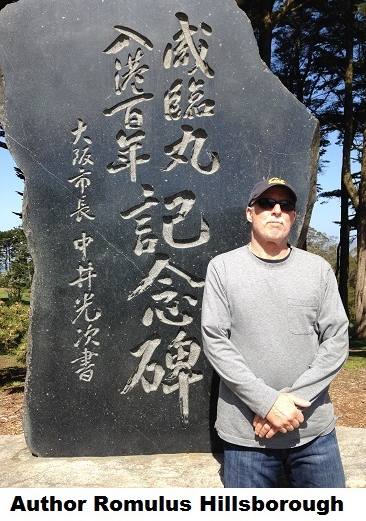
Recently the SA talked to Mr. Hillsborough (pictured here with the memorial tablet presented to San Francisco by Osaka in 1960 to commemorate the 100th anniversary of the Kanrin Maru’s voyage to that city-a voyage captained by Katsu Kaishu) about the book and some of the issues it explores. In the following interview, RH is author Romulus Hillsborough and SA is the Samurai Archives’ Randy Schadel. 


SA: Mr. Hillsborough, congratulations on the publication of Samurai Revolution and thanks for taking the time to discuss the new book with the Samurai Archives. Could you start off by letting our readers know a bit of your backgroundyour career, education, and travels?

RH: First of all, I would like to thank you for the opportunity to speak to the readers of your excellent forum. As for my background, I grew up in Los Angeles, CA. I have a BA in English and an MA in humanities. My passions are writing and reading (mostly, literature, history and philosophy). My favorite writers over the years have been (in reverse chronological order) Friedrich Nietzsche, Eugene O’Neill, Mark Twain, William Butler Yeats, Dylan Thomas, Akutagawa Ryunosuke, Shiba Ryotaro, Ernest Hemingway, and J.R.R. Tolkien. I practiced a Japanese martial art in an organization called Shotokan Karate of America (SKA), chief instructor Tsutomu Ohshima, for more than 30 yearsincluding in Los Angeles, Tokyo and San Francisco. Shortly after graduating from college I went to Japan, where I lived for around 16 years, and where I “came of age” as a writer. In the mid-1980’s I worked for popular Japanese magazines while researching and writing my first book, Ryoma: Life of a Renaissance Samurai, an historical novel. All of my other books were written after I returned to the United States in the 1990’s. My martial arts practice along with my experience living, studying and working in Japan have greatly influenced my writing. 

SA: Samurai Revolution is quite the ambitious work, weighing in at 600 pages and giving a comprehensive overview of the decline of the Bakufu (the Tokugawa shogunate) and eventual extinction of the samurai class. It spans the gamut from the earliest rumblings of foreign interference in Japanese affairs that pre-dated Perry’s Black Ships to the last throes of the samurai during the Satsuma Rebellion. It does an excellent job of explaining in an understandable and detailed manner the sometimes confusing shifts of allegiance and philosophy undergone by groups as well as individuals. Did you start off with the idea of writing such a comprehensive and detailed work, or did it take on a life of its own during the writing process? 

RH: When I conceived of a book focusing on Katsu Kaishu around the year 2000 (shortly after publishing Samurai Sketches), I intended to write a fictionalized “autobiography.” But after working on it for a while, I abandoned that format for two reasons. One was the dearth of published material about Kaishu in the English language. I thought that there ought to be at least one detailed, historically and culturally accurate non-fiction account of the life and times of such an important and interesting figure published for an international readership. I wanted this book to be the definitive portrait (it is not a biography in the traditional sense) of Katsu Kaishu in English. And I also wanted to make the book more of a comprehensive treatment of the Bakumatsu era than I had originally intended, presenting this history as the human drama that it actually is. To do so I needed to focus on the personalities of its leading players, giving them more attention than I would have in an “autobiography.” These include the last shogun Tokugawa Yoshinobu and his father Tokugawa Nariaki of Mito; their nemesis Ii Naosuke, the dictatorial regent to the boy shogun Iemochi whose assassination in the spring of 1860 was the beginning of the end of the Tokugawa Bakufu; Yoshida Shoin, Takasugi Shinsaku, and Katsura Kogoro, the three most important figures of Choshu during the Bakumatsu, posthumously succeeded by Ito Shunsuke (later Hirobumi, Meiji Japan’s first prime minister) and Inoue Monta (later Kaoru); Kaishu’s and Shoin’s teacher, Sakuma Shozan, perhaps the most brilliant of all, who even before Perry had advised the Bakufu to develop a modern navy to defend against Western imperialism; Saigo Takamori and Okubo Toshimichi of Satsuma, the leaders of the Satsuma clan and collectively the most powerful driving force behind the revolution; Shimazu Nariakira, the revered daimyo of Satsuma who died in his prime, some believe by poisoning by his own vassals; Sakamoto Ryoma and Nakaoka Shintaro, the two political outlaws (ronin) from Tosa who managed to unite Satsuma and Choshu in a political-military alliance that would change history and who were assassinated together shortly after Yoshinobu abdicated based on a plan formulated by Ryoma; and others who I will not mention here but who have also been given ample attention in Samurai Revolution

And during the eleven years it took me to complete Samurai Revolution (including two periods totaling about two years when I did not work on it), it did “take on a life of its own”actually it went through several metamorphoses. For example, my original intent was to end the book with the fall of the Bakufu and the peaceful surrender of Edo Castle as negotiated by Kaishu and Saigo. But as I approached the end of the story, I realized I could not simply drop itand let my readers wonder what happens next in this riveting human drama. So I included Book 2 to chronicle the rise of Imperial Japan. The definitive and culminating event during that era (i.e., the first decade of Meiji) is the Satsuma Rebellion; and the driving personality behind it is Saigo, for whom Kaishu had the courage to continue expressing his undying admiration, never once forgetting their friendship even after Saigo had died as an alleged “traitor,” stripped of his Imperial rank, for his supposed leading role in the Rebellion. I also thought that I would need an Epilogue to complete the manuscript, which at around 325,000 words was substantially longer than the edited published version. And so, in its final form, Samurai Revolution is a detailed examination and analysis of the Bakumatsu era through the eyes of Katsu Kaishu, who seemed to me the best spokesman for the era (for reasons I explain below.) Regarding the reason for the epithet “the shogun’s last samurai,” that is explained in the Epilogue. 

SA: Speaking of shifts of allegiance and philosophy, what was the catalyst that caused the Sonno-Joi (Revere the Emperor, Expel the Barbarians) groups to embrace Western learning and technology, dropping Sonno-Joi for Kinno-Tobaku (Imperial Loyalism, Down with the Bakufu)? 

RH: The short answer, I think, is an honest acceptance of reality around the summer of 1863, ten years after Perry first showed up. Until then Sonno-Joi had been embraced with religious zeal. In the summer of 1862, Takasugi Shinsaku, one of the leaders of Sonno-Joi in Choshu, traveled to Shanghai during the Taiping Rebellion. Upon arriving he was struck by the large number of foreign ships, many of them warships, in the harbor. And he was deeply troubled to see Chinese kowtowing to white men and the defilement of a Confucian shrine, which was being used as a British military encampment. He also observed modern weaponry, including breech-loading guns, at foreign merchant houses in the city. All of this convinced him of the futility of trying to take on the likes of Great Britain, France and other Western powers without first developing a modern military. He concluded that there was no room for Joi (“Expel the Barbarians”) in the Sonno (“Revere the Emperor”) equation, if the rebels intended to overthrow the Bakufu and create a modern Japanese state under the Emperor, strong enough to deal with Western imperialism from a position of poweras Takasugi’s martyred teacher, Yoshida Shoin, had espoused. But most Choshu samurai remained fanatically anti-foreignuntil Choshu was humiliated with the bombardment by foreign ships and brief occupation of its territory on the Shimonoseki coast by French troops in the summer of 1863. This, then, was the catalyst which forced them to accept the reality that Joi was impossible. A few days after the French occupation, Takasugi established the Kiheitai, Japan’s first modern militianot to “expel the barbarians” but to overthrow the government (i.e., the Bakufu) which had let them in. 

Meanwhile, Satsuma, the other leader in the Sonno-Joi movement, experienced a rude awakening of its own when it engaged British naval forces in its own front yard on Kagoshima Bay about a month after the bombardment of Shimonoseki. The British had come to Satsuma to demand reparation for the murder of a British subject, Charles Lennox Richardson, by Satsuma men at Namamugi in the previous year (the notorious Namamugi Incident, also known as the Richardson Affair). Satsuma refused and the British attacked. Though Satsuma put up a good fight, its forces were no match for the superior guns and warships of the British, which, in the words of Ernest Satow, who was aboard one of the ships, “dismounted some of their batteries and laid the town to ruins,” before retreating. As a condition for peace, however, Satsuma agreed to pay an indemnity and punish Richardson’s killers, though the second part of its promise was never fulfilled. As I wrote in Samurai Revolution: “But the Satsuma men learned an important lesson from the whole ordeal, realizing once and for all that they were not equipped to expel the foreigners by military force.” Ironically, the Satsuma men embraced the British as allies to help them build up their military in the gathering revolution. 

SA: Most works on the Bakumatsu center around figures of the Loyalist factions, most notably Sakamoto Ryoma and Saigo Takamori. However, Samurai Revolution uses Katsu Rintaro (usually known as Katsu Kaishu in the West), a vassal of the Tokugawa shogun, as its focus. What made Katsu the appropriate vessel to carry such a wide-ranging narrative? 

RH: Beside my own personal interest in Katsu Kaishu (he’s generally known by this name in the Japanese literature as well) both as a personality and an historical figure, and the lack of accurate and detailed information on him in English, he was one of the few men on the Tokugawa side who commanded the respect and goodwill of the Imperial Loyalists. In fact, he was more popular among the enemy side than among people in the Tokugawa camp, where he was widely reviled as a traitor (though he was not a traitor in any sense of the word)and this is an overriding theme in my book, as reflected in my use of the term “outsider” to describe him. (“Outsider” is included in the titles of each of the five Parts comprising the book.) And since he had many friends and allies among the Loyalists, including most notably Ryoma and Saigo but also Katsura Kogoro and others from Choshu, Satsuma, and Tosa, and even Anegakoji Kintomo, one of the two leaders of the Sonno-Joi faction at the Imperial Court until his assassination in 1863, Kaishu was able to see things from both perspectives. So much so that he eventually told his superiors in the Bakufu, “The Bakufu must willingly fall,” which is an astonishing pronouncement from a loyal Tokugawa vassal with the high position of commissioner of warships. And it was precisely his flexibility of mind and his moral and physical courage to admit that the Bakufu’s time had run out that earned him the respect of the other side and the enmity of his own camp. But for all of his honesty and pragmatic realism, he was loyal to the Tokugawa family to the bitter endwhich, I think, was one of the reasons that he embraced men such as Ryoma and Saigo to do the “dirty work” of actually overthrowing the Bakufuwhich as a samurai of the Tokugawa clan he was incapable ofalthough in his later years he did say about the Bakufu: “Eventually I brought it down myself.” 

SA: It’s somewhat ironic that the seeds of the shogunate’s downfall were found in the activities of Mito Han, itself a major Tokugawa branch house. However, despite being a major player in the early stages of the Bakumatsu, they soon were eclipsed by activists from Choshu, Tosa, and Satsuma. What differentiated Mito Han’s brand of Imperial Loyalism from these other han? 

RH: As you mention, Mito was one of the Three Tokugawa Branch Houses (the “go-sanke”), the highest ranking of all the han. And so even the most radical of the Loyalists of Mito never opposed the Tokugawa Bakufu itself. But Mito was the cradle of Imperial Loyalism, which sprang from the Mito school of thought called Mitogakuand the retired daimyo of Mito, Tokugawa Nariaki (Yoshinobu’s father), had coined the term Sonno-Joi. As such, Nariaki, one of the most powerful voices within the Bakufu, was the champion of the early Imperial Loyalism movement. And though Mito would never oppose the Bakufu, it would and certainly did oppose certain elements within the Edo regime that it found reprehensible and anathema to Imperial Loyalism, most notably Ii Naosuke, who was finally assassinated by a band of eighteen ronin, seventeen from Mito and one from Satsumathough it was the Satsuma man who actually killed the regent, cutting off his head. 

Mito Han is very difficult to comprehend, which makes it even more difficult to explain. And since I will include a great deal about Mito Han and Mitogaku in my next book, I will save further commentary about Mito for the future. 

SA: One of Mito’s most notorious acts was the assassination of the shogun’s Tairo (Great Elder of the shogunate), Ii Naosuke. Naosuke was the lighting rod around which anti-foreign sentiment seemed to coagulate, both for opening certain ports to foreign trade and the often heavy handed way he dealt with political opponents. Did Ii ever have a realistic chance of garnering support for the way he handled foreign relations, or was any action he took doomed to fail (either by angering the Western nations or the anti-foreign Joi factions)?  

RH: Kind of “damned if he did and damned if he didn’t,” right? Yes, I would agree with that. In fact, Ii Naosuke was probably no less anti-foreign at heart than his biggest enemies including the most fervent “barbarian haters” of Mito, Satsuma, Choshu, and Tosa. If he had had his way Japan would have probably remained closed. But, like Katsu Kaishu and other progressive thinkers of the time, Ii Naosuke was a realist. I wrote a lengthy chapter about these issues in Samurai Revolution, in which I argue that Naosuke demonstrated political courage in concluding the foreign trade treaties in defiance of popular opinion and even the Imperial Court itself, and that as the most powerful man in Japan, “he faced a dangerous and crucial decision—and in making that decision it appears that he had the welfare of Japan first and foremost in his heart. And in his mind—and indeed the minds of most if not all of the reactionary feudal lords of the Tokugawa camp—the Bakufu was Japan. But unlike many of his fellow antiforeign reactionaries, Naosuke had the sense to realize that if he refused the Americans’ demands for a trade treaty, he faced the very real danger of a devastating war. On the other hand, if he yielded to those demands, he knew that he would have to deal with a country of hotheaded samurai who violently opposed opening the ports to the barbarians, and that those samurai were led by his nemesis, Nariaki.” And so, he decided to conclude the trade treaties as the lesser of two evils, thus saving Japan from foreign subjugation. And for that and his crackdown on his political enemies, he was eventually killed. 

SA: While the men who specialized in spreading violence and murder (from the numerous Loyalist assassins to the Shinsengumi) often become the face of the Bakumatsu in popular culture, many of the intellectual leaders (teachers in particular) had a far greater impact on the course of Japanese history in the 1850’s and 1860’s. Many of the Bakumatsu’s most famous figures (on both sides) received their intellectual training and core values from these teachers. Obviously your central character Katsu Rintaro was one of these teachers, but even the teacher needed to be taught. Could you tell us about a few of the other more notable teachers?  

RH: Katsu Kaishu’s two greatest teachers, I think, were Sakuma Shozan of Matsushiro Han and Yokoi Shonan of Kumamoto Han. Sakuma was also the teacher of Yoshida Shoin and many other notable men. He was a compelling character not only for his foresight and brilliance (his influence on Japan can be seen up to WWII) but for his quirky yet strong personality. He married Katsu Rintaro’s younger sister and it was Sakuma who gave Rintaro the pseudonym “Kaishu,” which Sakuma himself had used. One of his cherished slogans was “control the barbarians through barbarian technology,” as he had advised the Bakufu as early as 1850, three years before Perry showed up. I introduce that slogan here because it sums up Sakuma’s ideas of how to deal with the dangers of Western imperialism. I wrote quite a bit about him in Samurai Revolution, including his significant influence on both of Katsu and Yoshida. 

Yokoi was the chief political advisor to Matsudaira Shungaku, the powerful daimyo of Fukui (a Tokugawa-related house) who served as the Bakufu’s political director. (Shungaku was also a personal friend and political ally of Kaishu’s.) Kaishu described Yokoi as profound; and in his profundity, Kaishu found him “frightening.” “I’ve seen two frightening men in my life,” Kaishu said years later, in the 1890s. One was Yokoi, the other Saigo. “Yokoi didn’t know that much about the West; I taught him a thing or two [on that subject]. But there were often times, when it came to the high tone of his ideas, that I felt I could never reach [his level]. . . . Although Yokoi was not very good at working on his own, if there was anyone around who could implement his ideas, I thought that the two of them [could accomplish great things.]” As it turned out, two of Kaishu’s closest confidants on the anti-Bakufu side, Ryoma and Saigo, did implement Yokoi’s ideas, which of course changed history. 

Sakuma, Yokoi, and Ryoma were assassinated. Saigo too met a violent death in the Satsuma Rebellion. Kaishu himself was nearly assassinated on several occasions. They lived in an exceedingly violent time. 

SA: The shogunate failed badly in two abortive attempts to militarily chastise the rebels in Choshu Han. This not only led to a loss of respect among their allied han and foreign nations, but also much resentment among the various han for the seemingly harsh attitude they were taking towards Choshu (who, after all, were seen by many as just trying to carry out the Emperor’s edict of expelling the foreigners). Was this the turning point of the Bakumatsu? Did Choshu’s military abilities, the Bakufu’s failure, and public opinion serve to isolate the Bakufu from all but their most hardcore allies?  

RH: I don’t think it was a turning point in the revolution, the first of which came several years earlier in 1860 with Ii Naosuke’s assassination. The next turning point I think was the Satsuma-Choshu Alliance, concluded in early 1866. Without the Satsuma-Choshu Alliance, and the help of Sakamoto Ryoma’s company in procuring weapons from foreign traders, Choshu would not have had the means to defeat the Bakufu in the war which broke out in the summer of 1866. So more than describing the war as a turning point, I look at it more as a nail in the coffin of the Bakufu, which was already tottering before the war startedwhich was why Choshu was able to win. But when Yoshinobu became shogun at the end of that year, things started to look better for the Bakufuand had he played his cards a little differently, and been more lucky at the game, he might have been able to revive the teetering regime that he had inherited. Of course, he did notbut I write about those things in detail in Samurai Revolution

SA: While the focus usually falls on Choshu Han as the driving force behind the anti-Bakufu factions, in many ways it seemed that it was Satsuma Han that determined the course of the Bakumatsu. From allies of the shogunate and sworn enemies of Choshu they abruptly allied with Choshuand during the early years of the Meiji Period became enemies of Choshu again. They seemed to be the true wild card of the Bakumatsu, never keeping to a consistent policy but rather adapting to opportunities as they presented themselves. While Sakamoto Ryoma’s part in securing the ‘Satcho’ alliance is well known, why was Satsuma even willing to ally itself with enemies? Did they see parallels between the treatment of Choshu and their own position, and perhaps thought that the increasing influence of Tokugawa Yoshinobu on Bakufu policy (he was not yet shogun) posed a danger to Satsuma?  

RH: There were numerous men and factors who influenced Satsuma’s decision (which was actually Saigo’s and Okubo’s decision) to ally itself with Choshu, including the ideas of their late revered daimyo Shimazu Nariakira, Satsuma’s relationship with the British, the ideas of Katsu Kaishu and Sakamoto Ryoma, and Satsuma’s (i.e., Saigo’s and Okubo’s) flexibility to seize an opportunity when it presented itself. The alliance with Choshu was such an opportunity, and the seeds of the alliance were planted in Saigo’s mind by Kaishu; and they were nurtured by Ryoma. But I feel that this question is far too complicated to do justice to in this forum. Therefore I refer readers to Samurai Revolution, in which I discuss in detail Satsuma’s history and ethos (which resembles the ethos of the ancient Spartans in its stoicism), the origins of the Satsuma-Choshu Alliance, and the roles of those two han, among others, in the overthrow of the Bakufu. But let me share one of my favorite Katsu Kaishu quotes here: “The difference between Choshu and Satsuma is that Choshu men make money to gain political power, whereas Satsuma men gain political power to make money. . . . A Choshu man will carefully write down his last will and testament to avoid being misunderstood after death. . . . But a Satsuma man is very straightforward. When he encounters a situation in which he knows he will die, he won’t utter a word.” Here, Kaishu was referring to the Satsuma ethos. 

SA: Yamauchi Yodo, the retired daimyo of Tosa Han, ruthlessly moved to purge the Loyalist element from his domain. He was well known for being an ardent supporter of the shogunate. Yet it was largely because of him that the last shogun, Tokugawa Yoshinobu, resigned from the office and returned power to Emperor Meiji. Why did such a loyal shogunate vassal end up working towards its removal from power?  

RH: All I will say here is that Yodo did not work to remove the Bakufu from power. Rather he worked to save the Bakufu and Yoshinobu from destruction by endorsing Sakamoto Ryoma’s plan for the shogun to abdicate peacefully and restore Imperial rule, thereby expecting a place for the former shogun within the new government. The detailed explanation to all of this is in my new book. 


Part 2 of our interview with Mr. Hillsborough will be forthcoming shortly and will touch on such topics as the early years of the Meiji Restoration, the Satsuma Rebellion of 1877, the advantages of writing about places an author has explored in person, assassination conspiracy theories, and even a bit of speculative history. For now, you can order “Samurai Revolution” on the SA’s Amazon store HERE or directly from Tuttle Publishing’s website HERE . Visit Romulus Hillsborough’s “Samurai Revolution” website for more about the book along with interesting essays and news items (such as documents recently discovered in Kochi sealed with Sakamoto Ryoma’s blood).
Tuesday, October 26, 2010

Heroes To Some, Villains To Others-Animeigo's Shinsengumi Chronicles

Few groups tend to raise such disparate images as the Shinsengumi, the Kyoto based group of swordsmen sponsored by the Shogunate that fought Imperialist agents (as well as other disruptive forces and crime in general) in Bakumatsu Japan. Heroes to some, villains to others, and a wildly popular subject for anime and manga, the Shinsengumi rarely fail to create strong opinions among those with an interest in Japanese history. Animeigo's newest release, 1963's "Shinsengumi Chronicles" (based on the first part of a print trilogy by Shimozawa Kan), takes a far more realistic look at the group than does Animeigo's other Shinsengumi offering, Mifune Toshiro's "Shinsengumi-Assassins of Honor" (1969). The film we reviewed last week had two big name stars as its headliner (Samurai Vendetta with Ichikawa Raizo and Katsu Shintaro)-this one does as well, this time featuring Raizo and Wakayama Tomisaburo (billed here as Jo Kenzaburo). It's an excellent film from Daiei that features the distinctive down-and-dirty realistic style the studio's samurai epics were noted for-and a style perfectly suited for its subject matter.

Virtually all the characters in Shinsengumi Chronicles are based on its real life members and events. Raizo's character is Yamazaki Susumu, a member that largely functioned as a spy and because of his education also as an intermediary in 'polite society' such as the Imperial Court. Wakayama fills the shoes of the group's second leader, former farmer and Tennen Rishin-ryū sword instructor Kondo Isami. Most of the group's core members are on hand as well, including the first chief Serizawa Kamo, his deputy Niimi Nishiki, Kondo's second in command Hijikata Toshizo, sword prodigy Okita Soji, spearman Harada Sanosuke, and 'traitor' Todo Heisuke. The other main character is Yamazaki's woman, Shima (Fujimura Shiho). Shima functions as the voice of reason that continually tries to turn Yamazaki from the Shinsengumi towards a normal life. Interestingly enough, while Yamazaki was a doctor in real life, he is presented here as a ronin with no purpose in life and Shima is given the role of physician. Being based on a trilogy, the movie takes the Shinsengumi only so far as the Ikedaya Incident-an incident, however, that proved to be the group's finest hour and defining moment.

The Shinsengumi are cast in a poor light from the very beginning where a shot of a crucified man displays a placard that the group has killed him for his crimes against the state. While it's found out later he was killed by a ronin working for Imperialists from the Tosa clan to frame their enemies, it's clear the Shinsengumi have already inspired fear and loathing among many of the citizens of Kyoto. When ronin Yamazaki Susumu comes across a Shinsengumi member dying from wounds incurred when slaying an Imperialist, he takes the man's netsuke and attempts to return it to the group and inform them of what has happened. Initially he's repelled when the Shinsengumi's chief, Serizawa Kamo, snorts in disgust and walks off. However, he becomes spellbound when Serizawa's subordinate, Kondo Isami, displays concern and invites him to talk. Kondo had earlier restrained and apologized to Kamo on behalf of a geisha who had inadvertently insulted the drunken Shinsengumi chief. Yamazaki recognizes that Kondo, although a former farmer, embodies the true spirit of the samurai and believes that he has found a leader worth following. He joins the group despite the pleas of his woman and childhood friend Shima, who believes the Shinsengumi are nothing more than a group of murdering thugs who are worse than the men they hunt down.

From here the film focuses on the early history of the Shinsengumi and Yamazaki's inner conflict as he attempts to reconcile harsh reality with the ideals he thought that lived in Kondo. The extortion of money from merchants, the elimination of Kamo's faction and Kondo's rise to power, the casual murder of a sumo wrestler and the assassination of the police officer that arrested a Shinsengumi member for the crime, and the torture of suspected enemies all raise doubts in Yamazaki as to whether this is the life he wants to pursue. Yamazaki is seen as being a potentially traitorous element in the ranks, and is first set up to commit a murder by Hijikata Toshizo and Okita Soji. They then use this as a way to have him removed by the police, but Yamazaki is saved by Kondo's intervention with their sponsors, Aizu han. The situation has put the Shinsengumi's future in doubt, and it might take an extremely daring act to put them back in the good graces of the Shogunate-a chance that might be provided by the scheming Imperialists of Choshu han. Despite his misgivings, the distrust of his comrades, and his discovery by Tosa assassin Okamoto Kyuzo (who had slain the ronin hired by Tosa to frame the Shinsengumi early in the film), Yamazaki sets out to discover the plot-and does so, facing down the conspirators alone while the bulk of the Shinsengumi is attacking the wrong building. With enemies numbering not only the Imperialists but also among his own allies, will Yamazaki be able to survive?

Raizo's performance as Yamazaki Susumu allows him to display an emotional range that was absent in some of his films-Yamazaki is an idealist in a world full of characters on both sides with seemingly no standards. Yamazaki is caught between the honor he believes is embodied in Kondo Isami and the dishonorable acts he is required to perform as a Shinsengumi member. The moral dilemma at times puts Yamazaki into the role of the 'deer in the headlights', frozen into inaction and confusion-even when his life hangs in the balance. Raizo excelled at roles such as this, even bringing an undercurrent of the 'frustrated idealist' to his most famous film role, nihilistic ronin Nemuri Kyoshiro. Yamazaki's attempts at espionage also bring to mind Raizo's roles as ninja Goemon/Saizo in the Shinobi No Mono series. Fujimura Shiho as Yamazaki's love Shima plays her role effectively, being the picture of Japanese womanhood-feminine, strong, and both supportive and critical as the situation calls for.

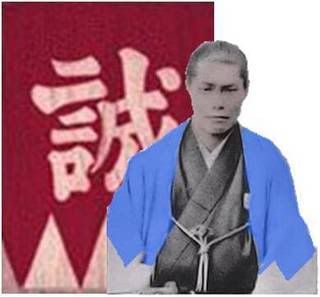
For the Shinsengumi's leader Kondo Isami there were few actors better suited for the role than Wakayama Tomisaburo. Kondo tended to let Hijikata Toshizo (his deputy) perform the actual administration of the group while he provided the strong, silent symbol that the group could use as their anchor. Wakiyama's best known for roles in which he has relatively little dialogue and for his precise and vicious swordsmanship, both being attributes that served him well in portraying Kondo. His rather gruff and unpolished appearance also helped define the character, a farmer-turned-samurai. Wakayama (like many chanbara stars) also had a lot of experience playing characters that had lofty ideals but were eminently pragmatic (most notably Ogami Itto from the Lone Wolf and Cub series) and provides the balance between Yamazaki's idealism on the one hand and the ruthlessness of ones like Hijikata and Okita on the other. This is perhaps best seen when he is confronted by Yamazaki over some of the group's acts and delivers his response while staring at the Shinsengumi's battle standard-the flag displaying the kanji for sincerity. His faith and confidence in Yamazaki shows that honor is indeed still alive within the ranks of the Shinsengumi.

Director Misumi Kenji helmed many other violent samurai action films, including entries in the Zatocihi, Shinobi No Mono, Hanzo the Razor, and Lone Wolf and Cub franchises. The fast pace and brutal violence evidenced in these efforts are also on full display in Shinsengumi Chronicles. However, unlike many chanbara directors, Misumi never hesitated to show sword duels for what they were-ugly, chaotic, and bestial. This is best evidenced in the closing minutes of the film where a lingering shot of corpses frozen in awkward positions amongst the post-Ikedaya carnage shows that there's little real glory in killing, even when it's for a greater good-particularly so when it's juxtaposed with the Shinsengumi wearily trodding off. Misumi traces the culture of violence through the development of the Shinsengumi's new members, most notably Yamazaki's aide, young Oshu. Oshu is almost childishly insistent on his wish to become a samurai-someone with status, someone important. When first donning his Shinsengumi 'colors' and thrusting his sword through his sash, Oshu is beaming like a kid getting his first toy-and when first killing a foe, only thinks of how this act will make him a man in the other member's eyes. This has interesting parallels to the mentality of US street gangs-as does the Shinsengumi's insistence that new members be 'tested' by slaying an enemy as soon as possible (or implicate themselves in one of the group's more illegal activities, making it tougher for them to go rouge). The allure and glamor of the gang life is underlined when Oshu buys a woodblock print of a valiant samurai-with that appeal symbolically exposed as false when his blood spills over it in the aftermath of a fight. And as shown towards the end when Yamazaki literally turns his back on Shima (his chance at a normal life) and never looks back, once you're in, you're in for good (that of course being one of the Shinsengumi's rules-no one could quit the group). The heat of the Kyoto summer also played an interesting part in the film-no doubt this was shot in summertime, because all the actors are in a constant sweat. This helped to further infuse their characters with the uncomfortable sense of edginess that summertime temperatures can bring.

Just as it did for another recent release, Samurai Vendetta, Animeigo has included two sets of program notes. One set covers the historical background for the Shinsengumi and provides a general overview of the situation during the Bakumatsu. The other set comprises the standard cultural and film notes. Happily, both are extremely well done and extensive, using solid scholarly books as sources (such as "The Emergence of Meiji Japan", a digest version of volume five of the "Cambridge History of Japan"). Viewers unfamiliar with the history of Japan at that time will find their enjoyment of the film to be greatly enhanced by reading the Shinsengumi set. Other extras include cast and crew bios, a still gallery, the theatrical trailer, and trailers for three other related Animeigo releases (Mifune's "Shinsengumi" and Raizo's "Samurai Vendetta" and "Sleepy Eyes of Death" series). The translations are as good as we've come to expect from Animeigo, including the bonus of a complete translation of the credits (something many companies releasing Asian films fail to do).

Shinsengumi Chronicles is one of the more accurate film portrayals of the historical group. It never hides the excesses or blemishes of its members but never simply writes them off as Shogunate thugs. Despite the infighting, extortion, and treachery the group was often noted for, when it came time to fight for their ideals, they were by and large the most effective and passionate group the Bakufu had to offer (and in many ways not much different from their Imperialist foes). Heroes to some, villains to others, but never boring-and with Raizo and Wakayama, a chanbara hound's delight. You can get a copy of Shinsengumi Chronicles direct from Animeigo or from Amazon through the SA Store.

All images courtesy and copyright 1963 Kadokawa Pictures, Inc

Saturday, August 01, 2009

Moe Yo Hirugohan 燃えよ昼ご飯

(Burn My Lunch)

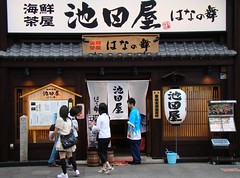
This is a review of the Ikedaya restaurant in Kyoto, Japan. But before I get on with the review, let me explain a little about the Ikedaya’s background. For those of you who don’t know, the Ikedaya used to be an old inn and was the site of a bloody incident involving the Shogunate’s special security unit, the Shinsengumi and pro-imperial radicals on July 8, 1864. Within the walls of the Ikedaya, radicals, called shishi, who were mainly from the domain of Chōshū, came up with a plan to set fires in Kyoto and cause a lot of mayhem aimed at bruising the credibility of the Shogunate. The Shinsengumi got wind of the plot and proceeded to surround the Ikedaya while the shishi were gathered there and apparently in their cups. All hell broke loose as a group of the Shinsengumi, lead by its senior commander, Kondō Isami, stormed the place. Steel met steel, flesh and bone and without exaggerating, the Shinsengumi kicked some serious shishi butt. The Shinsengumi probably saved the entire city from going under the torch, although as much as 1/3 of the city would burn as a result of the fires set during the fighting between Chōshū and pro-Bakufu forces that started at the Imperial Palace’s Hamaguri Gate.

As time went by and the Ikedaya incident grew stronger in legend, the building eventually fell into disrepair. The site eventually gave rise to an ugly 3-story pachinko parlor that closed early in 2009. It was announced that an izakaya (Japanese style pub and restaurant) chain was going to buy the property and turn it into a historically-themed place to eat and drink. As those who know me can attest to, I am a Bakumatsu period history nut and was really happy to hear this. So, when If found myself in Kyoto for the Gion Matsuri on July 16-17, 2009, I just *had* to go there for lunch, once I had discovered that the new Ikedaya had just opened.

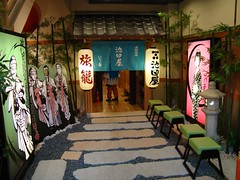
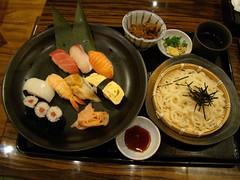
As I strolled up to the building, I was greeted by restaurant staff, trying to hook people in, announcing the lunch specials and that the restaurant was now open. It was hard not to chuckle as all he staff were dressed in Shinsengumi uniform-style hapi (short coats). I saw they had a sushi + cold udon (rice flour noodle) set as a lunch special, and was ushered in. Before I could adjust my eyes to the surroundings, I found myself being ushered up the stairs to the second floor. I wondered what Okita Soji must have felt as he led the assault on the shishi in the second floor. My thoughts about what must have been going through his head quickly changed to a “WTF” moment, as I myself was visually assaulted by a ridiculous looking manga mural of the Shinsengumi. So much for authentic realism. I then arrived at the second floor. As I came off the staircase onto the landing, I saw a raised area on tatami mats containing replica old looking furniture and other items. It seemed like a weird combination of things that made no practical sense. Turning my head back in the direction that my feet were travelling, in pursuit of the staff member who was trying to guide me to my table, I was assaulted yet again by the ridiculous as I came to the entranceway of where the tables are located. “Cheese Meets Wabisabi”, where the words that went through my mind. “What have they done to this place,” I silently bemoaned. The colors, strange manga versions of historical figures, oh, it was hurting my eyes!


After a few second eternity, I finally made it to my table and began to pour over the menu. I have to admit, some of the things on the regular dinner menu looked all right, after all, this place is an izakaya. But never-the-less, I pretty much decided on the sushi and cold udon set, and that is what I ordered. While waiting for the food to arrive, I chugged glass after glass of cold barley tea, called mugi cha, as I was hot and a little dehydrated from standing outside for more than 3.5 hours in the humid steam cooker that Kyoto becomes in summer in order to watch the Gion Matsuri parade. My mind kept also trying to get around the 'cheese factor' that the owners had introduced to this solemn place, however, I reasoned to myself that if the food is good, I could forgive the tackiness of the place and maybe commit myself to coming back for an evening excursion at some point in the future. But before I could get lost in any deep thoughts and future plans, the food arrived.

As I snapped some photos of my meal, I realized that the sushi didn’t look so hot. Now don’t get me wrong. I am a foodie and consider myself a connoisseur of good sushi and know sushi is not supposed to be served hot. What I mean, is that it didn’t look all that great. My first taste confirmed what I suspected. Sure, it was edible, but not very good. Kind of like what one would find at a fast-food, conveyer-belt sushi chain outside of Japan, or what you’d get at a shopping mall’s food court. Worst of all, was the anago (sea eel). It was so soft and mushy, I nearly had to spit it out. Yuck!! I then set upon my udon, which was fine. You can’t really massacre cold noodles. I found myself slurping my noodles faster than usual, though, as I realized that I probably wanted to get out of the Ikedaya worse than a trapped Chōshū shishi the night the Shinsengumi crashed their party. As soon as I put my noodles down, I grabbed my backpack, camera and took a few more photos before I descended the “staircase of destiny” to pay my bill. I was happy to leave the Ikedaya. I really was.

A few minutes after I left the place, I called up the Samurai Archives’ Shogun, Kitsuno, to relay my Ikedaya experience as I aimlessly wandered around the the Pontochō geisha district in a light on and off drizzle. I remember musing on the phone that I probably should have steered away from ordering sushi in an izakaya chain-store restaurant and in Kyoto of all places. I suppose I should mention that while Kyoto is known for exquisite cuisine (and I am not referring to pizza-man from convenience stores), the city isn’t exactly famous for having good sushi. Kitsuno listened to my ramblings and told me that I should blog about my experience, so here I am, doing exactly that!

Now to sum things up, I wasn’t happy with the Ikedaya, from both a historical and epicurean experience. I found the place tacky and my lunch equally disappointing. I do suspect that some of the evening fare is better than the sushi, and besides, they have a large selection of alcohol to numb one’s taste buds. If you are a Bakumatsu history junkie and have to see this place for yourself, go ahead! Just don’t order sushi! As for myself, I don’t have a burning ambition to return to this place. But like the name of the famous fictional book about the Shinsengumi called Moe Yo Ken (Burn My Sword) by Shiba Ryōtarō, I felt an urge to burn my lunch!

A few more pictures from the Ikedaya and a variety of photos from Kyoto and other historical places in Japan can be found on my flickr website at http://www.flickr.com/photos/rekishinotabi

Saturday, November 15, 2008

Footnotes of History?


Have you ever wondered why there seems to be so little scholarship on the Shinsengumi available in English? One may find it surprising, considering all the attention the Shinsengumi get in imported Japanese “pop” culture in the form of films, anime and manga. To date, the only book I know that is dedicated to the study of the “Wolves of Mibu” is Romulus Hillsborough’s Shinsengumi: The Shogun’s Last Samurai Corps published in 1995. On one hand, I have to tip my cap to Hillsborough for writing this book. At least he had the chutzpah to tackle this controversial historical group, and as a result, he’s been beaten up in internet forums for being unbalanced in his approach to the political factions of that day, overly critical of the Shinsengumi by those who adore them, as well as has been accused of writing a book that lacks a coherent flow and contains too many corny and hackneyed phrases. Yet for all of Hillsborough’s faults, both real, imagined or exaggerated, his work remains the only readily available non-fiction book about the Shinsengumi in English. So again, why aren’t there more? I was recently asked this question by a friend and this triggered a serious round of thinking. The following is based on my response.

I think the reason why there is so little on the Shinsengumi in English is that in terms of the overall story of the Bakumatsu/Restoration, they are relatively minor players and don’t do anything save one incident which dramatically affects the pace of events. That event was of course, the Ikedaya affair where they pretty much saved Kyoto from deliberately getting torched by some Chōshū nut job extremists. Other than that, what else can you say about these thugs and their brutal behavior towards each other and the loyalist extremists they hunted down? Sorry-- I use the word “thugs” to describe the Shinsengumi, but what other word best describes these guys? I’m definitely no lover of the loyalists, but let’s face it—the Bakufu thought the best way to fight the loyalist thugs that were terrorizing the streets of Kyoto would be with their own “deputized” gang of thugs—and they were right! So while the Shinsengumi may have been minor players in the overall big picture, they do loom very large in the Bakumatsu period history of Kyoto. It would be ludicrous to think that the Shinsengumi did not have a direct impact on the events in that city and everyday life there for a handful of tumultuous years. Again, their impact on Kyoto can’t be denied and is probably one of the reasons they are popular to this day in Japan. Stories and incidents that took place in Edo and Kyoto dominated the mass media then, so we are left with a wealth of material about their exploits in the not so distant past. This is evident by the number of books about the Shinsengumi that can be found on Amazon.co.jp or in any decent-sized Japanese bookstore. One look at my bookshelf further backs this up.

Okay, so the Shinsengumi remain a popular topic of scholarship in Japan, but why not in the rest of the world?

I think you can look at the Shinsengumi’s popularity in Japan and compare it to why a sizeable portion of American society may be able tell you a thing or two from the days of the Wild West about the James Gang or the Dalton Gang on the wrong side of the law or the Texas Rangers, Bat Masterson and the Earp brothers and their friends on the “right” side of the law. In a 20th century context, I guess you could make a loose comparison to Elliott Ness’ G-Men acting as a crack unit to take down Al Capone and the other gangsters of Chicago. Neither the outlaws nor their “good” guy counterparts were angels, but they all stick out and are relatively well known. Americans can tell you about these people and some of their exploits because they were exciting points in the long and bland history of how as a people and a country, the US got from there to here. Also, these people, both “good” and “bad”, were products of the times as well as the culture. They weren’t catalysts or show stoppers in a historical context, but just interesting, and because of this, they are remembered and studied. I don’t think too many non-Americans know much about these people, besides what they may have seen in movies or in old TV shows. I’m willing to wager that there probably aren’t too many non-fiction books published in foreign countries about these historical American figures for the same reason it is hard to find histories of Shinsengumi in languages other than Japanese.

Just as many Americans can say that they know the name of Jesse James or Billy the Kid, the same holds true for how Japanese look at the Shinsengumi—whether they are fans or not. Everybody in Japan knows something about the Shinsengumi—even the idiot kids who can’t even tell you the name of the current prime minister! So even though the Shinsengumi are a part of the landscape of Japanese history and culture and are fodder for exciting stories of adventure and dark camaraderie forged in blood, how much interest does a non-Japanese academic or his/her peers have in this topic? I’m not so sure they fully “get it” or find the subject matter all that interesting in the larger scheme of things. If we really think about it, there really aren’t too many books out there in English on the Bakumatsu. I’m already hearing groans from those who already think there are enough books on the Bakumatsu and not enough on the Sengoku period, but let’s face it; there really aren’t all that many books available on Japanese history as opposed to say, European or American history, yes? And most of the books on the Bakumatsu are going to focus on the general big picture or on the key individuals or han, such as Chōshū, Satsuma or Tosa. Thus sadly, for western written histories of the Bakumatsu, the Shinsengumi are nothing more than an interesting footnote. This is one of the problems with non-Japanese scholarship on this period. A lot of the exciting stuff gets relegated to mere footnote status as it really doesn’t alter the outcome of events. Hence, at least in English, the Shinsengumi, for the large part, remain footnotes of history.

So, the question is—who is going to write the next non-fictional account of the Shinsengumi in English? Any takers?

Saturday, March 15, 2008

Trip to Kyoto

I am currently in Kyoto. I will have to follow up this post with pictures later, since I can't upload them from this hotel computer. I spent some time at Mibu temple, the site of Serizawa Kamo and Hirayama Goro's graves, and a large stone bust of Kondo Isami. Next door is the Yagi residence, where the Shinsengumi lived for a time. I walked through the room that Serizawa and Hirayama were sleeping in when they were attacked, and touched the desk that Serizawa fell over dead on. Didn't notice any blood stains though.

Before that, I had went to Nijo castle and walked the grounds. That was my second or third time there, but it is still interesting. For the first time I went to the grounds of the Kyoto imperial palace. I didn't actually get inside the palace itself, but the grounds are huge. They take up quite a large portion of the city center.


I also went to the Kamo river, to Sanjo bridge, the site of various events such as the Sanjo Seisatsu incident, and the location that Kondo Isami's head was displayed. I also had the misfortune to have a pizza-man (round cake thing with pizza filling) torn from my hands by a hungry hawk by the riverbank - something I was definitely not expecting. I still have a nice cut on my right hand from it. On my way back, I stumbled on the gravesite of Toyotomi Hidetsugu, and 46 of his vassals slain by Hideyoshi in 1595.

Took a trip to Higashi and Nishi Honganji, but I wasn't terribly impressed. Both temples look the same, and there isn't a lot to see.

Today I went to Kodai-ji, and visited Kitamandokoro's (One/Nene) gravesite. Also went to the Shishi graveyard nearby, and visited Sakamoto Ryoma and Nakaoka Shintaro's graves, as well as Kido Takayoshi, and four or five dozen slain Choshu and Tosa men, killed during everything from the Sakuradamon no hen to the Ikedaya Incident. The entire area around Kodai-ji has a very Kyoto-ish feel to it, with Jinrikisha men carting around Geisha, Maiko, tourists, and various Kimono-adorned women. There is also a giant fake Buddha statue thing between Kodai-ji and the Shishi graveyard. Not sure what it is, and I didn't really want to pay the money to find out.