Showing posts with label Satsuma. Show all posts

Monday, July 17, 2017

Murderous Samurai of the Bakumatsu Period


In the latter half of the 19th Century, Japan would see 250 years of relative peace devolve into a bloody landscape of violence, with disillusioned samurai banding together to attach and permanently silence those who they believed to be ruining the country. This was further exacerbated by historic rivalries between domains, by class differences between the lower and upper samurai, as well as by the intra-domain politics of the time. In the midst of this chaos, bands of samurai bonded together to uphold their ideals, cloaking their murders under the pretense of honorable justice.

With Samurai Assasins, available from McCarthy and available on Amazon.com, Romulus Hillsborough continues his examination of the Bakumatsu--the fall of the Tokugawa Bakufu--that eventually gave birth to the Meiji Government and modern Japan. Fans of his earlier work on the Shinsengumi will recognize his style, presenting the events of the time with an eye towards the dramatic and captivating stories of the myriad individuals involved in those bloody events. Whereas that previous work focused primarily on those pro-Bakufu forces, this book focuses more on the actions of the pro-Imperial factions.  Together, these works complement each other and help further illuminate the complex violence of the period.

Hillsborough has really become one of the most recognized names in English literature on this period, presenting it in a way that is digestible even by those without previous depth in the period. He doesn't simplify the narrative, but neither is it beyond the reader to be able to comprehend. The present work may not be the go-to first volume for someone without any prior knowledge of Japanese history, but for those who have at least the broad brush strokes of the Bakamatsu period it may provide some insights easily overlooked when following some of the more popular threads in the intricate tapestry of events that unfolded in the latter half of the 19th century.

Samurai Assasins looks at three areas of the fall of the Tokugawa government and how assassinations, or "dark murder", played a role in how the events unfolded.  He starts with the assassination of Ii Naosuke, whose strongman tactics and then death many claim as one of the primary catalysts behind the later violence.  From there he looks at the numerous assassinations by men of the Tosa Loyalist Party, a pro-Imperial, anti-foreigner group of men that terrorized Kyoto in the 1860s.  Finally, he takes a look at the death of Sakamoto Ryōma, whose proposals were part of the foundation for the later Meiji government.  Through these events, he outlines some of the chaos and bloodshed that went on throughout this period.

With these stories, Hillsborough makes it clear that the political turmoil that brought down the Bakufu was extremely complex.  While it may be tempting to simplify the story of the revolution--the Imperial Loyalists, led by the Satsuma-Chōshū alliance, against the Tokugawa Bakufu and their supporters--Hillsborough delves into some of the complex motivations that moved the situation forward.  This can make the text dense at points; Hillsborough takes great lengths to provide the names of all of the actors, which may get confusing for readers not accustomed to Japanese names.  He counters this with a narrative style that comfortably leads the reader through the twists and turns of this historical record. 

Statue of Ii Naosuke in Hikone.
The subject of the first part of this book, the assassination of Ii Naosuke, the Bakufu's strongman during the turbulent times of the mid-19th century, is often seen as a catalyst for much of the violence that would follow.  Romulus Hillsborough takes a look at the causes and effects of the Ansei Purge, Ii Naosuke's iron fisted attempts to squash Bakufu resistance, in conjunction with the rise of the subversive Mitogaku school of political thought that drove the assassins.  This assassination, known to history as the Sakuradamon Incident, is especially interesting in the light of the assassins' ties to the Bakufu--they were men of Mito, one of the three domains overseen by direct descendants of Tokugawa Ieyasu, the founder of the Tokugawa government.  In fact, in the following decade one of the scions of the Mito house would actually come to power as shōgun Tokugawa Yoshinobu, who would then have the dubious distinction of being the last shōgun, overseeing the end of the Bakufu. 

In examining the events, Hillsborough focuses less on the assassination itself, which has been fairly well documented in a variety of sources, and more on the causes and ramifications that followed.  He provides the situation in Mito leading up to the decision, and one can clearly see the conflict in society.  This was not a simple decision, nor was it inevitable, but myriad twists and turns pushed these men over the edge.  Hillsborough looks at the conditions in Mito, both the political situation of the Mito house of Tokugawa and the reaction among the lower ranks of samurai since the arrival of foreigners and the Bakufu's own negotiations with them.  From local remonstrations to the eventual assassination, Mito was clearly at odds with Bakufu policy, though they wouldn't go as far as the next domain.

Depiction of the Sakuradamon Incident.

The second topic in the book delves into the Tosa Loyalist Party, with particular attention paid to its leader, Takechi Hanpeita (aka Takechi Zuizan).  Tosa is another example of the complexity of this period, as its daimyō were traditionally fiercely loyal to the Tokugawa family.  However, the Tosa Loyalist Party took up the cause of Sonnō Jōi ("Revere the Emperor, Expel the Foreigners") even though their daimyō was a staunch supporter of the Bakufu.  Hillsborough covers many assassinations, from that of Yoshida Tōyō to numerous examples of tenchū, or "Heavenly Punishment". Most of these appear to have been instigated and carried out under the orders and influence of Hanpeita.  Detailing the bloody violence that these assassins brought to Kyoto--violence that eventually influenced the creation of the infamous Shinsengumi--Hillsborough describes the terror that they wrought.  This provides a clear counterpoint to his work on the Shinsengumi, and goes to show that there is blood on the hands of both sides in the fall of the Bakufu.
Yoshida Tōyō
The killings in Kyoto are told in detail, at least where we have them.  Given that most of these killings were published by the assassins themselves, displayed on signs next to the heads or corpses of those they had killed, we have quite a bit of information, although the actual identities of most of the assassins remains a mystery.  Of those we know, only a few of the murders can be attributed to them directly.  Some of the more enlightening passages are the few contemporary accounts of the character and behavior of some of those involved in these dark deeds.  Throughout it all, the
humanity of the situation comes through, with many of the murderers driven in at least part with what they considered honorable motives.

Covering the Tosa Loyalist Party, Hillsborough looks at the inequalities between the various levels within the samurai class itself, especially in the Tosa domain.  This was exacerbated by the differing views of daimyō and his own retainers.  Although the ties of vassalage in feudal Japan are often thought to be absolute, the intra-domain politics were quite fierce, and with various parties vying for control of the ruling house.  Hillsborough describes the tension and conflict, following it through to the death of the Tosa Loyalist Party leader, Hanpeita.  Even then, the tale of his imprisonment and eventual execution--illuminated by his own letters to his wife, as well as the official record--demonstrates conflict within the domain and the beliefs that were driving anti-Tokugawa sentiment.

Interestingly, Hillsborough makes a similar case about the drivers of the Tosa Loyalists--and, in fact, many of the assassins of this period--as he does about the Rōshigumi and the Shinsengumi.  That is to say, these are samurai of the lower classes who likely saw an opportunity to showcase their skills and seek glory, hoping to increase their place in society through these acts.  The system of stipends, along with restrictions on what jobs a samurai could actually take and a rising population, meant that a good many were under-employed and their stipends did not go as far as they used to.  For them, a show of prowess may just earn them enough face and respect to land them a better position.  On either side, the killings were justified under extreme interpretations of bushidō and Neo-Confucian concepts of loyalty to either the Emperor or the Bakufu.  Few would have imagined that their acts would eventually lead to the destruction of the samurai class as a whole.
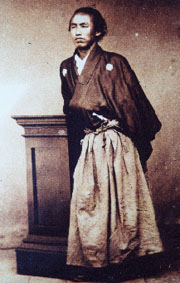
Hillsborough finishes off with the assassination of Sakamoto Ryōma.  Unlike the previous assassinations, committed by enemies of the Bakufu, this assassination was committed by pro-Bakufu forces, though the exact details remain unclear.  After a brief introduction to Sakamoto Ryōma, (more information on his life can be found in numerous English works, including Hillsborough's own Ryoma: Life of a Renaissance Samurai) Hillsborough takes the reader through the various reports of the incident.  There is no clear narrative on the assassination.  Many of the Bakufu reports are missing, and later "confessions" by people who claimed to be part of the attack don't fully match up with the official record, nor each other.  Hillsborough merges these accounts, and provides his take on their veracity, providing at least a plausible account of what happened (spoiler: he puts the blame on the Mimawarigumi).  He finishes off with a look at the repercussions and ramifications of the assassination, as well as a brief summary on the final fall of the Tokugawa Bakufu and the rise of the Meiji government.

Overall, the book reads well, and provides a look at these instances which many people outside of specialists are unlikely to be intimately familiar with.  Despite a slightly idiosyncratic system of Romanization (in particular the use of é on all kanji-final "e", not simply word-final, providing things like Takéda Hanpeita), the text flows easily enough.  It is accessible for even casual readers, covering subjects not typically found in most English histories of Japan.  Perhaps most importantly is the way that he follows the various paths that wind and wend their way through the fabric of this era.  It is easy to mistake this period as a straight up fight between supporters of the Bakufu and Imperial Loyalists.  Instead, we see exposed the internal tensions of Tokugawa Japan, formed through the historic ties between the various domains.  Although Satsuma and Chōshū are often spoken of in a single breath as the forces that finally brought down the government, it is easy to forget that before the political deal-making of Sakamoto Ryōma these two domains were fierce rivals.  That the concept of "expel the foreigners" was not strictly an anti-Bakufu stance, while many Imperial Loyalists viewed opening ties with the West as crucial to build up Japan's strength.  In all there was not one single factor that can be pointed to as the ultimate reason for the Bakufu's demise.  Hillsborough does an excellent job of cutting through all of this without oversimplifying everything.

If you are interested in Samurai Assassins, or some of Hillsborough's earlier works, his Amazon page.

Friday, March 28, 2014

Katsu Kaishu, Navigator Of Chaos: An Interview With Romulus Hillsborough, Author Of “Samurai Revolution”, Pt. 1

Romulus Hillsborough is the author of several popular books dealing with the Bakumatsu/early Meiji period of Japanese history and the personalities that shaped its course. These include Shinsengumi: The Shogun's Last Samurai Corps, Samurai Tales: Courage, Fidelity and Revenge in the Final Years of the Shogun (an expansion of his earlier Samurai Sketches), and the work for which he is perhaps best known, Ryoma: Life of a Renaissance Samurai. Just published is Samurai Revolution: The Dawn of Modern Japan Seen Through the Eyes of the Shogun's Last Samurai. Samurai Revolution tells the story of the final years of the shogunate in the 1850’s and 60’s to the last rebellion of the former samurai class in 1877. It’s largely told through the life and works of Katsu Kaishu, a vassal of the Tokugawa who was both loved and loathed by the shogunate and its Imperial Loyalist enemies. We found it to be not only an excellent biography of Katsu, but an exceedingly well-done, intricate, and clearly written overview of this vital period of Japanese history. 

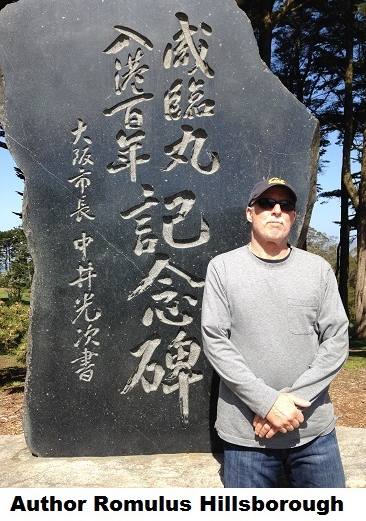
Recently the SA talked to Mr. Hillsborough (pictured here with the memorial tablet presented to San Francisco by Osaka in 1960 to commemorate the 100th anniversary of the Kanrin Maru’s voyage to that city-a voyage captained by Katsu Kaishu) about the book and some of the issues it explores. In the following interview, RH is author Romulus Hillsborough and SA is the Samurai Archives’ Randy Schadel. 


SA: Mr. Hillsborough, congratulations on the publication of Samurai Revolution and thanks for taking the time to discuss the new book with the Samurai Archives. Could you start off by letting our readers know a bit of your backgroundyour career, education, and travels?

RH: First of all, I would like to thank you for the opportunity to speak to the readers of your excellent forum. As for my background, I grew up in Los Angeles, CA. I have a BA in English and an MA in humanities. My passions are writing and reading (mostly, literature, history and philosophy). My favorite writers over the years have been (in reverse chronological order) Friedrich Nietzsche, Eugene O’Neill, Mark Twain, William Butler Yeats, Dylan Thomas, Akutagawa Ryunosuke, Shiba Ryotaro, Ernest Hemingway, and J.R.R. Tolkien. I practiced a Japanese martial art in an organization called Shotokan Karate of America (SKA), chief instructor Tsutomu Ohshima, for more than 30 yearsincluding in Los Angeles, Tokyo and San Francisco. Shortly after graduating from college I went to Japan, where I lived for around 16 years, and where I “came of age” as a writer. In the mid-1980’s I worked for popular Japanese magazines while researching and writing my first book, Ryoma: Life of a Renaissance Samurai, an historical novel. All of my other books were written after I returned to the United States in the 1990’s. My martial arts practice along with my experience living, studying and working in Japan have greatly influenced my writing. 

SA: Samurai Revolution is quite the ambitious work, weighing in at 600 pages and giving a comprehensive overview of the decline of the Bakufu (the Tokugawa shogunate) and eventual extinction of the samurai class. It spans the gamut from the earliest rumblings of foreign interference in Japanese affairs that pre-dated Perry’s Black Ships to the last throes of the samurai during the Satsuma Rebellion. It does an excellent job of explaining in an understandable and detailed manner the sometimes confusing shifts of allegiance and philosophy undergone by groups as well as individuals. Did you start off with the idea of writing such a comprehensive and detailed work, or did it take on a life of its own during the writing process? 

RH: When I conceived of a book focusing on Katsu Kaishu around the year 2000 (shortly after publishing Samurai Sketches), I intended to write a fictionalized “autobiography.” But after working on it for a while, I abandoned that format for two reasons. One was the dearth of published material about Kaishu in the English language. I thought that there ought to be at least one detailed, historically and culturally accurate non-fiction account of the life and times of such an important and interesting figure published for an international readership. I wanted this book to be the definitive portrait (it is not a biography in the traditional sense) of Katsu Kaishu in English. And I also wanted to make the book more of a comprehensive treatment of the Bakumatsu era than I had originally intended, presenting this history as the human drama that it actually is. To do so I needed to focus on the personalities of its leading players, giving them more attention than I would have in an “autobiography.” These include the last shogun Tokugawa Yoshinobu and his father Tokugawa Nariaki of Mito; their nemesis Ii Naosuke, the dictatorial regent to the boy shogun Iemochi whose assassination in the spring of 1860 was the beginning of the end of the Tokugawa Bakufu; Yoshida Shoin, Takasugi Shinsaku, and Katsura Kogoro, the three most important figures of Choshu during the Bakumatsu, posthumously succeeded by Ito Shunsuke (later Hirobumi, Meiji Japan’s first prime minister) and Inoue Monta (later Kaoru); Kaishu’s and Shoin’s teacher, Sakuma Shozan, perhaps the most brilliant of all, who even before Perry had advised the Bakufu to develop a modern navy to defend against Western imperialism; Saigo Takamori and Okubo Toshimichi of Satsuma, the leaders of the Satsuma clan and collectively the most powerful driving force behind the revolution; Shimazu Nariakira, the revered daimyo of Satsuma who died in his prime, some believe by poisoning by his own vassals; Sakamoto Ryoma and Nakaoka Shintaro, the two political outlaws (ronin) from Tosa who managed to unite Satsuma and Choshu in a political-military alliance that would change history and who were assassinated together shortly after Yoshinobu abdicated based on a plan formulated by Ryoma; and others who I will not mention here but who have also been given ample attention in Samurai Revolution

And during the eleven years it took me to complete Samurai Revolution (including two periods totaling about two years when I did not work on it), it did “take on a life of its own”actually it went through several metamorphoses. For example, my original intent was to end the book with the fall of the Bakufu and the peaceful surrender of Edo Castle as negotiated by Kaishu and Saigo. But as I approached the end of the story, I realized I could not simply drop itand let my readers wonder what happens next in this riveting human drama. So I included Book 2 to chronicle the rise of Imperial Japan. The definitive and culminating event during that era (i.e., the first decade of Meiji) is the Satsuma Rebellion; and the driving personality behind it is Saigo, for whom Kaishu had the courage to continue expressing his undying admiration, never once forgetting their friendship even after Saigo had died as an alleged “traitor,” stripped of his Imperial rank, for his supposed leading role in the Rebellion. I also thought that I would need an Epilogue to complete the manuscript, which at around 325,000 words was substantially longer than the edited published version. And so, in its final form, Samurai Revolution is a detailed examination and analysis of the Bakumatsu era through the eyes of Katsu Kaishu, who seemed to me the best spokesman for the era (for reasons I explain below.) Regarding the reason for the epithet “the shogun’s last samurai,” that is explained in the Epilogue. 

SA: Speaking of shifts of allegiance and philosophy, what was the catalyst that caused the Sonno-Joi (Revere the Emperor, Expel the Barbarians) groups to embrace Western learning and technology, dropping Sonno-Joi for Kinno-Tobaku (Imperial Loyalism, Down with the Bakufu)? 

RH: The short answer, I think, is an honest acceptance of reality around the summer of 1863, ten years after Perry first showed up. Until then Sonno-Joi had been embraced with religious zeal. In the summer of 1862, Takasugi Shinsaku, one of the leaders of Sonno-Joi in Choshu, traveled to Shanghai during the Taiping Rebellion. Upon arriving he was struck by the large number of foreign ships, many of them warships, in the harbor. And he was deeply troubled to see Chinese kowtowing to white men and the defilement of a Confucian shrine, which was being used as a British military encampment. He also observed modern weaponry, including breech-loading guns, at foreign merchant houses in the city. All of this convinced him of the futility of trying to take on the likes of Great Britain, France and other Western powers without first developing a modern military. He concluded that there was no room for Joi (“Expel the Barbarians”) in the Sonno (“Revere the Emperor”) equation, if the rebels intended to overthrow the Bakufu and create a modern Japanese state under the Emperor, strong enough to deal with Western imperialism from a position of poweras Takasugi’s martyred teacher, Yoshida Shoin, had espoused. But most Choshu samurai remained fanatically anti-foreignuntil Choshu was humiliated with the bombardment by foreign ships and brief occupation of its territory on the Shimonoseki coast by French troops in the summer of 1863. This, then, was the catalyst which forced them to accept the reality that Joi was impossible. A few days after the French occupation, Takasugi established the Kiheitai, Japan’s first modern militianot to “expel the barbarians” but to overthrow the government (i.e., the Bakufu) which had let them in. 

Meanwhile, Satsuma, the other leader in the Sonno-Joi movement, experienced a rude awakening of its own when it engaged British naval forces in its own front yard on Kagoshima Bay about a month after the bombardment of Shimonoseki. The British had come to Satsuma to demand reparation for the murder of a British subject, Charles Lennox Richardson, by Satsuma men at Namamugi in the previous year (the notorious Namamugi Incident, also known as the Richardson Affair). Satsuma refused and the British attacked. Though Satsuma put up a good fight, its forces were no match for the superior guns and warships of the British, which, in the words of Ernest Satow, who was aboard one of the ships, “dismounted some of their batteries and laid the town to ruins,” before retreating. As a condition for peace, however, Satsuma agreed to pay an indemnity and punish Richardson’s killers, though the second part of its promise was never fulfilled. As I wrote in Samurai Revolution: “But the Satsuma men learned an important lesson from the whole ordeal, realizing once and for all that they were not equipped to expel the foreigners by military force.” Ironically, the Satsuma men embraced the British as allies to help them build up their military in the gathering revolution. 

SA: Most works on the Bakumatsu center around figures of the Loyalist factions, most notably Sakamoto Ryoma and Saigo Takamori. However, Samurai Revolution uses Katsu Rintaro (usually known as Katsu Kaishu in the West), a vassal of the Tokugawa shogun, as its focus. What made Katsu the appropriate vessel to carry such a wide-ranging narrative? 

RH: Beside my own personal interest in Katsu Kaishu (he’s generally known by this name in the Japanese literature as well) both as a personality and an historical figure, and the lack of accurate and detailed information on him in English, he was one of the few men on the Tokugawa side who commanded the respect and goodwill of the Imperial Loyalists. In fact, he was more popular among the enemy side than among people in the Tokugawa camp, where he was widely reviled as a traitor (though he was not a traitor in any sense of the word)and this is an overriding theme in my book, as reflected in my use of the term “outsider” to describe him. (“Outsider” is included in the titles of each of the five Parts comprising the book.) And since he had many friends and allies among the Loyalists, including most notably Ryoma and Saigo but also Katsura Kogoro and others from Choshu, Satsuma, and Tosa, and even Anegakoji Kintomo, one of the two leaders of the Sonno-Joi faction at the Imperial Court until his assassination in 1863, Kaishu was able to see things from both perspectives. So much so that he eventually told his superiors in the Bakufu, “The Bakufu must willingly fall,” which is an astonishing pronouncement from a loyal Tokugawa vassal with the high position of commissioner of warships. And it was precisely his flexibility of mind and his moral and physical courage to admit that the Bakufu’s time had run out that earned him the respect of the other side and the enmity of his own camp. But for all of his honesty and pragmatic realism, he was loyal to the Tokugawa family to the bitter endwhich, I think, was one of the reasons that he embraced men such as Ryoma and Saigo to do the “dirty work” of actually overthrowing the Bakufuwhich as a samurai of the Tokugawa clan he was incapable ofalthough in his later years he did say about the Bakufu: “Eventually I brought it down myself.” 

SA: It’s somewhat ironic that the seeds of the shogunate’s downfall were found in the activities of Mito Han, itself a major Tokugawa branch house. However, despite being a major player in the early stages of the Bakumatsu, they soon were eclipsed by activists from Choshu, Tosa, and Satsuma. What differentiated Mito Han’s brand of Imperial Loyalism from these other han? 

RH: As you mention, Mito was one of the Three Tokugawa Branch Houses (the “go-sanke”), the highest ranking of all the han. And so even the most radical of the Loyalists of Mito never opposed the Tokugawa Bakufu itself. But Mito was the cradle of Imperial Loyalism, which sprang from the Mito school of thought called Mitogakuand the retired daimyo of Mito, Tokugawa Nariaki (Yoshinobu’s father), had coined the term Sonno-Joi. As such, Nariaki, one of the most powerful voices within the Bakufu, was the champion of the early Imperial Loyalism movement. And though Mito would never oppose the Bakufu, it would and certainly did oppose certain elements within the Edo regime that it found reprehensible and anathema to Imperial Loyalism, most notably Ii Naosuke, who was finally assassinated by a band of eighteen ronin, seventeen from Mito and one from Satsumathough it was the Satsuma man who actually killed the regent, cutting off his head. 

Mito Han is very difficult to comprehend, which makes it even more difficult to explain. And since I will include a great deal about Mito Han and Mitogaku in my next book, I will save further commentary about Mito for the future. 

SA: One of Mito’s most notorious acts was the assassination of the shogun’s Tairo (Great Elder of the shogunate), Ii Naosuke. Naosuke was the lighting rod around which anti-foreign sentiment seemed to coagulate, both for opening certain ports to foreign trade and the often heavy handed way he dealt with political opponents. Did Ii ever have a realistic chance of garnering support for the way he handled foreign relations, or was any action he took doomed to fail (either by angering the Western nations or the anti-foreign Joi factions)?  

RH: Kind of “damned if he did and damned if he didn’t,” right? Yes, I would agree with that. In fact, Ii Naosuke was probably no less anti-foreign at heart than his biggest enemies including the most fervent “barbarian haters” of Mito, Satsuma, Choshu, and Tosa. If he had had his way Japan would have probably remained closed. But, like Katsu Kaishu and other progressive thinkers of the time, Ii Naosuke was a realist. I wrote a lengthy chapter about these issues in Samurai Revolution, in which I argue that Naosuke demonstrated political courage in concluding the foreign trade treaties in defiance of popular opinion and even the Imperial Court itself, and that as the most powerful man in Japan, “he faced a dangerous and crucial decision—and in making that decision it appears that he had the welfare of Japan first and foremost in his heart. And in his mind—and indeed the minds of most if not all of the reactionary feudal lords of the Tokugawa camp—the Bakufu was Japan. But unlike many of his fellow antiforeign reactionaries, Naosuke had the sense to realize that if he refused the Americans’ demands for a trade treaty, he faced the very real danger of a devastating war. On the other hand, if he yielded to those demands, he knew that he would have to deal with a country of hotheaded samurai who violently opposed opening the ports to the barbarians, and that those samurai were led by his nemesis, Nariaki.” And so, he decided to conclude the trade treaties as the lesser of two evils, thus saving Japan from foreign subjugation. And for that and his crackdown on his political enemies, he was eventually killed. 

SA: While the men who specialized in spreading violence and murder (from the numerous Loyalist assassins to the Shinsengumi) often become the face of the Bakumatsu in popular culture, many of the intellectual leaders (teachers in particular) had a far greater impact on the course of Japanese history in the 1850’s and 1860’s. Many of the Bakumatsu’s most famous figures (on both sides) received their intellectual training and core values from these teachers. Obviously your central character Katsu Rintaro was one of these teachers, but even the teacher needed to be taught. Could you tell us about a few of the other more notable teachers?  

RH: Katsu Kaishu’s two greatest teachers, I think, were Sakuma Shozan of Matsushiro Han and Yokoi Shonan of Kumamoto Han. Sakuma was also the teacher of Yoshida Shoin and many other notable men. He was a compelling character not only for his foresight and brilliance (his influence on Japan can be seen up to WWII) but for his quirky yet strong personality. He married Katsu Rintaro’s younger sister and it was Sakuma who gave Rintaro the pseudonym “Kaishu,” which Sakuma himself had used. One of his cherished slogans was “control the barbarians through barbarian technology,” as he had advised the Bakufu as early as 1850, three years before Perry showed up. I introduce that slogan here because it sums up Sakuma’s ideas of how to deal with the dangers of Western imperialism. I wrote quite a bit about him in Samurai Revolution, including his significant influence on both of Katsu and Yoshida. 

Yokoi was the chief political advisor to Matsudaira Shungaku, the powerful daimyo of Fukui (a Tokugawa-related house) who served as the Bakufu’s political director. (Shungaku was also a personal friend and political ally of Kaishu’s.) Kaishu described Yokoi as profound; and in his profundity, Kaishu found him “frightening.” “I’ve seen two frightening men in my life,” Kaishu said years later, in the 1890s. One was Yokoi, the other Saigo. “Yokoi didn’t know that much about the West; I taught him a thing or two [on that subject]. But there were often times, when it came to the high tone of his ideas, that I felt I could never reach [his level]. . . . Although Yokoi was not very good at working on his own, if there was anyone around who could implement his ideas, I thought that the two of them [could accomplish great things.]” As it turned out, two of Kaishu’s closest confidants on the anti-Bakufu side, Ryoma and Saigo, did implement Yokoi’s ideas, which of course changed history. 

Sakuma, Yokoi, and Ryoma were assassinated. Saigo too met a violent death in the Satsuma Rebellion. Kaishu himself was nearly assassinated on several occasions. They lived in an exceedingly violent time. 

SA: The shogunate failed badly in two abortive attempts to militarily chastise the rebels in Choshu Han. This not only led to a loss of respect among their allied han and foreign nations, but also much resentment among the various han for the seemingly harsh attitude they were taking towards Choshu (who, after all, were seen by many as just trying to carry out the Emperor’s edict of expelling the foreigners). Was this the turning point of the Bakumatsu? Did Choshu’s military abilities, the Bakufu’s failure, and public opinion serve to isolate the Bakufu from all but their most hardcore allies?  

RH: I don’t think it was a turning point in the revolution, the first of which came several years earlier in 1860 with Ii Naosuke’s assassination. The next turning point I think was the Satsuma-Choshu Alliance, concluded in early 1866. Without the Satsuma-Choshu Alliance, and the help of Sakamoto Ryoma’s company in procuring weapons from foreign traders, Choshu would not have had the means to defeat the Bakufu in the war which broke out in the summer of 1866. So more than describing the war as a turning point, I look at it more as a nail in the coffin of the Bakufu, which was already tottering before the war startedwhich was why Choshu was able to win. But when Yoshinobu became shogun at the end of that year, things started to look better for the Bakufuand had he played his cards a little differently, and been more lucky at the game, he might have been able to revive the teetering regime that he had inherited. Of course, he did notbut I write about those things in detail in Samurai Revolution

SA: While the focus usually falls on Choshu Han as the driving force behind the anti-Bakufu factions, in many ways it seemed that it was Satsuma Han that determined the course of the Bakumatsu. From allies of the shogunate and sworn enemies of Choshu they abruptly allied with Choshuand during the early years of the Meiji Period became enemies of Choshu again. They seemed to be the true wild card of the Bakumatsu, never keeping to a consistent policy but rather adapting to opportunities as they presented themselves. While Sakamoto Ryoma’s part in securing the ‘Satcho’ alliance is well known, why was Satsuma even willing to ally itself with enemies? Did they see parallels between the treatment of Choshu and their own position, and perhaps thought that the increasing influence of Tokugawa Yoshinobu on Bakufu policy (he was not yet shogun) posed a danger to Satsuma?  

RH: There were numerous men and factors who influenced Satsuma’s decision (which was actually Saigo’s and Okubo’s decision) to ally itself with Choshu, including the ideas of their late revered daimyo Shimazu Nariakira, Satsuma’s relationship with the British, the ideas of Katsu Kaishu and Sakamoto Ryoma, and Satsuma’s (i.e., Saigo’s and Okubo’s) flexibility to seize an opportunity when it presented itself. The alliance with Choshu was such an opportunity, and the seeds of the alliance were planted in Saigo’s mind by Kaishu; and they were nurtured by Ryoma. But I feel that this question is far too complicated to do justice to in this forum. Therefore I refer readers to Samurai Revolution, in which I discuss in detail Satsuma’s history and ethos (which resembles the ethos of the ancient Spartans in its stoicism), the origins of the Satsuma-Choshu Alliance, and the roles of those two han, among others, in the overthrow of the Bakufu. But let me share one of my favorite Katsu Kaishu quotes here: “The difference between Choshu and Satsuma is that Choshu men make money to gain political power, whereas Satsuma men gain political power to make money. . . . A Choshu man will carefully write down his last will and testament to avoid being misunderstood after death. . . . But a Satsuma man is very straightforward. When he encounters a situation in which he knows he will die, he won’t utter a word.” Here, Kaishu was referring to the Satsuma ethos. 

SA: Yamauchi Yodo, the retired daimyo of Tosa Han, ruthlessly moved to purge the Loyalist element from his domain. He was well known for being an ardent supporter of the shogunate. Yet it was largely because of him that the last shogun, Tokugawa Yoshinobu, resigned from the office and returned power to Emperor Meiji. Why did such a loyal shogunate vassal end up working towards its removal from power?  

RH: All I will say here is that Yodo did not work to remove the Bakufu from power. Rather he worked to save the Bakufu and Yoshinobu from destruction by endorsing Sakamoto Ryoma’s plan for the shogun to abdicate peacefully and restore Imperial rule, thereby expecting a place for the former shogun within the new government. The detailed explanation to all of this is in my new book. 


Part 2 of our interview with Mr. Hillsborough will be forthcoming shortly and will touch on such topics as the early years of the Meiji Restoration, the Satsuma Rebellion of 1877, the advantages of writing about places an author has explored in person, assassination conspiracy theories, and even a bit of speculative history. For now, you can order “Samurai Revolution” on the SA’s Amazon store HERE or directly from Tuttle Publishing’s website HERE . Visit Romulus Hillsborough’s “Samurai Revolution” website for more about the book along with interesting essays and news items (such as documents recently discovered in Kochi sealed with Sakamoto Ryoma’s blood).