Showing posts with label Bakumatsu. Show all posts

Monday, July 17, 2017

Murderous Samurai of the Bakumatsu Period


In the latter half of the 19th Century, Japan would see 250 years of relative peace devolve into a bloody landscape of violence, with disillusioned samurai banding together to attach and permanently silence those who they believed to be ruining the country. This was further exacerbated by historic rivalries between domains, by class differences between the lower and upper samurai, as well as by the intra-domain politics of the time. In the midst of this chaos, bands of samurai bonded together to uphold their ideals, cloaking their murders under the pretense of honorable justice.

With Samurai Assasins, available from McCarthy and available on Amazon.com, Romulus Hillsborough continues his examination of the Bakumatsu--the fall of the Tokugawa Bakufu--that eventually gave birth to the Meiji Government and modern Japan. Fans of his earlier work on the Shinsengumi will recognize his style, presenting the events of the time with an eye towards the dramatic and captivating stories of the myriad individuals involved in those bloody events. Whereas that previous work focused primarily on those pro-Bakufu forces, this book focuses more on the actions of the pro-Imperial factions.  Together, these works complement each other and help further illuminate the complex violence of the period.

Hillsborough has really become one of the most recognized names in English literature on this period, presenting it in a way that is digestible even by those without previous depth in the period. He doesn't simplify the narrative, but neither is it beyond the reader to be able to comprehend. The present work may not be the go-to first volume for someone without any prior knowledge of Japanese history, but for those who have at least the broad brush strokes of the Bakamatsu period it may provide some insights easily overlooked when following some of the more popular threads in the intricate tapestry of events that unfolded in the latter half of the 19th century.

Samurai Assasins looks at three areas of the fall of the Tokugawa government and how assassinations, or "dark murder", played a role in how the events unfolded.  He starts with the assassination of Ii Naosuke, whose strongman tactics and then death many claim as one of the primary catalysts behind the later violence.  From there he looks at the numerous assassinations by men of the Tosa Loyalist Party, a pro-Imperial, anti-foreigner group of men that terrorized Kyoto in the 1860s.  Finally, he takes a look at the death of Sakamoto Ryōma, whose proposals were part of the foundation for the later Meiji government.  Through these events, he outlines some of the chaos and bloodshed that went on throughout this period.

With these stories, Hillsborough makes it clear that the political turmoil that brought down the Bakufu was extremely complex.  While it may be tempting to simplify the story of the revolution--the Imperial Loyalists, led by the Satsuma-Chōshū alliance, against the Tokugawa Bakufu and their supporters--Hillsborough delves into some of the complex motivations that moved the situation forward.  This can make the text dense at points; Hillsborough takes great lengths to provide the names of all of the actors, which may get confusing for readers not accustomed to Japanese names.  He counters this with a narrative style that comfortably leads the reader through the twists and turns of this historical record. 

Statue of Ii Naosuke in Hikone.
The subject of the first part of this book, the assassination of Ii Naosuke, the Bakufu's strongman during the turbulent times of the mid-19th century, is often seen as a catalyst for much of the violence that would follow.  Romulus Hillsborough takes a look at the causes and effects of the Ansei Purge, Ii Naosuke's iron fisted attempts to squash Bakufu resistance, in conjunction with the rise of the subversive Mitogaku school of political thought that drove the assassins.  This assassination, known to history as the Sakuradamon Incident, is especially interesting in the light of the assassins' ties to the Bakufu--they were men of Mito, one of the three domains overseen by direct descendants of Tokugawa Ieyasu, the founder of the Tokugawa government.  In fact, in the following decade one of the scions of the Mito house would actually come to power as shōgun Tokugawa Yoshinobu, who would then have the dubious distinction of being the last shōgun, overseeing the end of the Bakufu. 

In examining the events, Hillsborough focuses less on the assassination itself, which has been fairly well documented in a variety of sources, and more on the causes and ramifications that followed.  He provides the situation in Mito leading up to the decision, and one can clearly see the conflict in society.  This was not a simple decision, nor was it inevitable, but myriad twists and turns pushed these men over the edge.  Hillsborough looks at the conditions in Mito, both the political situation of the Mito house of Tokugawa and the reaction among the lower ranks of samurai since the arrival of foreigners and the Bakufu's own negotiations with them.  From local remonstrations to the eventual assassination, Mito was clearly at odds with Bakufu policy, though they wouldn't go as far as the next domain.

Depiction of the Sakuradamon Incident.

The second topic in the book delves into the Tosa Loyalist Party, with particular attention paid to its leader, Takechi Hanpeita (aka Takechi Zuizan).  Tosa is another example of the complexity of this period, as its daimyō were traditionally fiercely loyal to the Tokugawa family.  However, the Tosa Loyalist Party took up the cause of Sonnō Jōi ("Revere the Emperor, Expel the Foreigners") even though their daimyō was a staunch supporter of the Bakufu.  Hillsborough covers many assassinations, from that of Yoshida Tōyō to numerous examples of tenchū, or "Heavenly Punishment". Most of these appear to have been instigated and carried out under the orders and influence of Hanpeita.  Detailing the bloody violence that these assassins brought to Kyoto--violence that eventually influenced the creation of the infamous Shinsengumi--Hillsborough describes the terror that they wrought.  This provides a clear counterpoint to his work on the Shinsengumi, and goes to show that there is blood on the hands of both sides in the fall of the Bakufu.
Yoshida Tōyō
The killings in Kyoto are told in detail, at least where we have them.  Given that most of these killings were published by the assassins themselves, displayed on signs next to the heads or corpses of those they had killed, we have quite a bit of information, although the actual identities of most of the assassins remains a mystery.  Of those we know, only a few of the murders can be attributed to them directly.  Some of the more enlightening passages are the few contemporary accounts of the character and behavior of some of those involved in these dark deeds.  Throughout it all, the
humanity of the situation comes through, with many of the murderers driven in at least part with what they considered honorable motives.

Covering the Tosa Loyalist Party, Hillsborough looks at the inequalities between the various levels within the samurai class itself, especially in the Tosa domain.  This was exacerbated by the differing views of daimyō and his own retainers.  Although the ties of vassalage in feudal Japan are often thought to be absolute, the intra-domain politics were quite fierce, and with various parties vying for control of the ruling house.  Hillsborough describes the tension and conflict, following it through to the death of the Tosa Loyalist Party leader, Hanpeita.  Even then, the tale of his imprisonment and eventual execution--illuminated by his own letters to his wife, as well as the official record--demonstrates conflict within the domain and the beliefs that were driving anti-Tokugawa sentiment.

Interestingly, Hillsborough makes a similar case about the drivers of the Tosa Loyalists--and, in fact, many of the assassins of this period--as he does about the Rōshigumi and the Shinsengumi.  That is to say, these are samurai of the lower classes who likely saw an opportunity to showcase their skills and seek glory, hoping to increase their place in society through these acts.  The system of stipends, along with restrictions on what jobs a samurai could actually take and a rising population, meant that a good many were under-employed and their stipends did not go as far as they used to.  For them, a show of prowess may just earn them enough face and respect to land them a better position.  On either side, the killings were justified under extreme interpretations of bushidō and Neo-Confucian concepts of loyalty to either the Emperor or the Bakufu.  Few would have imagined that their acts would eventually lead to the destruction of the samurai class as a whole.
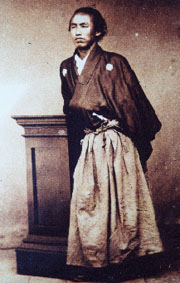
Hillsborough finishes off with the assassination of Sakamoto Ryōma.  Unlike the previous assassinations, committed by enemies of the Bakufu, this assassination was committed by pro-Bakufu forces, though the exact details remain unclear.  After a brief introduction to Sakamoto Ryōma, (more information on his life can be found in numerous English works, including Hillsborough's own Ryoma: Life of a Renaissance Samurai) Hillsborough takes the reader through the various reports of the incident.  There is no clear narrative on the assassination.  Many of the Bakufu reports are missing, and later "confessions" by people who claimed to be part of the attack don't fully match up with the official record, nor each other.  Hillsborough merges these accounts, and provides his take on their veracity, providing at least a plausible account of what happened (spoiler: he puts the blame on the Mimawarigumi).  He finishes off with a look at the repercussions and ramifications of the assassination, as well as a brief summary on the final fall of the Tokugawa Bakufu and the rise of the Meiji government.

Overall, the book reads well, and provides a look at these instances which many people outside of specialists are unlikely to be intimately familiar with.  Despite a slightly idiosyncratic system of Romanization (in particular the use of é on all kanji-final "e", not simply word-final, providing things like Takéda Hanpeita), the text flows easily enough.  It is accessible for even casual readers, covering subjects not typically found in most English histories of Japan.  Perhaps most importantly is the way that he follows the various paths that wind and wend their way through the fabric of this era.  It is easy to mistake this period as a straight up fight between supporters of the Bakufu and Imperial Loyalists.  Instead, we see exposed the internal tensions of Tokugawa Japan, formed through the historic ties between the various domains.  Although Satsuma and Chōshū are often spoken of in a single breath as the forces that finally brought down the government, it is easy to forget that before the political deal-making of Sakamoto Ryōma these two domains were fierce rivals.  That the concept of "expel the foreigners" was not strictly an anti-Bakufu stance, while many Imperial Loyalists viewed opening ties with the West as crucial to build up Japan's strength.  In all there was not one single factor that can be pointed to as the ultimate reason for the Bakufu's demise.  Hillsborough does an excellent job of cutting through all of this without oversimplifying everything.

If you are interested in Samurai Assassins, or some of Hillsborough's earlier works, his Amazon page.

Saturday, July 16, 2011

The History Of Japan-As Seen Through Paradox

Paradox Interactive has long been known as a producer of highly detailed, accurate, and immersive historical simulations for home computers. Their upcoming effort "Sengoku" promises to debut as the be-all end-all of strategy games for Japan's Warring States period (the Sengoku Jidai, which began with the Onin War in 1467 and lasted for well over a hundred years). Slated for a September release, we'll be doing an interview with the game's developers and designers along with an in-depth review. Until then, we'd thought we'd spotlight two other recent Paradox sims that between them stretch from the days of the Muromachi Bakufu in 1399 to the early years of the 20th century. "Europa Universalis III: Divine Wind" introduces Japan and China to the popular Europa Universalis series, while "Pride of Nations" is an original effort by AGEOD that covers the world's great powers between 1850 and 1920.

The original Europa Universalis was introduced in 2000 and proved to be wildly popular among strategy gamers, with two later versions of the game and four expansion packs. Currently, you can play as any of over 300 historical nations controlling more than 1700 provinces and regions in games that can stretch from 1399-1820. And in DAILY turns. Yes, daily-and we're not even going to speculate if it's the Gregorian, Julian, or Lunar calendar. "Divine Wind" is the latest expansion pack, giving a new dimension to the previously generic nations of Japan and China. While Europa Universalis II had released a special version (entitled 'Asia Chapters') giving life to the Orient for Asian markets, this is the first time it has done so in the West. Since this is, after all, the Shogun-ki, we'll be focusing on gameplay as Japan.

The first thing you'll notice is that instead of the game using historical 'clans', it uses a system popular in Japanese gaming-having the nation controlled by the Genpei Toukitsu, the "Four Famous Clans" of Minamoto, Taira, Tachibana, and Fujiwara that almost all samurai supposedly can trace their roots to. Since the game covers roughly 400 years and the entire world, this was probably a good choice-with all the other nations, it simply wouldn't have been possible to keep track of all the tiny clans that emerged and were destroyed over the years. Just think of the 'Genpei Toukitsu' as representing the different clans that descended from them. While you're perfectly free to try anything you want anywhere in the world (we invaded Ming China on Turn One just to see if we could), this will cause disruption and unrest among your people, so it's best to concentrate on consolidating Japan under your leadership first. After all, only the Shogun can effectively carry on diplomatic relations with outside countries.

Juggling your economic resources to keep your people happy, developing your provinces with buildings, and recruiting military units are the basic building blocks of this type of game. However, you can also recruit leaders and other 'great men of history', each with their unique strengths and weaknesses. As the economy and technology develop, more and more choices and options open to players. Missions are given to players and can range from elaborate to simple-our first mission involved adding to the nation's culture by cultivating the art of tending to cherry blossoms. These missions sometimes require concurrent advances in different fields along with using up specialized personnel. Diplomacy allows players to do something as subtle as insulting a rival to provoke a war and leave your opponent looking like the bad guy. You can sponsor artists and writers to heighten the nation's culture. Keeping your military tradition high is crucial in insuring you will have effective generals and admirals to recruit. Battles are played out on a strategic level, and there are no 'real time' tactical level battles. Players can set priorities for their nations by adjusting sliders that determine how much of a country's resources will go into them. Each aspect of the game has repercussions for every other aspect, meaning that a wise player will not just look at the immediate effects of a decision but also how it will affect other factors over time.

The level of depth and options in Europa Universalis is staggering. You can recruit all sorts of agents-spies, admirals, conquistadors, diplomats, missionaries, all with different functions. Spies can perform all sorts of actions, ranging from counterfeiting another area's currency to undermining their guild structures and spreading false rumors. Unlike many games of this ilk, steamrolling province after province without provocation will result in bad things happening to the player. Unbridled aggression will drive up a player's infamy, a game device which fits in well with Japanese history-think of how Oda Nobunaga or Taira no Kiyomori tended to unite the ranks of their disorganized foes. Provoking opponents into rash attacks or coming into a war on the side of an ally who was 'unjustly attacked' provide much safer avenues for expansion.

One area in the game we noticed that comes up a bit short is 'localization'. Most game terms are European (understandable, since the game is centered on Europe, and having more than one set of commands would cause mass confusion). Likewise, many of the portraits the game uses are of Europeans and look completely out of place when matched up with a Japanese character. Many of the Japanese characters have clearly Chinese names. Overall, given the scale of the game, this a relatively minor annoyance.

Graphics are effective, relatively uncluttered, and there are multiple intuitive interfaces and filters that will tell you at the click of a button virtually any bit of information you'd ever want to know. Even though the game runs day-by-day over 400 years, it can be sped up greatly so the days fall away like a fluttering desk calendar. It can also be slowed down or paused during times of great activity where precision is paramount. And of course, playing as Japan just scratches the surface of what's on tap. Virtually any nation you can think of in any time period covered is available, offering a whole new gaming experience. Exploration, colonization, and developing new technologies become a big part of gameplay. While historical technology can be sped up by infusing it with development cash, it becomes much harder to do so the further it diverges from its historical appearance. Victory is determined largely by the goals players set for themselves-obviously, making France, England, or Russia the #1 nation in the world will be much easier than doing so with a small Germanic state-or even Japan. But often realizing a modest goal with a small faction is far tougher than meeting a large goal with a large nation. This makes for an almost endless variety of game experiences, as the goals for each nation are set by the players themselves and are easily changed from game to game. While there are no scenarios per se, there are bookmarked years that allow players to start the game in years of note-like the discovery of the new world, the League of Cambrai, the Thirty Years War, and the American and French Revolutions. There are ample mods for the game, which we'll delve into later in the review. Anyone interested in the game would likely be better off buying the "Europa Universalis III: Chronicles" pack which includes the original game and all the expansions, including Divine Wind. It's far more convenient than buying them separately.

We could go on and on giving details for Europa Universalis, but we still have "Pride of Nations" to cover. While similar in play to the Europa Universalis series, Pride of Nations is even more elaborate. While the main playable choices are the USA, Great Britain, Germany, France, Japan, Russia, Austria-Hungary, and Italy, you can actually play as virtually any country on the map (albeit without getting country specific 'events').

We started off as Japan again, and found that the game rewards players that proceed in an historical manner. Thus your early goal is to keep the Tokugawa Shogunate in business, putting down rebels and earning valuable Prestige Points that make your nation stronger. Early turns in our mini-campaign were spent building up Japan's basic economy as quickly as possible while also putting together a small fleet that could trade with Southeast Asia. Trying to speed up history and getting rid of the Tokugawa will result in a shattered country that could provide easy pickings for circling Europeans. The change in the political climate will come soon enough, and it's important to have a Japan that can economically take advantage of it-as well as one with enough prestige to count on the world stage.

The strongest aspect of the game is the military component (an aspect of play that AGEOD has excelled at), an armchair general's fantasy. You have all the building blocks you need to form any unit from a company to an army, and they can be combined in any way imaginable (although there is a minimum size for an independent unit). Supply units, engineers, infantry, artillery, cavalry, and more-they're all here. Leader units usually have a photo of the historical leader on their counters, and clicking on each unit will show an illustration of their uniforms and arms-again, specific to each country. Individual ships will have a photo of the historical ship on the counter wherever possible. Garrisons are raised automatically as needed (representing a sort of 'local militia'). Each unit is rated in a mind-boggling variety of categories-range, ammo, cohesion, aggressiveness, speed, discipline, and recon being a few. There are over FIVE HUNDRED special abilities a unit can possess. Combat is again played out on the strategic level-no tactical battles. Units can simply march to a location, or use rail and naval transport (if you have it).

Pride of Nations also emphasizes logistics and supply. Putting together a large force to send to East Africa is easy-keeping it alive once it's there is a whole other story. An army far from home that doesn't has access to plentiful ammo, food, and replacement parts is an army in a world of trouble. Whether it's horse drawn supply attached to units, rail, or naval transport, setting up your the supply network is all important. Attrition to units via climate, disease, and moving through rough terrain can deplete an elite unit in no time. Much like the real world, non-battlefield casualties account for just as much damage or more than those sustained in battle. And also much like the real world, the army with the best logistics will be the one in the best position to win. Players with the patience and ability to put together a strong supply network will find the going much easier. Other than the Takeda series of games, we can't recall a sim involving Japan where supply was such a crucial element.

Diplomacy is a bit abstract-there are the standard options for making alliances, defensive treaties, and right of access along with less common ones like making inter-country loans. Declaring war is somewhat difficult-it's not as easy as just saying so. Players will need a casus belli to do so, which often comes out of a 'crisis'. This is an event generated by the game and is determined by several factors-the state of diplomatic relations between counties, troops gathered on a border, or a disputed parcel of land being some of these. This triggers a crisis where the player has six turns to either go up by three dominance points or simply be ahead at the end. Dominance is established by press conferences, oratory, calling for a resolution or delay, or attempting to gain the support of third parties. Winning a crisis might garner enough prestige points to justify declaring war on an opponent.

The economic aspect of the game is excellent. It's largely based on manufacturing while keeping your population happy enough to prevent rioting. Manufacturing allows for lucrative international trade in conjunction with a merchant fleet. These are vital for procuring raw materials and items not found in your country (a real problem for resource-starved Japan) to keep those factories running and the cash rolling in. The level of detail is so layered that a player can actually set up a factory in a different country (pursuant to an agreement to do so) and ship finished goods back to the homeland. Another nice aspect is the distinction between private and government funds-government funds are raised from different sources and are used mainly for military funding, whereas private funds bankroll factories. Colonization is obviously a big help in supplying whatever resource a country might be lacking in, so most of the game's battles center on colony disputes rather than direct invasions of the mother country. In countries that have elections, you can also attempt to push one candidate over the other (although as always your people might have different ideas!). Social classes, education, religion, nationalism, and ethnicity all have a hand in determining the stability of the home front.

Graphics are a bit more whimsical than in Europa Universalis, with tiny animated ships traversing the globe. We found the old fashioned real-time clock in the upper right a nice reminder that we needed to keep track of things in the real world, since the game is very addictive. Another nice touch was the background music-over 100 selections that reprise some of the more memorable period tunes. The map has several different modes (military, economic, decision, colonial) and several filters can show the supply grid, key cities, and even the weather. Unlike a lot of games, turns are simultaneous-when you click end turn, all of your orders made during the turn are then executed at the same time that every other country's orders are executed. This makes things far more unpredictable, as enemy forces will often move before an attack can be carried out.

Even with all of the research that went into the game, there were still some things that made us groan in the set-up. Shimazu Nariakira was shown as Daimyo of Tosa on Shikoku, not in Kagoshima (Satsuma) on Kyushu. Likewise, one of the Tokugawa is shown as being in control of Hiroshima and Tokugawa Yoshinobu is installed as a leader in Edo in 1850 (when he's only 13 and should be in Mito). Thankfully, he hasn't been made Shogun yet.

The biggest complaint among players of the game centers around its length. The Grand Campaign runs for 1680 turns, and on top of that the computer AI takes a LONG time between turns to make its decisions and sort out/coordinate all the orders given by all the factions. Mods are on the way that will double the time periods each turn covers (halving the number of turns), and hopefully some sort of patch that will address the AI decision making lag. If you're really impatient, there are four short 'battle scenarios' (including the Russo-Japanese War) that remove the economic element and allow you to slug it out-with the Spanish-American War scenario also available as DLC.

Pride of Nations is an amazing game that provides players with an avalanche of information, options, and materials but somehow makes it all manageable. With the different situations facing each country, it also has unlimited replay value-which is extended even further by the AI giving each country different objective cities each playthrough. With a strong military aspect, an excellent economic and diplomatic component, and establishing trade and colonialism as an integral part of success, it takes its place at the top of the list in grand strategic games.

Paradox makes their strategy games mod-friendly, so there are tons of interesting player-created mods for Europa Universalis and there are probably just as many on the way for the recently released Pride of Nations. Mods range from simply setting up new scenarios to changing the map, introducing new artwork and unit appearances, and plugging in new scripts. The load screens for the games even allow you to choose any mod you've downloaded before booting up! The best place to find mods to download is at the Paradox Interactive Forums...not to mention the skilled and knowledgeable players that will be able to help you out in any situation you might get into. Both games also offer online multiplayer (both LAN and online), with up to 32 different players taking part in the same campaign for Europa Universalis.

Both of these games make for great learning tools for those who don't just want to read about why history played out as it did, but also to experience it. They're the descendants of the monster board wargames of the 1970's and 80's with the advantages of greater depth and zero recordkeeping. While you won't get the 'real time battles' of "Total War-Shogun 2", you will get a much greater sense of running a faction's diplomacy, economy, and military along with an unmatched level of control and detail. There are no quick fixes here-you have to be thinking out your strategy years in advance, just not a couple of turns. You won't find more involved, well-researched, and addictive history games than these. Did we mention how inexpensive they are? Europa Universalis Chronicles lately has been on sale at Gamersgate for under $10, a steal. Pride of Nations is less than 20 bucks. Considering the amount of well-spent time you can enjoy playing them, it's the cheapest entertainment option around.You can find "Europa Universalis III Chronicles" and "Pride of Nations" on Amazon.com, or (recommended) in downloadable form at venues such as Gamersgate or Steam.

Thursday, March 25, 2010

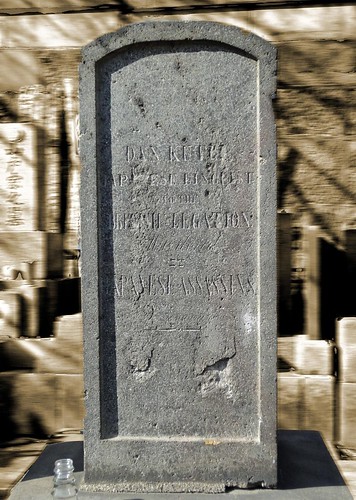
Here Lies Dan Kutci, Victim of Sonnō Jōi Terrorism


DAN-KUTCI
JAPANESE LINGUIST
TO THE
BRITISH LEGATION
Murdered
BY
JAPANESE ASSASSINS
29th January, 1860

Tucked away in a corner of Kōrin-ji, a Rinzai Zen Buddhist temple In Azabu, Minato-ku, Tokyo, one can find the grave of Dan Kutci, a Japanese linguist who was employed by the British legation. Kutci, like another fellow translator, Henry Heusken, whose tombstone lies within the shadow of Kutci’s, was killed in an act of terror committed by anti-foreigner ‘terrorists’ during the waning days of the Tokugawa Shogunate.

But who was Dan Kutci? Who wanted him dead and why? For starters, Dan Kutci was a native of Japan and was more commonly known among the Japanese by the name, Denkichi—Kumano no Denkichi, to be exact. Denkichi originally hailed from Shiotsumura in the province of Kishū (present day Shiotsu, Wakayama Prefecture). Denkichi served on a merchant ship, the Eirikimaru that was returning back to Setsu from Edo with a full cargo when the ship got caught in a storm on Dec 2, 1850. The ship drifted for 53 days until it was rescued by an American merchant ship, the Aukland, which brought the Japanese to San Francisco on March 5, 1851. With nowhere to go, the 17-man crew of the Eirikimaru was confined to a US Customs ship, the Polk, for nearly a year until they boarded the USS Saint Mary, a warship outbound for Asia where it was hoped that the Japanese could be repatriated with Perry’s upcoming expedition. One of the Japanese died along the way and was buried in Hilo, Hawaii. The others continued on and arrived in China where they soon found employment and were dissuaded from returning to Japan with the Perry Expedition. However, Denkichi was eventually able to rendezvous with Perry’s squadron as it made its way back to America and was able to secure passage on Perry’s flagship, the Mississippi in July 1854 when the ship steamed into Hong Kong.

After five years in America, Denkichi found himself back in China where he was hired as a translator by Rutherford Alcock, England’s minister to Japan and the two arrived in Edo (Tokyo) on May 26, 1859. It had been 9 years since Denkichi had been back in Japan. But after returning home after such a long absence, Denkichi didn’t quite fit in and acted in a manner that was perhaps more Western than Japanese. He told people he was British, wore western clothing and acted very haughtily, which angered many of his countrymen and made him a prime target for the radicals who were advocating expelling the foreigners and restoring imperial rule. And it was on the afternoon of January 29, 1860 that two samurai wearing straw hats to cover their faces, attacked Denkichi, driving either a short sword (wakizashi) or most likely a dagger (tantō) up until the hilt deep into his back, leaving it there. Poor Denkichi, haughty or not, had just become a victim of sonnō jōi terrorism.

Sonnō jōi (revere the emperor; expel the foreigners) was a rousing phrase and political philosophy to which young radicals rallied in the waning days of the Tokugawa shogunate. Fueled by a growing pro-imperial sentiment and anger at the shogunate for opening the country to the West, the sonnō jōi movement became a nascent unifying force that challenged and weakened the 250 year-old status quo of Tokugawa rule. As violence was the movement’s primary tool as a means of enforcing ‘heaven’s will’, this helped Japan slip into the chaos and wanton terror that would help define the Bakumatsu period and engulf the lives of many foreigners and Japanese alike.

Denkuchi may have died a victim of sonnō jōi terrorism 150 years ago, but he’s not forgotten.

Source: Miyanaga, Takashi. “The Assassination of Denkichi. Journal of Society and Labour, Hosei University, 40(3/4), 1993.

Saturday, August 01, 2009

Moe Yo Hirugohan 燃えよ昼ご飯

(Burn My Lunch)

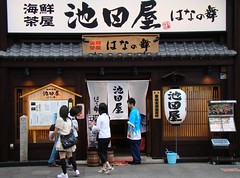
This is a review of the Ikedaya restaurant in Kyoto, Japan. But before I get on with the review, let me explain a little about the Ikedaya’s background. For those of you who don’t know, the Ikedaya used to be an old inn and was the site of a bloody incident involving the Shogunate’s special security unit, the Shinsengumi and pro-imperial radicals on July 8, 1864. Within the walls of the Ikedaya, radicals, called shishi, who were mainly from the domain of Chōshū, came up with a plan to set fires in Kyoto and cause a lot of mayhem aimed at bruising the credibility of the Shogunate. The Shinsengumi got wind of the plot and proceeded to surround the Ikedaya while the shishi were gathered there and apparently in their cups. All hell broke loose as a group of the Shinsengumi, lead by its senior commander, Kondō Isami, stormed the place. Steel met steel, flesh and bone and without exaggerating, the Shinsengumi kicked some serious shishi butt. The Shinsengumi probably saved the entire city from going under the torch, although as much as 1/3 of the city would burn as a result of the fires set during the fighting between Chōshū and pro-Bakufu forces that started at the Imperial Palace’s Hamaguri Gate.

As time went by and the Ikedaya incident grew stronger in legend, the building eventually fell into disrepair. The site eventually gave rise to an ugly 3-story pachinko parlor that closed early in 2009. It was announced that an izakaya (Japanese style pub and restaurant) chain was going to buy the property and turn it into a historically-themed place to eat and drink. As those who know me can attest to, I am a Bakumatsu period history nut and was really happy to hear this. So, when If found myself in Kyoto for the Gion Matsuri on July 16-17, 2009, I just *had* to go there for lunch, once I had discovered that the new Ikedaya had just opened.

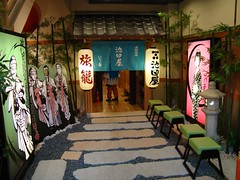
As I strolled up to the building, I was greeted by restaurant staff, trying to hook people in, announcing the lunch specials and that the restaurant was now open. It was hard not to chuckle as all he staff were dressed in Shinsengumi uniform-style hapi (short coats). I saw they had a sushi + cold udon (rice flour noodle) set as a lunch special, and was ushered in. Before I could adjust my eyes to the surroundings, I found myself being ushered up the stairs to the second floor. I wondered what Okita Soji must have felt as he led the assault on the shishi in the second floor. My thoughts about what must have been going through his head quickly changed to a “WTF” moment, as I myself was visually assaulted by a ridiculous looking manga mural of the Shinsengumi. So much for authentic realism. I then arrived at the second floor. As I came off the staircase onto the landing, I saw a raised area on tatami mats containing replica old looking furniture and other items. It seemed like a weird combination of things that made no practical sense. Turning my head back in the direction that my feet were travelling, in pursuit of the staff member who was trying to guide me to my table, I was assaulted yet again by the ridiculous as I came to the entranceway of where the tables are located. “Cheese Meets Wabisabi”, where the words that went through my mind. “What have they done to this place,” I silently bemoaned. The colors, strange manga versions of historical figures, oh, it was hurting my eyes!


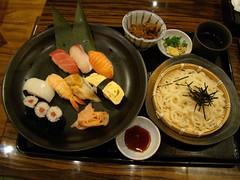
After a few second eternity, I finally made it to my table and began to pour over the menu. I have to admit, some of the things on the regular dinner menu looked all right, after all, this place is an izakaya. But never-the-less, I pretty much decided on the sushi and cold udon set, and that is what I ordered. While waiting for the food to arrive, I chugged glass after glass of cold barley tea, called mugi cha, as I was hot and a little dehydrated from standing outside for more than 3.5 hours in the humid steam cooker that Kyoto becomes in summer in order to watch the Gion Matsuri parade. My mind kept also trying to get around the 'cheese factor' that the owners had introduced to this solemn place, however, I reasoned to myself that if the food is good, I could forgive the tackiness of the place and maybe commit myself to coming back for an evening excursion at some point in the future. But before I could get lost in any deep thoughts and future plans, the food arrived.

As I snapped some photos of my meal, I realized that the sushi didn’t look so hot. Now don’t get me wrong. I am a foodie and consider myself a connoisseur of good sushi and know sushi is not supposed to be served hot. What I mean, is that it didn’t look all that great. My first taste confirmed what I suspected. Sure, it was edible, but not very good. Kind of like what one would find at a fast-food, conveyer-belt sushi chain outside of Japan, or what you’d get at a shopping mall’s food court. Worst of all, was the anago (sea eel). It was so soft and mushy, I nearly had to spit it out. Yuck!! I then set upon my udon, which was fine. You can’t really massacre cold noodles. I found myself slurping my noodles faster than usual, though, as I realized that I probably wanted to get out of the Ikedaya worse than a trapped Chōshū shishi the night the Shinsengumi crashed their party. As soon as I put my noodles down, I grabbed my backpack, camera and took a few more photos before I descended the “staircase of destiny” to pay my bill. I was happy to leave the Ikedaya. I really was.

A few minutes after I left the place, I called up the Samurai Archives’ Shogun, Kitsuno, to relay my Ikedaya experience as I aimlessly wandered around the the Pontochō geisha district in a light on and off drizzle. I remember musing on the phone that I probably should have steered away from ordering sushi in an izakaya chain-store restaurant and in Kyoto of all places. I suppose I should mention that while Kyoto is known for exquisite cuisine (and I am not referring to pizza-man from convenience stores), the city isn’t exactly famous for having good sushi. Kitsuno listened to my ramblings and told me that I should blog about my experience, so here I am, doing exactly that!

Now to sum things up, I wasn’t happy with the Ikedaya, from both a historical and epicurean experience. I found the place tacky and my lunch equally disappointing. I do suspect that some of the evening fare is better than the sushi, and besides, they have a large selection of alcohol to numb one’s taste buds. If you are a Bakumatsu history junkie and have to see this place for yourself, go ahead! Just don’t order sushi! As for myself, I don’t have a burning ambition to return to this place. But like the name of the famous fictional book about the Shinsengumi called Moe Yo Ken (Burn My Sword) by Shiba Ryōtarō, I felt an urge to burn my lunch!

A few more pictures from the Ikedaya and a variety of photos from Kyoto and other historical places in Japan can be found on my flickr website at http://www.flickr.com/photos/rekishinotabi

Saturday, February 07, 2009

Jōi and Pain: Trying to Make Sense of Tokugawa Nariaki

Tokugawa Nariaki: Devil or Saint? Who knows?!?


If anybody was the living embodiment of Mitogaku and all of its inherent contradictions, it had to be the retired lord of Mito himself, Tokugawa Nariaki. Outspoken, brash, lecherous and just plain clever, Nariaki was certainly one of the more colorful personalities that strutted across the early Bakumatsu stage. In the theater-in-the-round that Japanese politics devolved into as a result of the Perry expedition, all eyes were on Nariaki, who certainly dominated a large part of the action on center-stage. Wherever he went, whatever he said or wrote, controversy and riotous debate followed. He had a powerful voice that projected his message to all corners of the empire, no doubt rankling the ears of the Bakufu and certain powerful fudai daimyo. However, Nariaki’s soliloquies on how to remedy Japan’s ills and successfully deal with the ‘foreign issue’ found an adoring audience among reform-minded daimyo, courtiers within the halls of the imperial palace, and among all strata of samurai and commoners alike. Yet just what was Tokugawa Nariaki’s message?

To a lot of us living in the here and now, at first glance, the message looks garbled if not just downright confusing. Trying to decipher the message has led to many of those now famous ‘Bakumatsu headaches’ that some of us have been complaining to each other about recently. How can it not? Nariaki was a walking bag of contradictions. It’s a lot like some of the contradictions we all studied in high school world history classes about Europe in the age of ‘enlightened despotism’. I think it is safe to say that Nariaki was an enlightened feudal lord cut from a mold very similar those of the ‘enlightened despots’ of the European variety, and in some ways, he’s even more difficult to analyze than Frederick the Great, Louis XIV, or Catherine the Great. When it comes to Tokugawa Nariaki, “pro-reform/reactionary conservative; xenophobic/eager to import foreign ideas and technology; pro-Tokugawa/pro-Imperialist” are all words and phrases that are commonly used to describe him. To unravel his message, let’s take a look at his policies and what he stood for and in the process clarify some of these contradictions.

Pro-Reform/Reactionary Conservative Nariaki’s reforms were focused on the preservation of han unity and harmony on a local level and national unity and harmony on a macro level. As written by Aizawa and others, Nariaki firmly believed that harmony could only be maintained if all classes of society respected the existing social hierarchy and political institutions. And the political institutions and social orders were dependent on being sanctioned by the imperial throne—the source of all legitimacy in Japan. Therefore, full-hearted and proper respect must be shown to the emperor in order for Japan to enjoy the benefits of peace and prosperity. Without the proper level of respect being shown for the throne or the political and social orders, Japan would sink into chaos and misery. To Nariaki, the famines and the resulting turmoil of the Tempō period validated his Mitogaku inspired political theory. This is evident in a memorial Nariaki wrote to the Bakufu in 1839 that William Beasley quoted in The Meiji Restoration: “When superiors ignore the hunger and death of farmers in bad years, when they are remiss in making military preparations, when the samurai are weak and idle, then inferiors hate their superiors and do not fear them.” This is in reference to the peasant revolts that were rocking the nation at the time. Taking this a step further, a letter written to Mizuno Tadakuni in 1842, that also appears in Beasley’s book aptly sums up the essence of Nariaki’s beliefs about political and social order: “If the shogun takes the lead in showing respect for the throne, the whole country will inevitably unite in so doing; but it is vital that in this each should observe his proper place. The samurai shows respect for his lord, the lord shows respect for the shogun, the shogun shows respect for the emperor. To forget one’s place and take matters into one’s own hands is an evil act, worthy of the name of rebel.”

Thus, as we can see, Nariaki’s views quite neatly fit inside the Mitogaku interpretation of the Confucian social hierarchy triangle. And to help ensure that merchants remembered their proper place in the pyramid’s lowest rung, Nariaki enacted strict anti-commerce policies that were designed to discourage the growth of the merchant class’ power as well as to help keep farmers on the land, rather than try their luck as shop keepers or traders in urban centers. As for samurai, Nariaki felt that their decline in fighting ability and moral righteousness were due in part to commercial-related activities, giving him another reason to crack down on the merchant class. He, like Shimazu Nariakira, was also against the giving of two swords and a surname to merchants who sought to buy samurai status. It was an outrage to allow bushi status to be bought. And by allowing this sort of thing to happen, samurai morale, morals as well as ethics would erode.

So, what is the substance of Nariaki’s domestic political reforms? He seems like a classic Confucian conservative, does he not? If you agree with that statement, than it shouldn’t surprise you that in essence, Nariaki strove to bring his han back into a traditional Confucian framework that was envisioned by Ieyasu, but of course, with the emperor at the very top of the pyramid. Strong and just leadership combined with the enforcement and study of strict moral and ethical guidelines that constantly reminded all classes of their place, duties and obligation to respect society’s structure, would serve as a bulwark against the erosion of domain strength. Nariaki believed, as did many of his fellow daimyo, that if enactment of this ideal ‘reactionary’ neo-Confucian social structure could be replicated in every han, all would be well and Japan’s domestic troubles, as experienced in the Tempō period, would not and could not occur again.

In nearly all that he did, Nariaki strove to instill his ‘reactionary’ domestic reforms in a way that would preserve his ability as an individual daimyo and that of his beloved han to operate as independently as possible from Bakufu control. This makes perfectly good sense if you agree with Beasley that a feudal daimyo like Nariaki only had three things to be afraid of: Bakufu intrusion from above, peasant rebellion from below and foreign attack from outside. Makes you think Nariaki is really in it for himself, doesn’t it?

Xenophobic/Eager to Import Foreign Ideas and Technology It was Mitogaku that first coined the catchphrase sonnō jōi, and as spokesman for the movement, it is clear that Nariaki didn’t want Japan’s ports opened to the West nor did he want foreigners on Japanese soil in any large numbers. However, Nariaki wasn’t opposed to the importation of foreign ideas, education and technology--if it could be used to strengthen Mito and the various han throughout Japan. Again, Shimazu Nariakira, daimyo of Satsuma, held similar views to Nariaki—after all, he too, was a follower of Mitogaku, Nariakira built Japan’s first steam powered ship, established a telegraph line, started making modern weapons and other products—all aimed at strengthening Satsuma’s military and economic strength. Mito, not having the financial means as Satsuma, followed similar lines, but Nariaki’s economic view of the world was more agrarian-centric, as rice, not industrial products, served as the backbone of the Japanese economy and society. Nevertheless, from the 1840s, Nariaki argued to have the Bakufu’s prohibition on building large-ocean going ships overturned as he felt that there was a need for a strong navy. And once the Bakufu reversed course on the building of large blue water ships after Perry’s first expedition, almost immediately, Mito ordered one of Japan’s first western warships from the Dutch. Nariaki also tirelessly called for an overhaul of the baku-han military system in order to ensure Japan could enact jōi when the time came. In other words, it was acceptable to hold foreigners in contempt, but their goods, services and ideas, if they could be used to defeat or hold at bay those same foreigners, were perfectly okay! I just can’t help to wonder how if Nariaki really felt that in order to import all of these concepts and build up Japan’s defensive capabilities, was the open port of Nagasaki, along with its heavy restrictions placed on the Chinese and Dutch traders, enough to guarantee a big enough trickle of practical ‘barbarian’ ideas and goods?

Pro-Tokugawa/Pro-Imperialist This is the last contradiction that I’d like to take a look at. We know that Nariaki was probably the loudest daimyo when it came to preaching loyalty to the emperor, as espoused in Mitogaku. As a Tokugawa, and a descendent of Ieyasu and a blood relative of the shogun, it may strike people as odd that Nariaki sought to put the emperor above the shogun in the social and political order. But that’s exactly what he did. He even would go out of his way to point out, as he did in a letter to Abe Masahiro in 1846, that although Japan had been a ‘Tokugawa’ country since Sekigahara, there was no law or guideline saying that it should always remain this way. If the Bakufu failed to act to secure the safety of Japan in a time of crisis, others, such as some tozama daimyo, may accuse the Bakufu of failing to live up to its obligations, and an overthrow of the Tokugawa could then become a reality. To avoid this from happening, Nariaki argued that remaining passive and awaiting the outcome of events before making decisions was not an option. He continuously pushed for more proactive policy-making and planning on the part of the Bakufu.

Looking at the above paraphrased letter, it makes Nariaki look like soothsayer, as what he said could happen, eventually did in 1868. And it is clear, that although Nariaki noisily advocated that everything and everyone was subservient to the imperial throne, he did not want to see the Tokugawa fall from power. After all, Nariaki was a Tokugawa and he owed his own life of privilege to the very system that was in place. He clearly did not want the system to fail!

Whether regarded as an devil a saint or a walking bag of contradictions, Tokugawa Nariaki is truly one of the more interesting, yet puzzling figures of the Bakumatsu era.

Saturday, November 15, 2008

Footnotes of History?


Have you ever wondered why there seems to be so little scholarship on the Shinsengumi available in English? One may find it surprising, considering all the attention the Shinsengumi get in imported Japanese “pop” culture in the form of films, anime and manga. To date, the only book I know that is dedicated to the study of the “Wolves of Mibu” is Romulus Hillsborough’s Shinsengumi: The Shogun’s Last Samurai Corps published in 1995. On one hand, I have to tip my cap to Hillsborough for writing this book. At least he had the chutzpah to tackle this controversial historical group, and as a result, he’s been beaten up in internet forums for being unbalanced in his approach to the political factions of that day, overly critical of the Shinsengumi by those who adore them, as well as has been accused of writing a book that lacks a coherent flow and contains too many corny and hackneyed phrases. Yet for all of Hillsborough’s faults, both real, imagined or exaggerated, his work remains the only readily available non-fiction book about the Shinsengumi in English. So again, why aren’t there more? I was recently asked this question by a friend and this triggered a serious round of thinking. The following is based on my response.

I think the reason why there is so little on the Shinsengumi in English is that in terms of the overall story of the Bakumatsu/Restoration, they are relatively minor players and don’t do anything save one incident which dramatically affects the pace of events. That event was of course, the Ikedaya affair where they pretty much saved Kyoto from deliberately getting torched by some Chōshū nut job extremists. Other than that, what else can you say about these thugs and their brutal behavior towards each other and the loyalist extremists they hunted down? Sorry-- I use the word “thugs” to describe the Shinsengumi, but what other word best describes these guys? I’m definitely no lover of the loyalists, but let’s face it—the Bakufu thought the best way to fight the loyalist thugs that were terrorizing the streets of Kyoto would be with their own “deputized” gang of thugs—and they were right! So while the Shinsengumi may have been minor players in the overall big picture, they do loom very large in the Bakumatsu period history of Kyoto. It would be ludicrous to think that the Shinsengumi did not have a direct impact on the events in that city and everyday life there for a handful of tumultuous years. Again, their impact on Kyoto can’t be denied and is probably one of the reasons they are popular to this day in Japan. Stories and incidents that took place in Edo and Kyoto dominated the mass media then, so we are left with a wealth of material about their exploits in the not so distant past. This is evident by the number of books about the Shinsengumi that can be found on Amazon.co.jp or in any decent-sized Japanese bookstore. One look at my bookshelf further backs this up.

Okay, so the Shinsengumi remain a popular topic of scholarship in Japan, but why not in the rest of the world?

I think you can look at the Shinsengumi’s popularity in Japan and compare it to why a sizeable portion of American society may be able tell you a thing or two from the days of the Wild West about the James Gang or the Dalton Gang on the wrong side of the law or the Texas Rangers, Bat Masterson and the Earp brothers and their friends on the “right” side of the law. In a 20th century context, I guess you could make a loose comparison to Elliott Ness’ G-Men acting as a crack unit to take down Al Capone and the other gangsters of Chicago. Neither the outlaws nor their “good” guy counterparts were angels, but they all stick out and are relatively well known. Americans can tell you about these people and some of their exploits because they were exciting points in the long and bland history of how as a people and a country, the US got from there to here. Also, these people, both “good” and “bad”, were products of the times as well as the culture. They weren’t catalysts or show stoppers in a historical context, but just interesting, and because of this, they are remembered and studied. I don’t think too many non-Americans know much about these people, besides what they may have seen in movies or in old TV shows. I’m willing to wager that there probably aren’t too many non-fiction books published in foreign countries about these historical American figures for the same reason it is hard to find histories of Shinsengumi in languages other than Japanese.

Just as many Americans can say that they know the name of Jesse James or Billy the Kid, the same holds true for how Japanese look at the Shinsengumi—whether they are fans or not. Everybody in Japan knows something about the Shinsengumi—even the idiot kids who can’t even tell you the name of the current prime minister! So even though the Shinsengumi are a part of the landscape of Japanese history and culture and are fodder for exciting stories of adventure and dark camaraderie forged in blood, how much interest does a non-Japanese academic or his/her peers have in this topic? I’m not so sure they fully “get it” or find the subject matter all that interesting in the larger scheme of things. If we really think about it, there really aren’t too many books out there in English on the Bakumatsu. I’m already hearing groans from those who already think there are enough books on the Bakumatsu and not enough on the Sengoku period, but let’s face it; there really aren’t all that many books available on Japanese history as opposed to say, European or American history, yes? And most of the books on the Bakumatsu are going to focus on the general big picture or on the key individuals or han, such as Chōshū, Satsuma or Tosa. Thus sadly, for western written histories of the Bakumatsu, the Shinsengumi are nothing more than an interesting footnote. This is one of the problems with non-Japanese scholarship on this period. A lot of the exciting stuff gets relegated to mere footnote status as it really doesn’t alter the outcome of events. Hence, at least in English, the Shinsengumi, for the large part, remain footnotes of history.

So, the question is—who is going to write the next non-fictional account of the Shinsengumi in English? Any takers?