Saturday, August 08, 2009

Book Review: Warring Clans, Flashing Blades

Warring Clans, Flashing Blades: A Samurai Film Companion
Warring Clans, Flashing Blades

A number of years ago, while killing time in an airport bookstore, I stumbled across Stray Dogs & Lone Wolves: The Samurai Film Handbook. Or should I say the book sought me out and invited me to go on a fun-filled journey through the realm of samurai cinema. It wasn’t hard to convince me to go along for the ride. After all, I am a huge fan of this genre and after less than a minute of thumbing through the book, I was hooked and let myself be guided through some of the most entertaining Japanese films ever made. This book was truly a fun read, and with each new review that I devoured, I realized that I had found the perfect person to watch samurai films with in the form of the author, Patrick Galloway. I don’t mean that I’ve actually watched a film together with Pat, but I immediately liked what Pat had to say and loved his writing style. It wasn’t stuffy, condescending or academically dull. Pat writes about samurai period piece films in a natural way, just like you would talk to a good friend about a movie. And when deciding on whether or not to see a particular film, we often tend to rely on the advice and opinions of friends, yes? Well, that’s exactly what Pat Galloway’s book became—a surrogate friend that helped open the doors to new aspects of Japanese cinema that I was unaware of as well as introduced me to some very good films that I probably never would have known about if it wasn’t for this book. SD&LW quickly became my samurai film “buddy” and no doubt, for many others, too.

So as I consider SD&LW a “buddy” book, I wasn’t very surprised to see that Pat Galloway’s samurai film follow up, Warring Clans, Flashing Blades is appropriately subtitled as a “Samurai Film Companion”. This is exactly what the author Pat Galloway is—a companion who has once again returned in book form to take his readers through another fun-filled tour of chambara action, suspense and compelling jidai-geki (period piece) drama and intrigue. The beautiful thing about Pat’s two books covering samurai cinema is how easily he guides readers along the path of true chambara enlightenment. Warring Clans, Flashing Blades, like its predecessor, emphasizes the element of fun as well as the entertainment value of these films while managing to teach something about the history, culture, actors and filmmakers in a way that that is witty, to the point, and tastefully done. This is a book aimed at everyone, written by a person who clearly has a love for the genre and wants to share his enthusiasm with his readers. And Pat’s enthusiasm really is contagious. Amazon.com and a couple of other vendors scored some big DVD orders off of me after the release of SD&LW and I’ll willingly admit that I am now over US$150 poorer after ordering more samurai DVDs from Amazon.com since receiving Warring Clans, Flashing Blades. I’m blaming it on Pat Galloway!

And he really does deserve the blame. It’s his fault for writing about 40 or so captivating full-length reviews and another 20 capsule reviews of very interesting movies in a way that made me want to add some of these films to my already hefty collection of jidai-geki. And truthfully (ok, the truth finally comes out), I don’t feel so bad about spending the money on the movies because I know they will be good choices, providing hours of entertainment. Pat’s opinions and mine hardly ever diverge on what we like or dislike when it comes to samurai cinema, so I trust his reviews implicitly.

I really don’t have anything bad to say about the contents of this book. Sure, I can scrutinize historical commentary and how ‘reel’ history is portrayed in many of the films Pat reviews, but what is the point? There really isn’t one except for very important thing to keep in mind. This book is meant to be fun and is the result of Pat’s unabashed enthusiasm for the samurai film genre. Fun and historical realism often don’t mesh, particularly in samurai films, just as they don’t in American Westerns. The emphasis of these films is on entertainment and Warring Clans, Flashing Bladesdoes a mighty fine job of highlighting their entertainment value. Pat simply manages to always keep it in that perspective, which is something that would be hard for me, as I tend to occasionally take real Japanese history a little too seriously and can get very nitpicky when reading history books or when watching a film that is said to be historically accurate. Again, Pat keeps it all fun and fresh, and this, in my opinion, is what makes his books on samurai films stand out from the rest.
So, if you are looking for the perfect companion to guide you through the world of samurai cinema, then you want Pat Galloway. But as Pat can’t be with you in front of your TV and DVD player, go and get the next best thing—his newest book, Warring Clans, Flashing Blades. You won’t be disappointed.

Saturday, August 01, 2009

Moe Yo Hirugohan 燃えよ昼ご飯

(Burn My Lunch)

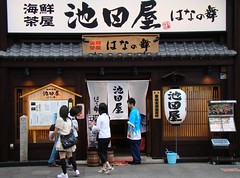
This is a review of the Ikedaya restaurant in Kyoto, Japan. But before I get on with the review, let me explain a little about the Ikedaya’s background. For those of you who don’t know, the Ikedaya used to be an old inn and was the site of a bloody incident involving the Shogunate’s special security unit, the Shinsengumi and pro-imperial radicals on July 8, 1864. Within the walls of the Ikedaya, radicals, called shishi, who were mainly from the domain of Chōshū, came up with a plan to set fires in Kyoto and cause a lot of mayhem aimed at bruising the credibility of the Shogunate. The Shinsengumi got wind of the plot and proceeded to surround the Ikedaya while the shishi were gathered there and apparently in their cups. All hell broke loose as a group of the Shinsengumi, lead by its senior commander, Kondō Isami, stormed the place. Steel met steel, flesh and bone and without exaggerating, the Shinsengumi kicked some serious shishi butt. The Shinsengumi probably saved the entire city from going under the torch, although as much as 1/3 of the city would burn as a result of the fires set during the fighting between Chōshū and pro-Bakufu forces that started at the Imperial Palace’s Hamaguri Gate.

As time went by and the Ikedaya incident grew stronger in legend, the building eventually fell into disrepair. The site eventually gave rise to an ugly 3-story pachinko parlor that closed early in 2009. It was announced that an izakaya (Japanese style pub and restaurant) chain was going to buy the property and turn it into a historically-themed place to eat and drink. As those who know me can attest to, I am a Bakumatsu period history nut and was really happy to hear this. So, when If found myself in Kyoto for the Gion Matsuri on July 16-17, 2009, I just *had* to go there for lunch, once I had discovered that the new Ikedaya had just opened.

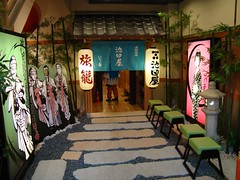
As I strolled up to the building, I was greeted by restaurant staff, trying to hook people in, announcing the lunch specials and that the restaurant was now open. It was hard not to chuckle as all he staff were dressed in Shinsengumi uniform-style hapi (short coats). I saw they had a sushi + cold udon (rice flour noodle) set as a lunch special, and was ushered in. Before I could adjust my eyes to the surroundings, I found myself being ushered up the stairs to the second floor. I wondered what Okita Soji must have felt as he led the assault on the shishi in the second floor. My thoughts about what must have been going through his head quickly changed to a “WTF” moment, as I myself was visually assaulted by a ridiculous looking manga mural of the Shinsengumi. So much for authentic realism. I then arrived at the second floor. As I came off the staircase onto the landing, I saw a raised area on tatami mats containing replica old looking furniture and other items. It seemed like a weird combination of things that made no practical sense. Turning my head back in the direction that my feet were travelling, in pursuit of the staff member who was trying to guide me to my table, I was assaulted yet again by the ridiculous as I came to the entranceway of where the tables are located. “Cheese Meets Wabisabi”, where the words that went through my mind. “What have they done to this place,” I silently bemoaned. The colors, strange manga versions of historical figures, oh, it was hurting my eyes!


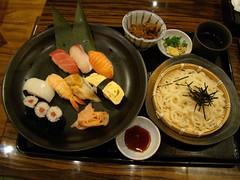
After a few second eternity, I finally made it to my table and began to pour over the menu. I have to admit, some of the things on the regular dinner menu looked all right, after all, this place is an izakaya. But never-the-less, I pretty much decided on the sushi and cold udon set, and that is what I ordered. While waiting for the food to arrive, I chugged glass after glass of cold barley tea, called mugi cha, as I was hot and a little dehydrated from standing outside for more than 3.5 hours in the humid steam cooker that Kyoto becomes in summer in order to watch the Gion Matsuri parade. My mind kept also trying to get around the 'cheese factor' that the owners had introduced to this solemn place, however, I reasoned to myself that if the food is good, I could forgive the tackiness of the place and maybe commit myself to coming back for an evening excursion at some point in the future. But before I could get lost in any deep thoughts and future plans, the food arrived.

As I snapped some photos of my meal, I realized that the sushi didn’t look so hot. Now don’t get me wrong. I am a foodie and consider myself a connoisseur of good sushi and know sushi is not supposed to be served hot. What I mean, is that it didn’t look all that great. My first taste confirmed what I suspected. Sure, it was edible, but not very good. Kind of like what one would find at a fast-food, conveyer-belt sushi chain outside of Japan, or what you’d get at a shopping mall’s food court. Worst of all, was the anago (sea eel). It was so soft and mushy, I nearly had to spit it out. Yuck!! I then set upon my udon, which was fine. You can’t really massacre cold noodles. I found myself slurping my noodles faster than usual, though, as I realized that I probably wanted to get out of the Ikedaya worse than a trapped Chōshū shishi the night the Shinsengumi crashed their party. As soon as I put my noodles down, I grabbed my backpack, camera and took a few more photos before I descended the “staircase of destiny” to pay my bill. I was happy to leave the Ikedaya. I really was.

A few minutes after I left the place, I called up the Samurai Archives’ Shogun, Kitsuno, to relay my Ikedaya experience as I aimlessly wandered around the the Pontochō geisha district in a light on and off drizzle. I remember musing on the phone that I probably should have steered away from ordering sushi in an izakaya chain-store restaurant and in Kyoto of all places. I suppose I should mention that while Kyoto is known for exquisite cuisine (and I am not referring to pizza-man from convenience stores), the city isn’t exactly famous for having good sushi. Kitsuno listened to my ramblings and told me that I should blog about my experience, so here I am, doing exactly that!

Now to sum things up, I wasn’t happy with the Ikedaya, from both a historical and epicurean experience. I found the place tacky and my lunch equally disappointing. I do suspect that some of the evening fare is better than the sushi, and besides, they have a large selection of alcohol to numb one’s taste buds. If you are a Bakumatsu history junkie and have to see this place for yourself, go ahead! Just don’t order sushi! As for myself, I don’t have a burning ambition to return to this place. But like the name of the famous fictional book about the Shinsengumi called Moe Yo Ken (Burn My Sword) by Shiba Ryōtarō, I felt an urge to burn my lunch!

A few more pictures from the Ikedaya and a variety of photos from Kyoto and other historical places in Japan can be found on my flickr website at http://www.flickr.com/photos/rekishinotabi

Sunday, July 19, 2009

The Reawakening Of "Sleepy Eyes Of Death"

Years ago, I remember buying my first film on VHS from Animeigo/Samurai Cinema-I believe it was Mifune’s “Samurai Banners”. After the film finished, there were three previews for other samurai-related films released by Animeigo. These were three of the most outrageous and violent films that my burgeoning interest in jidaigeki had seen-the first was a “Lone Wolf And Cub” film and the second featured what’s still one of my favorite action sequences from the “Hanzo The Razor” series (where assassins break into Hanzo’s booby-trapped house while he’s lounging in his bathtub with a Buddhist nun). The third showcased a badass samurai who effortlessly dispatched a dozen ninja or so before polishing off their leader with something he called the “Full Moon Cut”. I have a feeling this set of three previews (which ran with almost all of Animeigo’s releases) achieved a certain status of their own with fans of the genre, and in my case told me that Samurai Cinema was run by my kind of people. I was more than a little disappointed when I found out that only the Lone Wolf films were still available and the other two were nigh on impossible to find and outrageously pricy when you did. Still, I managed to put together the Hanzo trilogy with two VHS’s and a Laser Disc, but the other series-“Sleepy Eyes of Death”-proved to be much harder. It took years to find five of the six releases on original VHS, and I never did run across a copy of the sixth. Thankfully, Animeigo reacquired the license and has re-released the first four films in the “Sleepy Eyes of Death/Nemuri Kyoshiro” series in a well done DVD boxed set.

“Sleepy Eyes” star Ishikawa Raizo packed a lot of films into a relatively short career before his untimely death at the age of 37, and most fans of jidaigeki agree that his signature character was Nemuri Kyoshiro, “Son of the Black Mass”-the bitter half-breed ronin and master of the Full Moon Cut. Based on a series of novels by Shibata Renzaburo, the series was to span 14 films (the last two featuring a new actor who took over after Ishikawa’s death) and became increasingly bizarre, bloody, and violent as it went.

The four discs in the set (originally released in 1963 and 1964) are as follows:

“The Chinese Jade”-the first entry in the series is based on actual history involving an infamous merchant/smuggler in the Maeda domain of Kaga, one Zeniya Gohei. Here, Zeniya has been executed by Lord Maeda in order to cover up the clan's involvement in a profitable smuggling ring-and to confiscate Zeniya’s gold in the process. However, as luck would have it, Zeniya’s not quite dead yet-and both he and Maeda vie to recruit master swordsman Nemuri Kyoshiro. Up for grabs is the Chinese Jade, a statue hidden by Zeniya that contains a document that would spell doom for the Maeda clan were it to find its way into the hands of the Shogunate. Very little of Kyoshiro’s background is examined here, aside from a short segment involving his training. It seems the film is trying to set Kyoshiro up as an avenger of the common man and a noble ronin, complete with a support group of thieves, yakuza, and his sensei (all of whom were dropped after this film). Cast notables include Wakiyama Tomisaburo as Zeniya’s monkish enforcer, Chen Sun, and Date Saburo (who appears in three of the four of the films in the set as different characters) as Zeniya. While the film features excellent swordplay, plenty of dying ninja, gorgeous gals, an involving story, and Raizo’s cool yet intense performance, it has been criticized for humanizing the ‘nihilistic’ Kyoshiro too much, particularly the ending. We disagree-having always seen Kyoshiro as an idealist at heart, and like most idealists he becomes increasingly bitter, skeptical, and resentful as the majority of the people he runs across fall short of his expectations. It’s interesting to follow the progress of this characterization through the series as Kyoshiro becomes more and more hardened, raping innocents, and eventually killing people with no provocation-even unarmed women. Through it all, the spark of idealism still remains-there are moments in most of his films where a good and decent person will bring a moment of joy to him, or give him a reason to fight for them. This inner conflict gives expression to some of the cooler lines uttered in jidaigeki flicks, including my personal favorite from part nine: “The last person he saw in this world was me. What an unlucky man he was”.

“Sword of Adventure” introduces a theme that will run throughout much of the series-the spoiled bastard children of Shogun Ienari. The plot involves the efforts of the Shogunate’s elderly finance minister, Asahina Iori, to reform the currency system and put a stop to the elaborate expenditures of the Shogun’s court (this, too, is based on actual history). Naturally, he falls afoul of the corrupt ministers who have been profiting all along-but his biggest enemy turns out to be Princess Taka, whose huge annual stipend has been cut through Asahina’s action. Kyoshiro takes a liking to the old man and becomes his defacto bodyguard. Before the final resolution there are deceitful women, poison, ambushes, a rigged duel with a foe who might be Kyoshiro’s superior, and five master swordsmen he must overcome. We actually found old man Iori to be much more entertaining to watch than Kyoshiro, and the developing friendship between the two engaging.

“Full Circle Killing” introduces another of Ienari’s bastards, Katagiri Takayuki, whose supporters and mother have been killing off the Shogun’s legitimate heirs in order to leave him in position to inherit the Shogunate. Katagiri is a violent psycho who has been installed with a twisted version of Bushido by his mother-he enjoys testing out his collection of rare swords by killing peasants in a slum on the outskirts of Edo. Kyoshiro becomes involved when he wanders by the scene of one of the slayings, and further drawn in when Katagiri covets his exquisite Musou Masamune blade. Between protecting the villagers, keeping them from implementing their own ineffectual plans for revenge, and retaining the Musou Masamune, Kyoshiro has his hands full. An interesting moment here is when Kyoshiro explains the style of the Full Moon Cut, ending with the familiar boast that “…no opponent has ever lived to see the circle completed”.

The last film in the set, "Sword of Seduction", takes the series to new extremes-both storywise and in a visual sense. Kyoshiro is approached by a Christian on the run and beseeched to guard their saint, "The Virgin Shima" (who may or may not have familial ties to Kyoshiro). While Kyoshiro refuses, he goes to the man's aid after he is captured and being prepared for crucifixion. The Christian's sister has won his freedom (by 'converting' a Western missionary to Buddhism by seducing him), but not only has the Shogunate not honored their promise to free him but the depraved and disfigured Princess Kiku (another of Shogun Ienari's bastards) has arranged for her to be gang raped in front of her brother at the execution grounds. While Kyoshiro is unable to save the two, he manages to disrupt Kiku's 'entertainment' and send her scurrying back to Edo castle. Kyoshiro sets out to find the Virgin Shima, and while on the road faces an incredible series of ambushes, seductions, ninja assaults, and betrayals. Some of the most impressive set pieces to be found in the series are on display, and after further humiliating Princess Kiku (destroying her without killing her), Kyoshiro finds the Virgin Shima and confronts the group of opium smugglers that have been working with Kiku-including his monkish nemesis from part one, Chen Sun. After this final battle, Kyoshiro learns the truth behind the circumstances of his birth-a revelation that was to have a major influence on the further films in the series. This film not only has a glorious progression of well thought out action scenes, but also some of the more impressive "WTF?" moments in the Nemuri saga. One of these would be Chen Sun breaking off the ending battle to jump overboard for no reason in particular. Perhaps the most impressive one, however, occurs when the Western missionary has been released from prison after having been 'converted' to Buddhism. Kyoshiro comes galloping into the frame astride a horse and brandishing a sword, screams out "Go to Hell!", and sends the fallen Christian's head rolling (many critics seem to think that this was Kyoshiro's father-however, the evidence within the film points to this not being the case, not to mention the two are played by different actors). Perhaps the most impressive innovation is how the "Full Moon Cut" is now filmed in time lapse photography-adding a new dimension to its alleged hypnotic effect and giving it a supernatural feel. This film is a turning point in the series-it is from here that Kyoshiro's dark side really begins to take hold, and the succeeding films were to become increasingly violent and twisted. While Kyoshiro claims in the final Raizo installment (part 12, Castle Menagerie) that he has never killed someone who has not attacked him first, he seems to conveniently forget his victims such as the aforementioned missionary and an unarmed nun he slaughters at the end of the film.

All four of the films in the set are winners, and get stronger with each installment. They all feature the excellent set design and costuming that one sees in virtually every jidaigeki film of the 60's, along with solid cinematography and soundtracks. The casts are loaded with chambara veterans from Daei studios and packed with starlets to boot. Having all four in the same package makes for interesting viewing as one follows the progression of Kyoshiro's character-from a rather normal 'justice seeking noble ronin' in part one to the heartless killer of part four. It's rare to see a chambara hero that goes from shouting at the heavens over the loss of the one precious thing in life (when Chisa is killed at the end of part one) to proclaiming that women are nothing more than sex objects. Likewise, he has little sense of duty or obligation-rare in a genre where the conflict of duty versus self comprise the engine that runs many plots. Unarmed missionaries and nuns fall to his blade and innocent women are raped by him. Kyoshiro was the forebearer of the even more extreme antiheroes of the 70's in the "Lone Wolf" and "Hanzo the Razor" films.

Animeigo's packaging for the box set is striking with a black and white image of Kyoshiro in the middle of performing the Full Moon Cut set against a blood red background. The four discs are arranged in a gatefold sleeve decorated with images from the series with a booklet taking up one section of the sleeve. As for the DVD’s, the color and picture quality are sharp and the soundtracks have no audible hissing or popping. Subtitling is excellent and the translation is good-although one of my favorite lines, the infamous “I love you, man!” from part III was changed for the current release.

Each disc contains various extras that not only feature production stills, trailers, and cast/crew bios but also help explain the intricacies of Japanese culture and history as portrayed in the films. There’s much less history to be explained in the Sleepy Eyes series than in, say, the Shinobi No Mono films, so the program notes focus on Japanese culture. The presentation is largely accurate with a few typos and minor errors (such as stating that Kawanakajima is located in Echigo province). Each one of the discs has an interactive map spotlighting the locations used or talked about in the film along with more historical notes. Ric Meyers provides a commentary on the first disc that covers the first four films as a whole and is joined by author/martial artist Jeff Rovin. Meyers was responsible for one of the worst film commentary tracks we’ve heard on Animeigo’s Shinobi No Mono 2 disc, but here (and also on the commentary he provided for the “Shogun Assassin” boxed set) he’s actually quite good. Sticking to movie trivia and cinema history, he provides quite a bit of useful information on the stars, the studios, and the film series as a whole. And even though he STILL mangles the Japanese language, he’s at least getting better in this regard too. Hey, he’s trying! There are color and b/w stills for each film in the series and cast/crew bios unique and specific for each (rather than just running Raizo’s bio for every one). Each disc has five trailers-usually for the current and next films in the Nemuri series, one for a Shinobi No Mono entry, and two other Animeigo releases that the director of the current film also helmed. One of the discs even shows a gallery of the packaging Animeigo used for their ‘Sleepy Eyes’ VHS and Laserdisc releases. There’s also a booklet included that gives a general outline of the series, some background on the Edo period, and a history of Christianity in Japan during this time. Finishing it out are a couple of reviews taken from Pat Galloway’s “Stray Dogs and Lone Wolves” along with some other cast and crew information including Raizo.

Whether you’re replacing those worn-out VHS copies or taking your first steps into the Nemuri Kyoshiro saga, this DVD set fits the bill perfectly. Hopefully Animeigo will be releasing the next four films (that have recently been remastered in Japan) at some point. No samurai film collection is complete without the “Sleepy Eyes” films, so get the set now-before it goes the way of those ninja in that long-ago trailer…

You can get the Sleepy Eyes of Death Vol. I Box Set (the first four films) directly from Animeigo here or from Amazon through the SA Store here.

Tuesday, July 07, 2009

Review: Khubilai Khan's Lost Fleet

Review of James P. Delgado's Khubilai Khan's Lost Fleet: In Search of a Legendary Armada


In the late 13th century, one of the largest empires the world has ever seen directed its not inconsiderable attention to the island nation of Japan. Twice, Khubilai sent ships from the mainland carrying his soldiers to the shores of Japan, and twice they failed to add Japan to the Khan's empire. These conflicts would be revived when Japan once again faced the possibility of foreign invasion: both in the waning years of the Tokugawa bakufu and in the latter campaigns of World War II.

So where is the evidence of these two massive fleets? Perhaps the most compelling evidence has come, not from the famous Hakata bay, but the island of Takashima. Marine archaeologist James Delgado attempts to shine some light onto the latest research being performed, while also taking readers through the backstory of the assault itself.

Delgado opens with perhaps the most common images of the Mongol Invasions in English: the kamikaze. He then explores the history of the Mongol empire, including the situation on the mainland in the latter half of the 13th century. For both invasions, he provides maps of the routes, indicating the various naval engagements. The tale Delgado weaves around these events is infused with an emotional characteristic not usually evident in a strictly historical monograph. This quality may be due to the book having evolved from his work for National Geographic's series The Sea Hunters.

This, however, is as much about the history as generating interest in the archaeology. Delgado's account of the progress of the underwater dig around Takashima, and his hopefulness for the future, are compelling.

Delgado's forte is maritime archaeology and history, and this shows. His coverage of Japan is perhaps less in depth than serious readers might want, but he makes up for this with a broad look at Asian history in general, connecting events on the mainland with the invasions. He shows how the initial assault, even though it was repulsed, would have disrupted trade between Japan and their allies in the Southern Song dynasty; this may have been one of Khubilai's goals for the invasion in the first place. Following the second invasion, Delgado briefly looks at the Yuan dynasty's other failed maritime ventures against Vietnam and Srivijaya, which truly marked the end of the Mongols' attempts to take over the Southern Song's position as a naval power in East Asia.

If there were any main criticism of the book, it is the lack of actual archaeological finds. While much talk is directed at the research and its importance, the fruits of most of the labor will need to be found elsewhere. He does point out the remains (including armor) of one of the Mongol soldiers, and describes the contents of the "tetsuhau", or Mongol ceramic bombs. A series of photographs in the center provide further teasing glimpses of what appears to be a treasure trove of historical evidence. Fortunately for the serious student, Delgado provides an extensive list of references, including web links to the reports and recent scholarship which may provide enlightening.

Delgado does a terrific job of exposing the organizations and individuals behind the research, such as KOSUWA, ARIUA, Mozai Torao, Hayashida Kenzo, and Randall James "Randy" Sasaki, whose work has helped and continues to help expose these ages old relics to modern scholarship. Delgado's own part in all of this also comes through, adding a personal quality to his descriptions of the site that could not be acquired merely by reading books.

All in all, this book is a wonderful look at the famous Mongolian fleets, providing an intriguing read for both the novice and experienced scholar. I would definitely recommend it to anyone interested in the Mongol invasions.

For this and other interesting titles, check out the Samurai-Archives Bookstore, hosted by Amazon.

Sunday, June 21, 2009

State of War: The Violent Order of Fourteenth-Century Japan

This review should have been up about a month ago! Sorry folks! -JB


For anyone who has been reading the Samurai Archives forums for the past six months has likely seen or heard of Dr. Thomas Conlan. In recent years, this credited academic has brought his not inconsiderable talents to bear in the area of samurai and military history, a subject that is too often dismissed in serious academic circles.

My first introduction to Dr. Conlan's work came in the form of his monograph on the Mongol invasions, In Little Need of Divine Intervention, and taking his studies into the 14th century is a logical extension of that research. It is an area that is all too often overlooked, with most popular books focusing on either the Gempei Wars of the late 12th century or the exciting turbulence of the Sengoku period and the late 16th century; however, this leaves a large field between the two relatively untouched, except in the more scholarly journals.

Dr. Conlan's greatest asset is his ability to bring serious academic research and make it accessible to the armchair enthusiast. The well-organized and clear narrative is accompanied by stats and charts for those interested in a more detailed analysis. Furthermore, Dr. Conlan approaches the subject with a refreshing pragmatism, eschewing the popular mythology and legend that tends to cloud many popular works on the subject of pre-modern Japanese warriors.

The books starts off with a contemporary account of one of the warriors of the early 14th century, Nomoto Tomoyuki. Through records of the deeds performed by this warrior, written up as a petition for rewards by his son and preserved in the family records of the Kumagai down to the present day. This chapter uses Tomoyuki's escapades as a focus for a look at what it was like for warriors on the campaign. He draws particular attention to the bureaucracy involved; the need to have evidence in order to gain rewards for service in battle led the now well-documented instances of warriors who might show up for a battle and leave after taking only a single head, or even right after they were recorded as being in the camp!

This narrative, given at the ground level, as it were, is supplemented in the second chapter by a statistical analysis of 14th century warfare that provides a framework for describing the techniques and tactics employed by the armies of the time. Documentary evidence of wounds, usually recorded in the petitions, are drawn out in excruciating detail. In one appendix to the chapter (which is placed immediately following the chapter, vice at the end of the book), he provides numbers for all the documented deaths and wounds from 1333 to 1394, as well as listing the number of documents known to have been submitted in each year.

Other chapters detail the backbone of war, and how it was waged: supply lines, social and financial ramifications, religious influences, and legitimation. The make-up of the military, as well as how loyalties functioned within the first century of the Ashikaga shogunate, were quite interesting. He discusses the positions of retainers (wakatō) and the bakufu's housemen (gokennin), and their contributions to 14th century warfare. There is a lot of ground covered here, and I was really quite pleased with all of it.

However, buried within my praise, I must also acknowledge several things that let me down, especially in an otherwise enthralling work. First off, Dr. Conlan should have a word with his editor. There were many misspellings and grammatical mistakes that should never have made it to print (e.g. Nanbukucho v. Nanbokucho), especially in a book released by an academic institution focusing on Japanese studies. These are the sorts of things that are easy to miss when writing a book covering so much ground, but should also have been easy for a proofreader to pick up and mark for editing.

There were also some stylistic choices I can't say I agree with. References to figures are written as double references (e.g. "See figures 9 = pl. 7 and 10"), which were rather cryptic; the color plates didn't show up until near the end of the book, but before the final conclusion, their placement not making much sense. Dr. Conlan also appears to be overly enamored of the square bracket, leading to such sentences in his translation as: "[Nobutsune?] cut down one horseman wearing dyed and patterned [kōketsu] armor [hitatare]." This leads to confusion over whether a parenthetical is an assumed oversight in the original or if it is an explanation; e.g. if one does not already have a grasp of Japanese armor and clothing, one might assume that "hitatare" refers to a type of armor, rather than the original refering to a yoroi hitatare.

For someone who is interested in the precise terms, however, this flaw can often be a virtue. Many words that most modern authors would eschew from translating, or else provide only in the original Japanese, are given both in English and with a translation. Though at times tedious, unnecessarily breaking up the flow of the text, there are other times when it will be found a boon by the highly detail oriented amongst us.

It should be noted, that despite my objections, the style and grammar have little to do with the actual content, which is tremendous. The account, in the first chapter, of Nomoto Tomoyuki's service is an excellent exemplar of the type of service rendered by the average warrior during the 14th century. The statistics, gathered mostly in chapter two, contribute to the overall picture of violence in the 14th century. Further chapters elluminate such subjects as the role of violence in the social order. Dr. Conlan provides his audience with a compendium of modern scholarship on the issue. All of this helps to make this an eminently worthwhile book, and one that should be on the shelf of anyone seriously studying the history of warfare in Japan.

And for those looking for more, Dr. Conlan told SA during his interview that he was planning to expand the chapter on religion and war into his next monograph--so keep your eyes peeled.

For this, and other must-read books on Japanese history, check out the Samurai Archives Bookstore, hosted by Amazon.

Thursday, June 04, 2009

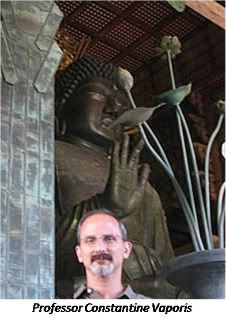
Interview with Historian and Author Constantine Vaporis


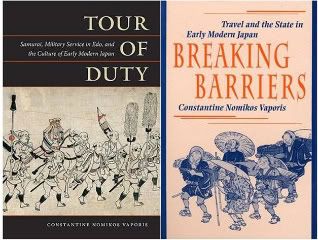
On behalf of the Samurai Archives, I’m pleased to be interviewing author and historian Professor Constantine Vaporis. Professor Vaporis, who received a PhD from Princeton, currently teaches Japanese and East Asian History at the University of Maryland, Baltimore County (UMBC). A noted scholar, Professor Vaporis has been the recipient of research grants in the field of Japanese history from the National Endowment for the Humanities (NEH), the Fulbright Program and the Japan Foundation. Professor Vaporis has authored two books on Edo period Japan—Breaking Barriers: Travel and the State in Early Modern Japan and Tour of Duty: Samurai, Military Service in Edo and the Culture of Early Modern Japan. Professor Vaporis is known to check out the action on the Samurai Archives Citadel of Japanese History from time to time and is also a valued member.

SA: Professor Vaporis, it’s a pleasure to have you here with us for this interview.

CV: Thank you. The pleasure is mine. As you noted, I have enjoyed being a member. I’ve benefitted personally from the Archives and so have many of my students.

SA: If you don’t mind, let’s start off with some basics. How did you become interested in Japanese history? What was the allure?

CV: I first fell I in love with Japan back in middle school when my father and I, along with my older brother, used to go to Japanese film festivals in Boston. I saw most of the classics of the 1960s this way. And, when an offer to learn Japanese came from one of my father’s students, who had been stationed in the military Japan in the mid-1950s, I jumped at it. So, to answer your question more directly, I first became enthralled with Japan and Japanese history as it appeared in celluloid and followed up that interest by studying the language. “Harakiri,” “Kiru,” “Ikiru,” and of course “Miyamoto Musashi” were some of my favorites—and now I teach a film course that uses a number of these.

SA: Your publications focus on the Edo period. What is it about the Edo period that fascinates you the most? Are there any other periods of Japanese history in which you have a special interest? Why?

CV: Let me answer these two together, as they are closely connected. When I headed to Princeton in 1980 to begin my graduate work, I intended to specialize in the late Warring States period and thought I might write a dissertation on one of the sengoku daimyo, like Takeda Shingen or even Oda Nobunaga. But, in Marius Jansen’s famous Friday morning seminar in Japanese history I read Englebert Kaempfer’s History of Japan and I was hooked on the Edo period. The vitality of the period, and as I later discovered, the richness of the historical record which remains for it, drew me in. Here I am, almost thirty years later still excited by teaching and researching the Edo period.

However, the last quarter of the 16th century in Japan still fascinates me. It was a dramatic, colorful period in Japanese history with personalities that were larger than life. It was also a time when European and Japanese history intersected—collided, really—, which added to the color and drama. By reading the letters the Jesuits sent home, particularly those of Alessandro Valignano, this all becomes clear.

SA: Which persona from Japanese history do you find the most interesting and why?

CV: Nobunaga would be one, again, because he was larger than life; his life was cut short, which makes one think about how the course of Japanese history might have been different had he lived long enough the complete his mission of unifying the realm.

Though not a Japanese, the life of Ganjin (Jianzhen) is fascinating to me. As you can see, I am drawn to travelers! Risking his life six times to make the sea-crossing to Japan in order to spread the dharma there, he finally made it in 753, by which time he had lost his sight. One can’t help but be awed by him and other travelers, both Japanese and Chinese, who braved the seas to travel to the other country on cultural and religious missions.

CV: Plenty of not-so-famous people fascinate me, too—like many of the diarists I encountered in researching Tour of Duty. Mori Masana of Tosa would be the best example. He strikes me as a bit of a maverick, something that was only possible for a younger son in a bushi family. He loved the physical as well as the intellectual and cultural. He was a prolific diarist, and his accounts are entertaining to read—not something one can say about most bushi diaries. He allows his personality to peer through his words. For example, wrestling sumo on the beach while the Tosa lord’s entourage waited for more favorable winds before setting sail, he injures his leg, but jokes in his journal about walking all the way to Edo on three legs. He spent much of his time in Edo studying as part of a number of cultural salons; he loved to shop and collected a large quantity of calligraphy and sword guards. On his first of many trips to Edo he did not have any official duties, but did something to attract the attention of officials close to the lord, and he was later rewarded for meritorious duty in protecting the lord as he was shuffled from place to place as a major fire spread across the city. He strikes me as a charismatic, energetic, intellectually curious man.

SA: Who are your favorite historians in the field of pre-modern Japanese history? Who had the biggest influence on you?

CV: Ron Toby and Martin Collcutt are two historians whose work I’ve always admired. Hal Bolitho has written some of the wittiest book reviews of academic works ever, and had a grand style in prose and speech both. Marius Jansen’s sweeping command of the field of Japanese history was awe-inspiring, as was his ability to synthesize scholarship.

SA: As an academic in the field, how do you feel about the current state of pre-modern Japanese studies?

CV: To be honest, I’m a bit troubled by what seems like an exodus of scholars from Tokugawa to Meiji history. In part I think this is market (read “job”) driven. There aren’t very many scholars left anymore who focus on the Edo period. But, perhaps that will change.

You were recently at a pre-modern Japanese history conference in Europe. Can you tell us a little about that?

CV: Yes, I was fortunate enough to be invited to a conference on Tokugawa history, organized by Professor Richard Bowring at Cambridge University in England this past March. I was asked to chair a panel on Ritual and Ritual Practice and to comment on the three papers the panelists presented. It was a wonderful opportunity to meet scholars of Tokugawa Japan from all over Europe, not to mention a handful each from the U.S. and Japan. This was the first such large conference—over thirty participants—on Tokugawa history in quite some time.

SA: On average, how many of your students per annum express an interest in pursuing a career related to Japanese history academia? What kind of advise do you give these students?

CV: Unfortunately my institution does not have a program in Asian studies, so we don’t develop students with the requisite language skills to do graduate work. I have had a handful of students who have transferred, though, in order to pursue further studies in Japanese history and culture. I tell any student who is interested in pursuing a higher degree in Japanese history to develop the best language skills they can as early as possible. I also urge them at a later date in their careers to learn to read brush-written documents; without that ability you are limited in your research to using materials that some other scholar or publisher thought important enough to make available in print.

SA: As an educator trying to impart your knowledge and passion about Japanese history on your students, what do you find most rewarding? What’s your biggest frustration?

CV: What I find the most rewarding and gratifying is when I discover that students are doing extra work (reading/research) on their own, beyond any class assignments, because they find the material we are studying so fascinating.

I think my job is easier now because of the popularity of anime. A lot of my students come to my classes interested in Japan—or what they think is Japan from anime—and want to learn more. In the early 1980s, the mini-series Shogun was big boost to the field, but now I would say it is anime. The first day of class this past semester I asked my students (in my “Japan in the Shogun Age” course) how many of them had heard about or seen “Samurai Champloo” and about 2/3 raised their hands! That surprised me.

Frustration? Not having a strong language program or area studies program at my university, which would support and complement what I do at the university.

SA: Let’s talk about your research and books. Both Breaking Barriers and Tour of Duty deal with traveling in the Edo period. What drew you to this specific topic?

CV: Kaempfer—reading his accounts of people encountered on the road as well as his lengthy description of a daimyo procession caught my attention my very first semester in graduate school. I wrote a paper on alternate attendance for that class, but ended up writing my first book on commoner travel and the development of a road network by the Tokugawa shogunate. In writing Tour of Duty I returned to what first caught my interest long ago. In a sense, these two works are book-ends: the first about the movement of commoners; the second, largely about the movement of bushi.

SA: I know that Americans have an affinity for road/travel tales as evident in classic pieces of literature written by such greats as Twain, Steinbeck and Kerouac, but so do the Japanese, who left an abundance of journals documenting their Edo period travels and experiences. Tell us what it was like reading these documents. Did it appeal to that “romance with the road” feeling that is hardwired into American DNA? [laughing]

CV: Well, it certainly appealed to the Greek-American DNA that courses through my own body. My grandfather was a big traveler—left his island of Kalymnos, near Turkey, for Argentina and then America. My father made his trans-Atlantic migration to the US at the age of three. We moved around quite a bit growing up, when my father was transferred from parish to parish (he was a Greek Orthodox priest). I’ve lived in a number of foreign countries and traveled to Japan 21 times, at last count. So reading other peoples’ accounts of traveling has always resonated with me.

Having trekked over some of the byways that travelers used during the Edo period—along the old Tōkaidō around Hakone and Hata, along a long stretch of the Kisokaidō, and along the Tosa routes to the north and to the east of Kōchi—it’s been easy trying to transport myself mentally back in time, to imagine what the experience must have been like. It is exciting to read a retainer’s account of his first trip outside his home domain, as he sees new things, experiences new customs and hears local stories.

SA: Documents from Tosa play a large role in Tour of Duty. What was a determining factor that locked you on to the impact the system of alternate attendance had on this han and retainers of the Yamauchi? Did this have anything to do with the influence of the late Professor Marius Jansen, who was an extensive scholar of Edo-era Tosa?

CV: What did it for me was the existence of a wide range of documents in Kōchi that would support the kind of social and cultural study that I wanted to write. Also integral was the openness and kindness of numerous people there who granted me unparalleled access to materials there. I write about this in my acknowledgements, but being allowed access to the family archive of one of the Counselors (karō) of Tosa domain before it opened to the general public and being allowed to work in the basement of the Yamauchi Shrine Archives, surrounded by the Edo-period documents and works of art stored there, are just two examples. The generosity of the people at the Prefectural Library and the friendliness of Kōchi people is something I will never forget.

SA: In your opinion, if you had to choose one overwhelmingly interesting inadvertent “byproduct” of the alternate attendance system, what would it be? How did it impact the development of Edo period society and culture?

CV: Just one?! Pressed to pick one, I would say that an important “byproduct” was the involvement of retainers in various cultural networks in Edo. Given that official duties were not onerous for most middle and lower-ranking retainers, there was plenty of time for them while in Edo to study with famous teachers and to cultivate skills (from the poetic, artistic to the martial) that would be of benefit back in the domain. The enforced period of residence in Edo in effect raised the cultural level of the country.

SA: A lot of your analysis delves into the explaining the symbols of power projection and some of the theatrical aspects that accompanied these displays during daimyo processions. In reality, how important were daimyo processions as a means of power projection once the daimyo left his own borders? Did they really mean something beyond projections of “face and prestige”?

CV: Interesting question. There were at least two audiences for daimyo processions: the first, as you point out, was the local, domestic audience, the people of the lord’s domain; the second was for a more general “public,” the people outside the domain, and helped to solidify a daimyo’s place in the political hierarchy of the realm. Very few people, relatively speaking, were able to witness a daimyo procession themselves, but word of mouth and graphic depictions of the processions played a role in establishing the reputation of a domain—i.e. whether its procession was still resplendent, or whether the lord was facing difficult times and had to cut back on the size of his procession. The reputation of a lord or domain was critical in the political world of the times.

But the processions had another, very different type of meaning, too. They were important to the local economies—the economies of the post stations and surrounding areas—in both a positive and a negative sense. The processions figuratively spread money along the highways, which benefitted local economies, but at the same time the corvee labor demands required of peasant-farmers who lived in surrounding areas to provide horses and labor power (a subject I write about in my first book, Breaking Barriers) had a negative impact on personal, household, and village economies.

SA: When I read Tour of Duty, I was somewhat surprised that there wasn’t much in it about samurai patronage of the pleasure quarters during their assignments in Edo. Are images of samurai from the outer han dallying in Akasaka, Asakusa and Yoshiwara a product of the imagination planted by exaggerated histories, books or movies?

CV: No, I don’t think so, but you do have to remember that diaries were meant to be read by others. The diary as a “private” piece of writing is a concept that would have seemed alien to people in the Tokugawa period. A bushi might keep a work diary so that his son could benefit from the father’s experience. Similarly a pilgrim to Ise or some other religious site might keep a record so that other family member’s might know what they could expect on a similar trip. Bushi were expected to act according to a strict moral code, so it is not surprising that they would not write about trips to the pleasure quarters in an explicit fashion. Some of my diarists write about going to the Yoshiwara to “sightsee” (kenbutsu). The term “flower viewing” (hanami) is sometimes used as a code-word for visiting the pleasure quarters, but I have not yet encountered a diarist who wrote explicitly about doing more than taking in the sights! Other types of evidence reveal that those bushi who could afford it did frequent the pleasure quarters. I do mention in the book one Yamauchi lord who seems to visit the pleasure quarters of Gion, in Kyoto; according to a non-official record, he traveled there “in disguise” for “flower viewing.”

SA: Tour of Duty is really a great book. I enjoyed it immensely. Do you have any other projects that you are working on that you can tell us about?

CV: Thank you very much.
Yes, I am working on a book tentatively entitled Japan as Samurai Nation. As this suggests, it is a study of the samurai as a trope or symbol for Japan, from the Edo period until today. It deals with both the historical reality of the samurai as well as the way that samurai have been perceived, historically, in both Japan and abroad. I’m particularly excited by this project, which will take me into contemporary times and treat issues of national identity.

SA: That certainly sounds like an interesting topic. I’m definitely looking forward to reading it as it sounds like you and I share some common interests! In terms of Japanese history, what have you recently been reading? Anything you can recommend?

CV: I’m currently reading, and enjoying, Richard Rubinger’s Popular Literacy in Early Modern Japan.

SA: How did you find the SA Archives and what drew you to its forum?

CV: I don’t recall how I first encountered it, to be honest. It was probably when I was first putting together a syllabus for a new course, “Constructing the Samurai,” and surfing the web to see what was out there. I’ve been impressed by the professional nature of the site, the wide coverage of subjects, the depth of the interviews with scholars and the considerable knowledge of the forum members. I’ve learned a lot from reading some of the threads. As you know, there are too many sites on samurai out there that have little substance; Samurai Archives is a welcome relief!

SA: Thank you for the positive feedback as it is much appreciated. However, is there anything you would like to see us try to do with the SA, in order to raise the level of our scholarship or improve the quality of historical discussions?

CV: There are probably copyright issues involved, but it would be nice to have full texts of the various daimyo house codes. Another idea might be to have a section devoted to primary source documentation. Again there might be copyright issues involved but in the case of documentation out there already on the web, you could have links to them. One example would be Charles Wigmore’s translations of the Laws for the Military Houses (Buke sho hatto). A bibliography on the samurai would be useful as well, not to mention a convenient list of good web sites related to the samurai.

SA: Thank you for the feedback. The rōjū will discuss your ideas with the Shogun. We do have some select bibliographies or resource lists in some of the individual forums, but they are in need of updating. And you are right about house codes and translation copyrights, but we will look into that.

Professor Vaporis, thank you very much for taking the time to sit down with us. This has been a real treat and a pleasure. We hope to have you back after your next book.


CV: Thank you for the opportunity.

Remember, both Tour of Duty and Breaking Barriers can be purchased from Amazon via the Samurai Archives Bookstore at http://astore.amazon.com/samurai-20?node=4&page=4