Tuesday, November 11, 2008

Weapons & Fighting Techniques Of The Samurai Warrior 1200-1877 AD

Wow, I thought to myself as I unwrapped a large parcel from a bookseller in the UK-Thomas Conlan (Associate Professor of Asian Studies at Bowdoin College and a leader in the scholarly examination of samurai warfare) has written a coffee table book-Weapons & Fighting Techniques Of The Samurai Warrior 1200-1877 AD! It's loaded with lots of color photos, diagrams, and artwork, including step by step demonstrations of fighting with bows, swords, spears, harquebus, and more. I can’t say I’m very impressed with the maps. Overall, the graphic presentation is a lot like Kure Mitsuo’s Samurai: An Illustrated History-but with more impressive writing.

While I’ve only given it a quick read through (I’ll post more on it later), these are my initial impressions. As far as text goes, there is a LOT to chew on here for those interested in samurai combat and tactics. Conlan brings the same fresh perspective that he’s brought to his two former books (In Little Need of Divine Intervention and State Of War). Even those who have kept up-to-date with the newest findings among Japanese historians will find some startling new material. Conlan continues the fine work that he (along with Karl Friday) has done in exploding the old myths of samurai combat and bushido. Samurai warfare is shown to have had over 75% of its casualties caused by projectile weapons (this concept isn’t new, but more evidence is presented). The impact of the small Japanese horse on battle is examined in depth (along with the extreme reluctance of horse owners to risk them in close combat), further reinforcing the notion that there were few if any massed cavalry charges in Japanese battles, with cavalry usually only being used in close combat to go after an enemy that had broken and was in retreat. Another interesting point Conlan makes (using contemporary accounts) is that the small horses put brawny warriors at a disadvantage.

Conlan also reexamines some of the more popular accounts given in most history books and puts a new spin on them. His section on Nagashino reinvents the likely course of the battle, beginning with debunking the numbers of guns fielded by the Oda. While most of us on the Samurai Archives realize that the Oda/Tokugawa forces had 1000, not 3000 (normally the number seen in Western histories), guns, Conlan takes it a step further and puts forth the notion it fielded 500 or fewer. Using the results of recent excavations of the battlefield, he postulates that Nobunaga achieved such a decisive victory by using the Tokugawa army as bait, concealing the Oda forces, and unleashing a massive ambush on the Takeda when they attempted to envelope the Tokugawa. The famous notion of ‘three ranks’ of rotating gunfire is largely discounted as an Edo period fabrication. It’s fascinating stuff many people won’t agree with, but it’s a well supported and thought out argument. Likewise, Conlan has a different viewpoint of the Uesugi army than is normally seen-he considers them to be right there with the Oda in terms of innovative and effective use of gunfire (largely due to their contact and friendly relations with the Ashikaga Shogunate, gaining access through them to early gunpowder and firearm technology) rather than the ‘traditional’ cavalry based army it is usually portrayed as. He ascribes the collapse of the major Eastern daimyo (the Takeda, Hojo, and Imagawa) largely to their failure to incorporate firearms technology quickly enough. Conlan even makes corrections to common attributions, such as identifying what is perhaps the most famous portrait of Minamoto no Yoritomo (as seen here) to be in reality a portrait of Ashikaga Tadayoshi (this info has been around since the mid-nineties, but is the first time I've seen it presented in an English language book).

The book comes up short in at least one major area-being written for a more general audience, it has no footnotes or endnotes. This makes further examination or study of Conlan’s points difficult to impossible. For example, he twice brings up a female warrior, Tsuruhime, who according to oral legend fought in several battles in the inland sea around 1542 (there’s an existing suit of modified armor attributed to her). He also mentions that there is an account of a group of female cavalry that fought in western Japan in the 1350’s. I find this interesting, but a dead end-what account? Contemporary? A war tale? Temple tradition? Where do the accounts of Tsuruhime come from? Without the notes, it’s impossible to tell and evaluate these claims.

Still, it’s a book that anyone with a serious interest in samurai warfare, Japanese history, or weaponry should have on their bookshelf. It will be interesting to see how the book is received by the public-the general audience it is aimed for will likely not take kindly to having its romanticized preconceptions dismantled so effectively. It’s sure to cause some spirited debate and get its readers reconsidering their positions on a multitude of topics. At around $13 for a 225 page hardcover loaded with color shots, it’s an absolute steal. Buy it today-you won’t be sorry.

Saturday, November 01, 2008

Author and Artist Sylvain Jolivalt - S-A Interview #3


For our third interview, our pal Obenjo Kusanosuke has taken the time to interview talented artist and author, Sylvain Jolivalt. Enjoy, and feel free to post questions for Sylvain in the comments.

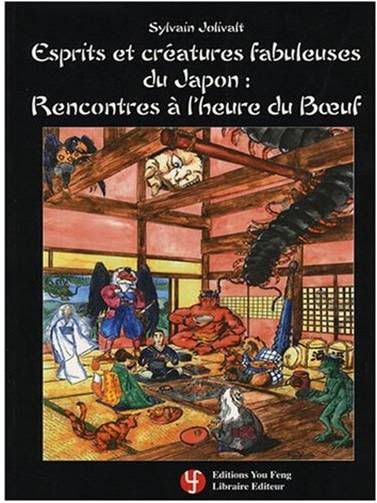
Today we are fortunate to have author Sylvain Jolivalt, our SA Citadel Forum’s own “Akaguma” with us for a special interview, and believe me, we’re in for a treat. Besides being extremely knowledgeable about Japanese history and culture, Sylvain is an accomplished artist, author and yokai expert. These skills are beautifully combined and represented in his book Esprits et créatures fabuleuses du Japon: Rencontre à l'heure du bouef , available from Amazon.co.fr. Also, be sure and check out Sylvain’s website at http://www.shiruban.new.fr and his blog at http://shiruban.over-blog.com where you can see much of his terrific artwork.

Obenjo Kusanosuke (OK): Sylvain, welcome to my little interview chashitsu. It is a real pleasure to have you here.

Sylvain Jolivalt (SJ): Thank you very much! It’s a pleasure for me too. It’s still a bit unusual for me to be interviewed. Wink

OK: I thought we’d start this out by asking you one of my basic questions—how did you become interested in Japanese history and culture? What drew you to it?


SJ: I couldn’t say it’s thanks to japanimation, as when I was a child, I didn’t even know those cartoons took place in Japan, or even were made in Japan. Actually, I became interested in Japanese culture thanks to… American comics! Since I was eight, I was a great fan of Marvel comics. I once read a story about the X-Men that took place in Japan, and found out that my favorite super-hero (Wolverine) could speak Japanese. That looked real cool. A few years later, I got into Frank Miller’s Daredevil (with a lot of ninja stuff), and then Miller’s Wolverine in which I learned my first words in Japanese, which then motivated me to buy a “learn-it-by-yourself” Japanese handbook. At this time, I was also fond of every ninja movie (like the ones featuring Shō Kosugi) that were released on VHS. Embarassed Wink , and of course, Shōgun could be watched on TV. Since then I began to read everything about samurai and ninja. In Dungeons & Dragons Oriental Adventures role-playing game I first read stuff about yōkai. Then, reaching university, I started to more seriously lean the Japanese language and culture.

OK: I can’t help but to admire your artwork. I think you’ve done a fabulous job of capturing the essence of traditional Japanese landscapes and objects in your work. I think your rich knowledge of Japanese culture really shines through in your work. Your illustrations have a nice modern and sappari (さっぱり)—refreshing—feel to them. At what point did you want to start blending your skills with the pencil and pen with your love of things “Japonais”?

SJ: Thank you. Actually I started to draw more or less Japanese things for quite a long time ago. But it’s since I began my comic book project six years ago that can be seen on my site, that I tried to stick closer to historical reality.


OK: Where are your top three favorite places in Japan that make you want to pick up a pencil and paper and start sketching when you are there?

SJ: Good question. I much liked to visit Mount Hiei. Not only the principal buildings of the Enryaku-ji, but also the forest between them. As we were most of the time all alone, we felt like we could anytime run into a tengu. I also like traditional looking streets like the ones in Takayama, and, of course, castles. The very first one I visited was Matsumoto-jō which impressed me very much.


OK: And at what point did you want to combine your artwork with words and write a book about yōkai? And why yōkai? What’s the allure of these mythical Japanese creatures to you?

SJ: fifteen years ago, I worked as assistant and interpreter for a Japanese geography professor who came in Alsace to study rivers, groundwater, and so on. When visiting different spots in the area, I always told him about local legends, which inevitably made him think I was much interested in myths and tales. He then offered me my very first book in Japanese about yōkai, Mizuki Shigeru’s yōkai dictionary. As there wasn’t any book about Japanese ghosts and goblins in French, I thought it could be interesting to write one. Once in Japan, I found out there were a lot of books about them, So, I came back in France with my luggage plenty full of these books. I then compiled and translated every data I could find. As I didn’t really know how ancient pictures found in those books were copyrighted, and as I liked to draw all sorts of strange creatures, I found it easier to illustrate the whole book all by myself.

What I find interesting in Japanese yōkai are their close links with geography and history-- that historical figures have met them, or that there still are signs of their presence. That’s funny!

OK: It seems there has been a recent rise in the amount of publications on yōkai both in Japanese and other languages over the years. The series of Shabake books by Hatakenaka Megumi about friendly yōkai who help the young heir of an Edo-period shipping company has been incredibly popular over the past few years and was even made into a television movie last year. Why do you think the fascination with yōkai has endured over the years in Japan and now in foreign countries?

SJ: It seems that this taste for fantastique seems to be a common trait in all our country, may it be through movies, books or comics. And with this wave of interest in Japanese horror movies, manga or anime, there are more and more people interested in yōkai. Hence my book.

OK: So do you think yōkai are just as relevant in today’s Japan as they were during, say, the Edo period?


SJ: I feel that Japanese are a bit more superstitious than Westerners can be. I was somehow amazed when a Japanese friend of my wife seriously advised her not to take photos in a cemetery because ghost might appear on pictures. Or I have a friend who felt really uncomfortable merely with looking at demon [inō[/i] masks. Maybe was it the same a long time ago.

OK: Can you please talk a little about your three favorite yōkai?

SJ: I like oni. I don’t really know why. Maybe its their hulkish attitude. Some of them dwell in mountains. Others are infernal jailers who spend their time torturing sinners. I’m sure they can be good drinking companions… as long as you have enough sake to offer Wink


This is a karasu-tengu (raven-mountain-goblin). They are usually mischievous toward humans, but when they find a worthwhile soon-to-be hero, they may teach him secret martial arts techniques.


When I decided to talk about the kūbi no kitsune (nine-tailed vixen) in my book, it was first to show to all those Naruto fans that she did exist before the manga. I then found out that she is a very interesting evil creature that has a long history. She caused the fall of two Chinese dynasties and even traveled to India, before trying her luck with the emperor of Japan. But there, she’d been quickly unmasked by an onmyōji, and hunted down by top-class archers. She had been caught in the shape of a rock that can still be found nowadays.


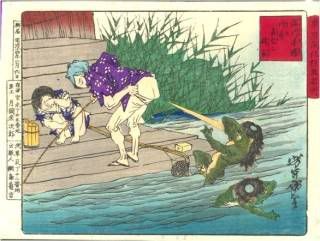
OK: I recently came across this ukiyo-e by Yoshitoshi. Here, we see a person defending himself from kappa by…aiming a “gas bomb” at the little green guys. Is this really an effective strategy for trying to keep from getting one’s shirikodama? I just need to know if it is a good thing to always bring some Satsuma imo and beer with me just in case I’m headed down to the river and am confronted by a kappa looking to rip into my bowels.


SJ: This can be a good technique that may prevent kappa from getting one’s shirikodama. Otherwise, you can bring your pet monkey… monkeys are supposed to be their sworn enemies. Or you can offer them cucumbers… kappa are really fond on them.

OK: I know I’ve asked this before on the SA Citadel forum, but I’ve got to ask again. Are you planning on having Esprits et créatures fabuleuses du Japon translated into English?

SJ: I’d like to. But my looking for a publisher hasn’t been this fruitful so far. I should insist a bit more.

OK: Let’s talk about a little about the study of Japanese history in France. I know you are very much interested in samurai history, their weapons and their armor. Is the study of samurai military history particularly popular in France? Is there a wide selection of books available books in French covering all th
e areas of Japanese history? Who are the more prominent scholars of samurai history in the French speaking world and what books opened the “samurai universe” to you? I suspect there is a rich collection of material available.

SJ: The military history of samurai warfare is not particularly studied in France in this detail. There are some nihontō aficionados who happen to write books about weapons. As far as I know, there are a lot of studies about contemporary Japan, but not much that I can recall about earlier periods. I’ve read a good book about the Kamakura period by Pierre Souyri. Francine Hérail’s books are also interesting (both of them were my teachers when I studied at Langues’O).

OK: Who are your favorite Japanese history scholars outside of France—such as in Japan, the UK or the US?

SJ: Actually, I couldn’t tell. I haven’t read this many books by English scholars (except one translation of Turnbull’s). As far as Japanese writers are concerned, only Kure Mitsuo‘s name whose book had been translated in French comes to my mind. I must confess that much of my humble knowledge comes from dictionaries and encyclopedias.

OK: Have you found any significant differences in how French scholars approach Japanese history and culture versus what you see in English language works?

SJ: I can’t really say. Most of the books I’ve read by French scholars are about cults, myth and religions. By the way, Musée Guimet’s Catalogue by Bernard Franck is one of the best introductions to Japanese Buddhist pantheon I’ve ever read.

OK: Which era of Japanese history are you most interested in and why?

SJ: I much like Heian and Edo periods. The Heian period for its heroic-fantasy flavor like in those Onmyōji movies, or Mizoguchi’s Tales of the Taira Clan (I also liked very much Yoshikawa Eiji’s book as well).
And the Edo period, while many might find it boring, it interests me because it is easy to find data about this period. You can easily find which daimyo ruled what fief, how much time it took for a courier to travel from place to place, what was the price of things, and so on. All this information is precious and provides a lot of background material needed to create various characters in RPG or in LARP. I do very much like it when my players feel like their characters could have really existed.

OK: Is there a particular persona from the Heian or Edo periods whom you would consider your favorite?

SJ: Minamoto no Yorimitsu! When writing my book, I found it funny to run into him and his ghost busting Shitennō crew so many times, just because they’ve fought many yōkai: earth-spider, Ōeyama’s oni, Rashōmon’s oni. Even one of his Shitennō – super-strong Sakata no Kintoki a.k.a. Kintarō – is the son of a yamauba (mountain-hag). It seems that numerous Minamoto family members had a brush with yōkai-- Yorimitsu’s father fought an oni as well, Yoshitsune had been trained by tengu on Mount Kurama. Another one fought a nue that haunted the emperor. It’s an interesting family.

OK: You’ve made your own set of samurai armor, which
looks really nice. What was your inspiration or who’s armor served as a model for your set?

SJ: Thanks. Actually, when visiting Odawara castle, I had the opportunity to wear a real armor (as far as reenactment armor can be real, of course). I then took pictures of every part of the armor:
http://shiruban.over-blog.com/photo-176737-shirubansamurai_jpg.html

How did you make your armor?

SJ: I’ve made this armor to be used in LARP. I took a huge PVC plate, and cut every part out of it. Then, I’ve drilled holes, heated those parts up in order to shape them the way I wanted, and varnished them black. The longest thing was to assemble all those parts. 70 meters of lace was needed for that.

Do you have any new projects in the works—either in terms of your artistic talents or as a writer?

SJ: I’ve written (and drawn) an adaptation of the classical Japanese fairytale Issun Bōshi (who meets two little fairies who strangely look like my daughters) that is being proposed to publishers.
I’m also working on this Azuchi-Momoyama period role-playing game rulebook I spoke about in Tony’s interview.

OK: You’re one of the more popular long-term members of the SA Citadel forum, but you don’t post as much as some of us would like. How can we get you more involved? Do you have any advice on any improvements we can make?

SJ: That’s a good question. I often come to Samurai Archive only to read new posts. I like to write any helpful post when I can, but sometimes, your discussions go past my very knowledge, which is far than being a bad thing since it enables me to learn a lot of stuff.
But soon, I’ll be able to talk with you about another topic-- Japanese dramas. Lately, my wife (my home computer specialist) showed that it was possible to see J-dramas thanks to the internet. I hadn’t had any opportunity to see a whole Japanese drama series… until now ! Wink

OK: Thank you so much for taking the time to allow me to interview you on behalf of the Samurai Archives. As always, it is a pleasure to converse with you.

SJ: Thanks to you, too!

OK: If forum members have questions for Sylvain, please place them in the comments section below by November 15.

Saturday, October 25, 2008

My Japanese Coach: A Pocket Sized Language Course


Ubisoft's newest edition to their series of language education programs for the Nintendo DS is 'My Japanese Coach'. A recurrent topic on the Samurai Archives is people wondering how to begin learning Japanese without actually having to attend classes. While there's no software or reading program developed that can take the place of a classroom, My Japanese Coach is a surprisingly involved and well done effort that will give beginners a solid grounding in grammar, sentence structure, writing, and vocabulary. The game claims to have been 'created in association with Japanese teachers' (just who isn't specified), and uses the Kevin Atkinson 2000 Dictionary and the 1997 Word.Net 1.6 by Princeton University.


The program starts you off with a placement test-50 multiple choice questions with three minutes to answer them. Miss two in a row and you're out. Based on your results, the program will skip you forward several lessons (a maximum of 10 if you answer all 50 correctly). There are over 1,000 lessons, all with a minimum of 10 new vocabularly words to master. Each word in the list can be listened to for pronunciation, recorded and played back to hear your efforts (and played along with the correct version for comparison), and there's also an onscreen stylus pad for practicing writing in kana or kanji. The first 100 lessons contain instruction from an animated teacher, Haruka, and do a good job of developing and building upon your skills as you progress in the program (the remainder of the 900+ lessons are open lessons with 10 words each-meaning that you'll know over 10,000 Japanese words if you finish them all). For example, lessons 17-21 are Kana 5, Greetings, Verbs In Sentences, Kana 6, and Informal Verbs. It teaches the basics of kana early on and encourages the reader to scrap the use of romaji as quickly as possible. After lesson 43, kanji is introduced. Proper sentence structure and grammar is emphasized, as is mastering each lesson before you move on to the next one. In fact, the program requires you to 'master' each word in the lesson before it unlocks the next lesson.


Words are mastered by playing through several types of games, many of which seem silly at first (but have an underlying rationale). There's Multiple Choice, Hit-A-Word, Word Search, Flash Cards, Memory, Bridge Builder (sentence construction), Spelltastic, Fill-In-The-Blank, Write Cards, Fading Characters, Scrolls, and Yomi. I found the write cards and flash cards to be very helpful, as each flash card has a time limit and the write cards (where it gives you a Japanese word in English or kana to write out in kana or kanji) give good timed practice as well. The games can be set from easy to difficult as well. The stylus recognition is surprisingly good-almost generous-but brutal on insisting on proper stroke order (occasionally getting the stroke order wrong). Overall it's much better than the stylus pad on my $300 Canon V90 Wordtank. The games can be (and HAVE to be, in order to master words) played apart from the lessons as often as desired, and add points to your mastery skill for individual words. The game ranks you (by showing what age level of native speaker you could talk to effectively) and also keeps track of your stats for each game, letting you see a graph of your progress on each.


In addition, the program serves as a pretty decent basic wordtank as well. All of the over 10,000 words available are in a dictionary with their kanji renderings and a simple English translation (sometimes a little too simple for English words with multiple meanings). You can also get an animated display of proper stroke order and sound for proper pronunciation. If it's a verb, you can bring up a list of conjugations. You can search with an on screen QWERTY keyboard. There's also a phrasebook that lets you search by category or key words. Finally, there's a sketchpad that allows you to 'draw what you need', so they say, if you're in Japan and the proper words escape you.


My Japanese Coach isn't without its shortcomings, however. Simple but vital things such as combining kana to form new sounds or using the character for 'ha' for the subject marker 'wa' (or 'wo' for 'o' on an object) are glossed over quickly or not mentioned. It tells you to see if you can figure out how verbs are conjugated without confirming this information (until a lesson that comes along much later). Sometimes the context is confusing to a beginner (like the particle に is introduced-the program correctly ID's it as 'to', but for some reason they have the particle と next to it as well). Some of the vocabulary words seem a bit advanced for beginners as well, and not all that useful in everyday speech. It also would have been nice to have a more involved placement test, so intermediate speakers could skip straight to the later lessons.


All in all, My Japanese Coach is an excellent low cost program (at about $29) for beginners. It's a no-brainer if you already have a DS (a very small unit, easily carried around in a pocket, purse, or briefcase) and want to learn Japanese, and I'd even say it's worth buying a DS just to have this program. Don't be fooled by the claim on the box that you can "learn Japanese in only 15 minutes a day". Sure, you'll learn a few odd words, but like everything else in life, you'll get out of it what you put into it. Practice hard and often (just like the program encourages you to do). It's no substitute for the feedback and individualized instruction a live teacher can give you, but it's the next best thing.

Monday, October 20, 2008

Film Review: Death Trance


Death Trance, Directed by Yuji Shimomura, gives the viewer a pretty bare-boned plot: Essentially a super-human fighter steals a coffin from a temple that is supposed to allow the one who opens it to have his biggest desire granted. In this mish-mash cross between a kung-fu movie, Mad Max, and Samurai-chambara, 4 Characters fight it out to steal the magic coffin from each other. That's basically the whole plot right there. Who are these four stolid warriors?

1. Sid (or, Totally Pointless Ronin with 80's Hair) This
pointless character is played by Steven Seagal's son Kentaro. The character does nothing to advance the plot (not that there is much of one to begin with), and Kentaro just plain lacks any of the screen presence or bad-ass charisma of his father.

2. Grave (or, Eternally hungry super human number one fighter) Played by Tak
Sakaguchi - Sakaguchi makes up for all of Kentaro Seagal's faults as an actor with charisma and stage presence in spades. Well, as long as he doesn't open his mouth. He owns every scene he's in with a Mifune-like flair, but for some reason, all of his lines fall flat. His action scenes are lightning fast and rock-solid whereas Kentaro's one marginal fight scene is pretty weak in comparison.

3. Yuri (or, Pa
le mysterious death angel lady) More of a plot device than a character, she sort of moves the plot along with the main protagonist:

4. Ryuen (or, Naive Over-His-Head Junior Priest) Tasked by the bishop of his destroyed temple with bringing back the coffin. He's the joe everyman in this crazy story of swordplay, blood, vampires, creepy little kids in kimonos, and kung-fu flying action.


Director Shimomura, who was action director for Ryuhei Kitamura on both "Aragami" and "Versus", obviously brought this experience with him. "Death Trance" is smoother than versus but not as much so as "Aragami", and the action is a combination of both films. I actually watched this movie specifically to see Kentaro Seagal, to see if he has inherited any of his father's screen presence or action skills. He disappoints in both areas. Tak Sakaguchi absolutely steals the show as the super human killing machine. I almost wonder if he actually studied Toshiro Mifune's swagger and bravado - he pulls it off brilliantly. Unfortunately he utterly lacks any power with his lines. Unlike Mifune, his voice definitely does not even come close to matching his swagger in this movie.

The locations and costumes were great, as was the washed out color most of the movie was filmed in, it gives it a dark and stylized look. All in all an OK popcorn movie with lots of katana, gun, and fist action, with some gunkata, capoeira, vampires, a motorcycle, and a bazooka thrown in for good measure. Final verdict:

Three Smilin' Sammys out of five:

Thursday, October 16, 2008

Questions Round 2 - Anthony J. Bryant

Here are some more questions that came in from the blog for Tony Bryant. Thanks everyone for participating, and thanks to Tony for agreeing to the interview in the first place.


Dear Sir Anthony,

Studying history requires us to investigate the past. Like a detective, we start with the easy, known pieces of historical information. We then shuffle other pieces around to see how they may fit together. Once all the pieces fit, we have the full picture. I think, it is really exciting to see the full picture.

Being a writer, how do you plan or prioritise points which you think are more important than others. Would you consider such work out/plan vital, as to make sure everything you write makes sense not only to you, but to the readers?


I don't really know how to answer that in general terms. Each project is different, so each case takes a need for a different approach and view.


History is full of true stories about real people – heroes, good guys, bad guys and ordinary people such as ourselves. When we take a closer look at their successes and failures, we may detect a certain philosophy/pattern. Does reading past historical events have any impact on your real life? What is your philosophy in life? What importance do you consider of being a balanced person? In your journey through life, you may encounter obstacles or some such. What “golden rules” would you like to give/advise which you think will help motivate younger generations?


That's a heck of a lot of questions -- any one of which could be paragraphs long in response. Gah.

Well, I'll have to try to be concise:


Does reading past historical events have any impact on your real life?


Short answer: It depends on the event. I generally can't think of any actual impact, but there are quite a few events that I wonder "what if" about sometimes, events that I would love to know what might have happened had things gone another way. I wonder what would have happened if someone had been with Lee at Gettysburg and had been able to stress the importance of occupying the high ground on his right on the first day -- which would have allowed him to flank the Union forces and possibly win. Or if someone could have told that unknown officer NOT to wrap Lee's complete battle plans around his cigars before the battle of Antietam. (Yes, I'm a Confederate sympathizer. Wink )

To bring it back into Japanese history, if someone could have talked Terumoto into actually marching to Sekigahara instead of sitting in Osaka -- or if someone could have convinced Ankokuji Ekei and Mori Hidemoto to just cut through Kikkawa Hiroie's position and descend on Ieyasu's rear. (Or, just to give some equal time, if someone could have gotten word to Hideyori *sooner* not to attack the Sanada). Likewise, I wonder if the Heian polity might have lasted longer if Taira no Kiyomori had followed his first intention and executed the young Yoritomo and Ushiwaka.

I guess the answer is, it doesn't actually *impact* my life, but it does give me things to think about.


What is your philosophy in life?


Crush your enemies, see them driven before you, and hear the lamentation of their women.

Actually, my philosophy has little to do with history per se -- I am an Orthodox Christian, and my philosophies on life -- and how one should act -- are a product of that.


What importance do you consider of being a balanced person?


Lots. Instability is Ungood.


In your journey through life, you may encounter obstacles or some such. What “golden rules” would you like to give/advise which you think will help motivate younger generations?


Read history, and learn from it.

As Gandhi said, tyrants may rise and for a time hold sway, but in the end, they always fall.

What makes a difference -- not only to your own soul but to the world at large -- is how you deal with the interim. You can be a Quisling or a Schindler -- a Petain or a deGaulle.

It is a truism that the only thing necessary for evil to thrive is for good men to do nothing.


3) May I ask some personal questions?


Well.... uh, okay. Wink


a) Have you reached the stage that you wish to have an exclusive relationship? I’m very curious as to why you are still single at this age. ^_^

I've often wondered the same thing. Just Kidding


b) Would you consider appearance more important than personality?

Depends on the appearance and the personality. Smile


c) Could you give 3 best female characters from the past history whom you like best, and why?

Limiting to three is hard. Oof. Hm.. (For the record, I think I stared at this question for almost half an hour trying to think of *only* three.)

The Theotokos. As an Orthodox Christian, I can't possibly leave her out.

Abigail Adams. Damn. Just.... damn. Read some of her correspondence.

Boudica. Sometimes, you win when you lose. Vercingetorix found that out, too.


It’s indeed a gift, the very sweetest and most precious of gifts to have known you and to have a chance to learn Japanese from you from the two forums I visit regularly. May I take this opportunity to wish you and your family good health, happiness and success on all levels.

Thank you. Wink

Back atcha. Smile

Saturday, October 11, 2008

Questions from the Audience - Anthony J. Bryant

For the follow up to our interview with Tony Bryant, Here are the answers to the questions that have come in from the readers:

Did you have much trouble learning classical Japanese and how did you master it?


AJB: Well, I was taught CJ in a very sink-or-swim methodology. There were five of us in the seminar, and Prof. Jurgis Elisonas had us get a kogo jiten (dictionary of classical Japanese), a copy of McCullough's Bungo Manual, and a copy of the Hôjôki. Then after a brief explanation of the agglutinative structure of Classical Japanese, we started reading and translating Hôjôki, one sentence at a time, parsing it and breaking each word down.

"Yuku kawa no nagare wa taezushite..." Yuku is the 4-dan verb "yuku" in the rentai kei, attached to the noun kawa; "no" is the genetive marker; "nagare" is the noun formed from the ren'yôkei of the shimo-2-dan verb "nagaru"; wa; "taezushite" is the shimo-2-dan verb "tayu" in the mizenkei with the negative "nu" in the renyôkei, added to which is the sa-hen verb "su" in the ren'yôkei with the continuative "tsuru" in the ren'yôkei...

After you do that for a few months, you start to dream that way. I'm a bit rusty now, as I haven't read much old Japanese for a long time. You also eventually learn not to trust what you *think* you know from modern Japanese. The Modern Japanese "ashita," for example, does not mean the same thing as the Classical Japanese "ashita," and something that would be called "omoshiroi" today would have been called something different back then.

In hindsight, I realize that many people teach CJ that way -- and, indeed, many other classical and dead languages. They're taught strictly as things to be READ.

Personally, I disagree with that methodology. I think people should be taught even these dead languages as languages to USE. I don't think you can fully grasp the rules of a language and make it your own unless you can USE it. So I would have had us writing compositions in classical Japanese, as well.

Tony, I'm curious: What areas of Japanese history are most in need of coverage in English? You mentioned some of your own personal projects, but what books would you really like to see written?


AJB: I've been thinking about this. There are so many subjects that are already *slightly* (at least) covered, that it's hard to think of a single area. I would like to see more biographies, and more translations of court diaries and documents. There are whole libraries of collected diaries and letters of important people who lived through important times, and they're inaccessible unless you know Japanese -- and more precisely, kanbun. I don't even know how many of them are available in Japanese in modern translations, but I suspect it's "next to none." They really are the hidden treasures.

How did you become involved with the Japan Society for Arms and Armour Research and Preservation, what activities were you involved in, and what has been most enriching about your experience?


AJB: Since one of my principle interests of all time has been Japanese armour, it seemed a perfectly logical thing to do. I found out where they met, showed up, filled out the form and forked over a couple of 10K yen notes, and I was good to go.

Basically the activities consisted of a monthly meeting that took the form of a presentation or lecture of some sort by one of the members on some topic, and then a "hang around and talk to people" time, and retiring to a coffee shop to talk more armour.

Once a year we'd have a retreat somewhere that usually coincided with the location having a special arms and armour exhibition. There was a big banquet, lots of speeches, and a BIG group photo, and a chance to talk with people in the Society from other chapters all over Japan.

The coolest thing was getting to meet, hang out with, and learn from people who still make armour the OLD way, some of whom were from families who'd been making armour for centuries.


The military history of Europe from the classical age to Waterloo is widely and seriously studied, as well as widely popular, however the impression that one gets of the study of Japanese history by western scholars is that military history is eschewed, or outright disdained. Although Japan's military history didn't have an impact on world affairs until the 19th-20th century, the level of battle strategy and technology (as well as copious surviving letters and documents) of, say 16th century Japan easily matched or rivaled that of Europe. What gives?


AJB: I don't know that it's actually eschewed. Certainly in academic circles there are people like Conlan, Ferris, and Friday doing serious research into the samurai and military history in general.

I think the problem is actually one of perception, and that is, sadly, due to the fanboy phenomenon.

There are no people who wax orgasmic over Napoleon, the 100 Years War, or the Crusades like they do over samurai and ninjas. I doubt very much that people go onto European history fora and ask if "Marshal St. Cyr" was a real person, and to be spoon fed a biography of him. Compare that to those who are caught up in shinsengumi fanboyism.

The uninformed enthusiast is at once our greatest resource and our greatest bane.

Fortunately, not a small number actually do some reading and develop a real interest in the history.

Another problem is the fact that there is not a town in America that doesn't have a karate school or some kind of dojo, and the percentage of good schools versus schools that have bogus histories (if they have any sense of history at all) is not good. There is a big playing up of that whole samurai/bushitto or ninja thing, and that is something hard for people to ignore when they see it.

While there are historical re-enactors who do western things, at least the West has the advantage of being the "us" (remember my earlier point about Asian history being the "other"). While reenactors tend to be viewed as slightly whacky by most people, there isn't that perception that these are the sum-total of western historians.

Ultimately, it's the unfavorable public perception that people interested in samurai are like the fanboys and ninjabees that causes the problem. That's also why I feel so exasperated when I encounter it. I really am caught on the horns of a dilemma between wanting to encourage the interest but at the same time as quickly as possible disabuse people of misconceptions.


What organizational tool or advice could you suggest for a writer who is researching historical fiction?


AJB: None. There is nothing when you're researching like actually doing the bloody reading.

I mean, that's really all there is. Read like a freaking madman, read on everything that touches on the era and location. Read until you know it and life during that period as well as you know your own life. Read *everything* until you know that you're not going to write something impossible.

I've read stories referring to places that didn't exist when the tale was written, technologies that were anachronisms, impossible social relationships, and so on; and I hate them all.

While it's virtually impossible to eliminate every possible mistake, your chances of making them are much higher if you don't really know the material. To an extent, most stories people write can be "fixed" with some judicious edits -- but if there are critical points in the story that are just wrong, the story can't be saved.

You didn't ask *this*, but since you did ask about writing, I'll take the opportunity to make a critical poing.

One horrible error that is easily fixed, but extremely aggravating, is "the exotic word syndrome." You're writing a story about and set in Japan. We get that. But the lingua franca of your book, and your audience, is ENGLISH. If there is an English word, USE IT. The only place you should use words from that language are where there is no direct English equivalent of the word you need. Especially in dialogue.

Think about it: if someone is speaking a sentence in Japanese, they would say the sentence in Japanese. If they're speaking in English, they say it in English. Random exclamations and so on should ONLY be in the "source" language if there is no English equivalent -- and there is no problem translating "naruhodo" to "ah" or "I see" or "gotcha"; likewise, the plethora of uses of "maaa" usually have English equivalents. And in English, we call people "Mr" and not "San."

Consider this. I've seen sentences like this:

"Wakarimashita, Tanaka-san. So he admitted that his own nii-san was the culprit, ne? Maa. I just can't believe it. Well, we can pick him up outside the Shinjuku Eki. Can I finish my bento first? Doumo."

That is just the same text as this (except the name change, as *this* is a Japanese writer trying to make a story sound like an American one):

"I understand, Mister Smith. Soitsu wa jibun no older brother ga hannin da to mitometa, huh? Jeez, shinjirarenai. Metro Station no mae de toraeru. Sono mae, boxed lunch wo tabesasete moraeru ka? Thanks."

Looks stupid, doesn't it?

Don't do that.

You *might* have to keep honorifics for the cultural info they impart, but on the whole, try not to use them.

The thing is, that is an EASY fix. It's all editing, and doesn't actually mess with the story. The counter point is, it's SO annoying that it puts the editor off right from the start, and even if the story is a decent one (and thus easily fixed and publishable), you're not likely to get that second chance because you've already blown the opportunity by cheesing off the editor in making a mistake you should not have made.

As a long time RPG player (the "pen and paper" version, of course Wink ), I had opportunities to master games based on Sengoku, the RPG rulebook you wrote with Mark T. Arsenault. What are your feelings about this book? Was it published the way you intended it to be?


AJB: Pretty much, yes. I'm rather pleased with the way it came out.

Mark and I had talked originally about doing the update of Bushido itself, but apparently those negotiations fell through, and the project languished for a while, until Mark decided to do his OWN game. Then he got back to me, and we went for it.

I, too, came out of the Bushido mold, and started working on Sengoku shortly after I left TSR. While I was at TSR, I tried and tried and tried to talk them in to letting me update "Oriental Adventures." They have since done so, but IMHO it's a horrid monstrosity. (That is, of course, because I'm a purist when it comes to Sino-Japanese history -- I don't like it being "diluted" with other stuff in the CORE rule book, or having all that weird L5R stuff.)

One thing I liked particularly was the "reality scale" in the game, allowing for everything from historical nitty-gritty to total fantasy, depending on how the rules were applied.


I recently found myself involved in co-writing a RPG rulebook about the Nobunaga-Hideyoshi period. The initiator of the project would like to cling to history as much as possible, but would also like to include fantasy parts with kami, buddha, yôkai, magic wielding miko and yamabushi, and so on. My job, for the moment, is to get him to part ways with every weird thing he may have learnt about Japanese civilisation and language through samurai RPG such as Bushido and Legend of the Five Rings. (Of course he also reads a lot of books about Japanese history available in French, but he has hard time loosing his hardboiled bushido player habits.) Do you have one or two pieces of advice you could tell me about writing this kind of historical-yet-a-bit-fantasy RPG rulebook? Or can you tell me which things I'm better off steering clear of?


AJB: Why don't you just give him a copy of Sengoku? That pretty much sounds like what you're describing. It's even the same era. Wink

Seriously, other than delving into specific game mechanics, I'm not sure what advice I could give on this one. There's a part of me that wants to reference "redesigning the wheel" but I don't want to come across as sounding arrogant about Sengoku.

I think the problem I have is that I don't get where it's different, so I don't know how to give you specific advice. If you can get back to me with specifics and more info, perhaps I can help.


Thanks again to Tony for the interview, and stay tuned for more!